
Mammals (Pigs)
Swabian-Hall Pig
Swabian-Hall
Classification and scientific name: Sus scrofa domesticus
Sources checked:
A typical pattern contrasts a black head and hindquarters with a light-colored middle
The Swabian-Hall is a traditional domestic pig breed from the Schwäbisch Hall region of Germany. It is connected with registration by regional breeding and conservation organizations. A typical pattern contrasts a black head and hindquarters with a light-colored middle.
Origins and distribution
Schwäbisch Hall, Germany
- Schwäbisch-Hällisches
- Schwäbisch Hall, Germany
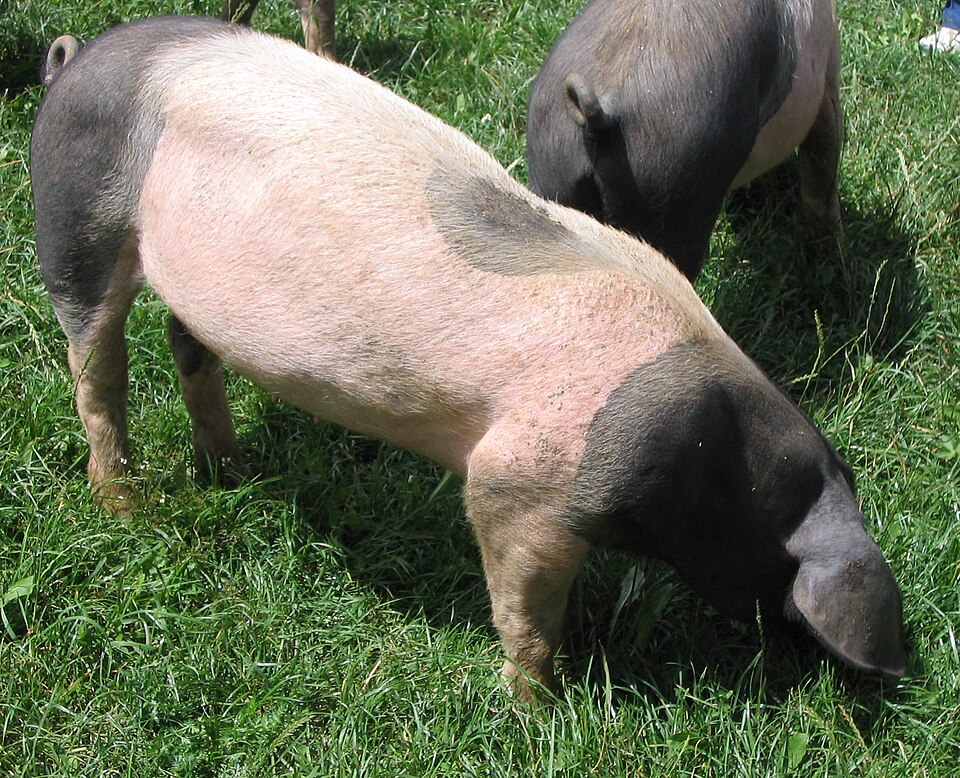
Reference photograph
Reference photograph of a Swabian-Hall pig. Examine this individual's color and form alongside the identification descriptions in the text.
Source: Flominator · Original material · CC BY-SA 3.0
1. Classification, origins and habitat
The Swabian-Hall is a traditional domestic pig breed from the Schwäbisch Hall region of Germany. It is connected with registration by regional breeding and conservation organizations.
This livestock connects regional German husbandry with breed conservation movements. Distinguishing the place name Schwäbisch Hall from current producer organizations' brands and certification helps avoid confusing a breed with food labeling. Not every animal with the traditional appearance meets a particular brand's production requirements.
2. Appearance and identification
A typical pattern contrasts a black head and hindquarters with a light-colored middle.
The head and rear body are black, separated by a light-colored middle. Compare the position of the pattern with Saddleback or Hampshire pigs, whose white belt crosses the front shoulders. Color boundaries and widths vary by individual, so consider photographs and pedigree information together.
Seeing black on the head and rear with a light middle allows comparison with other breeds emphasizing a belt over the front shoulders. Where lighting or mud in a photograph obscures color boundaries, describe only what is visible.
3. Behavior and way of life
The breed is used for regional meat production and traditional livestock conservation. Product names or regional brands do not imply identical conditions for every pedigreed animal.
It serves regional meat production and traditional livestock conservation. A producer's quality promotion does not cover the same scope as information on living pigs' ecology and welfare. Do not guarantee a particular product's flavor or quality from appearance alone; check actual husbandry practices and records.
4. Observation, conservation and care
Distinguish the breed's regional association from actual production certification. Coat patterns alone cannot establish production methods or food quality.
Check registered pedigree and production certification separately, and examine the individual's feeding, resting and exploratory environment. The value of regional conservation must also go hand in hand with management that prioritizes the current animal's body condition and health. When admiring the pattern, observe normal behavior rather than luring the animal closer.
Evidence and references
- Bäuerliche Erzeugergemeinschaft Schwäbisch Hall — Schwäbisch-Hällisches
Classification, origin, appearance, ecology or breed uses
- Defra — Pig behavior and environmental welfare guidance
Domestic pigs' exploratory behavior, food, shade and resting space. This is British material, not guidance on Korean law.