
Mammals (Pigs)
Collared peccary
Collared Peccary
Classification and scientific name: Dicotyles tajacu
Sources checked:
Dark hair with a light band near the neck and shoulders gives the animal its name
The collared peccary belongs to the peccary family, not the pig family. It is a separate American lineage with a pig-like appearance; the scientific name Dicotyles tajacu is also used. Dark hair with a light band near the neck and shoulders gives the animal its name. The tail is shorter than a pig's.
Origins and distribution
The Americas
- Pecari tajacu
- The Americas
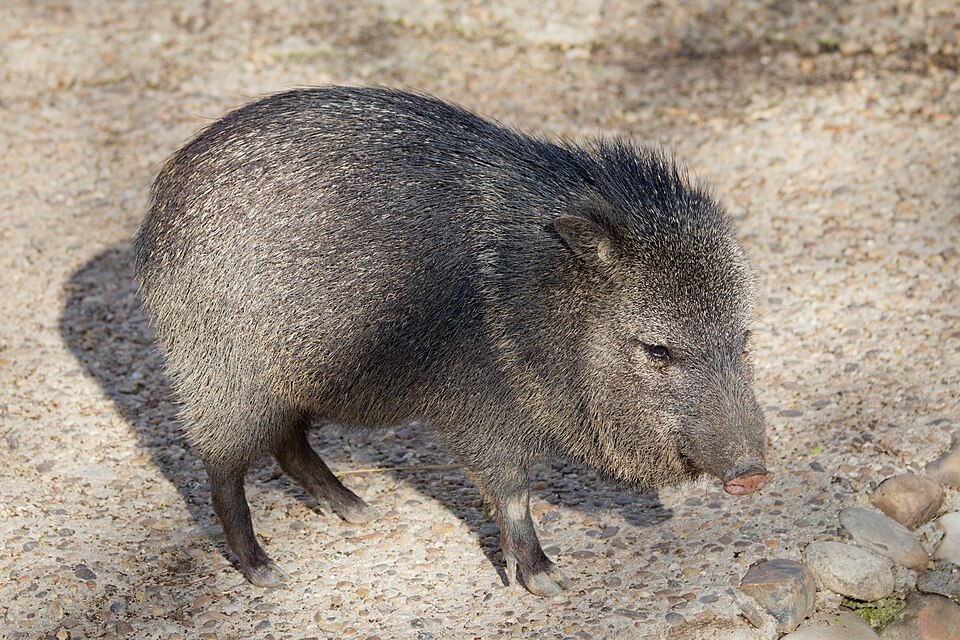
Reference photograph
Reference photograph of a collared peccary. Compare the photographed individual's color and form with the identification information in the text.
Source: Carlos Delgado · Original material · CC BY-SA 3.0
1. Classification, origins and habitat
The collared peccary belongs to the peccary family, not the pig family. It is a separate American lineage with a pig-like appearance; the scientific name Dicotyles tajacu is also used.
The collared peccary is an American member of the peccary family, a lineage different from domestic pigs. Sources may use Pecari tajacu or Dicotyles tajacu. The English name javelina accompanies a pig-like appearance; it does not mean an outdoor domestic pig or a wild-boar breed.
2. Appearance and identification
Dark hair with a light band near the neck and shoulders gives the animal its name. The tail is shorter than a pig's.
A short tail, coarse dark hair and a light band from neck to shoulder are characteristic. Posture and light may make the band difficult to see. Do not confuse a small, round-looking animal with a young domestic pig; observe the snout, tail and group together.
3. Behavior and way of life
Peccaries live in groups and use plant material and various other foods. They interact within the group through smell, sounds and other signals.
Group members communicate through scent and sound and move while searching for food. They may eat plants such as cacti in dry regions, but diet varies by region. Approaching a person does not guarantee a friendly temperament; an animal may have become accustomed to food from people.
4. Observation, conservation and care
The species uses environments ranging from dry regions to forests. Do not describe it as a domestic pig breed or through domestic pig husbandry conditions merely because it looks similar.
Food supplied by people can change group behavior and approach distances, so do not feed without authorization. Do not restrict descriptions of dry-region and forest populations to the same landscape. Maintain safe distance while observing, without splitting the group's path or approaching young.
Evidence and references
- Animal Diversity Web — University of Michigan — Pecari tajacu
Classification, origins, appearance, ecology or breed uses
- Arizona Game and Fish Department — Living with Javelina
Peccary classification, group life and maintaining distance from people