
Mammals (Pigs)
Common warthog
Warthog
Classification and scientific name: Phacochoerus africanus
Sources checked:
Facial projections, tusks and a mane along the body are characteristic
The common warthog is a wild member of the pig family living in African grasslands. It is not the same species as every other African wild pig. Facial projections, tusks and a mane along the body are characteristic. Despite the name, facial projections are not parasitic warts.
Origins and distribution
Sub-Saharan Africa
- Phacochoerus africanus
- Sub-Saharan Africa
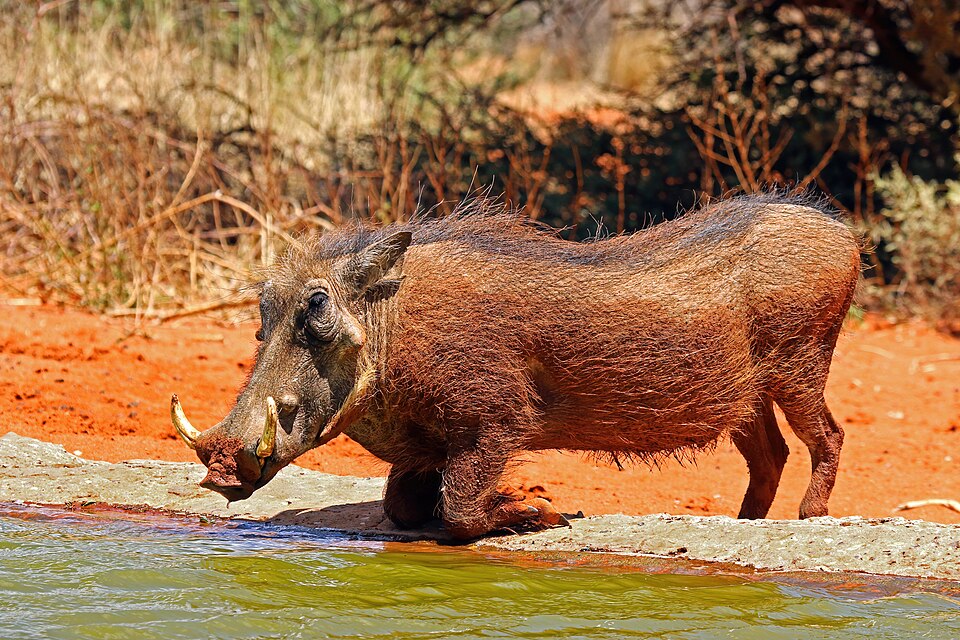
Reference photograph
Reference photograph of a common warthog. Compare the photographed individual's color and form with the identification information in the text.
Source: Charles J. Sharp · Original material · CC BY-SA 4.0
1. Classification, origins and habitat
The common warthog is a wild member of the pig family living in African grasslands. It is not the same species as every other African wild pig.
Distinguish the common warthog, Phacochoerus africanus, from other African wild pigs. Related species such as the desert warthog exist, so not every African warthog photograph depicts the same species. Read this as wild-animal ecology, separately from domestic pig breed origins.
2. Appearance and identification
Facial projections, tusks and a mane along the body are characteristic. Despite the name, facial projections are not parasitic warts.
Facial projections are particularly prominent in adult males, while tusks are upper and lower teeth. Long, mane-like hair occurs along the back, with a tuft at the tail tip. Projections and tusks vary with sex and age, so a small individual's appearance does not delimit adult characteristics.
The wart-like parts of the face are anatomical structures, not parasitic warts. Differences between sexes and growth stages mean that the projections and tusks of a large male are not the fixed appearance of every warthog.
3. Behavior and way of life
When grazing, warthogs bend the forelegs and rest the area near the knees on the ground. They also use burrows to avoid danger.
Bending the forelegs while grazing is a posture for reaching food. Warthogs may use burrows made by other animals, and the arrangement of grassland and burrows relates to safety and rest. A photograph of running with the tail raised records one behavioral moment, not a posture used constantly.
4. Observation, conservation and care
Grassland and shelters such as burrows are important to its life. During wild observation, consider tusks and the group's responses to distance, and do not feed directly.
Do not obstruct grassland feeding or burrow entrances while observing. Even if small young are nearby, consider surrounding adults and travel direction and maintain sufficient distance. A familiar pig-like appearance does not justify luring wild animals with food or attempting to touch them.
Evidence and references
- Animal Diversity Web — University of Michigan — Phacochoerus africanus
Classification, origins, appearance, ecology or breed uses
- San Diego Zoo — Warthog
Appearance, diet, burrow use and group life