
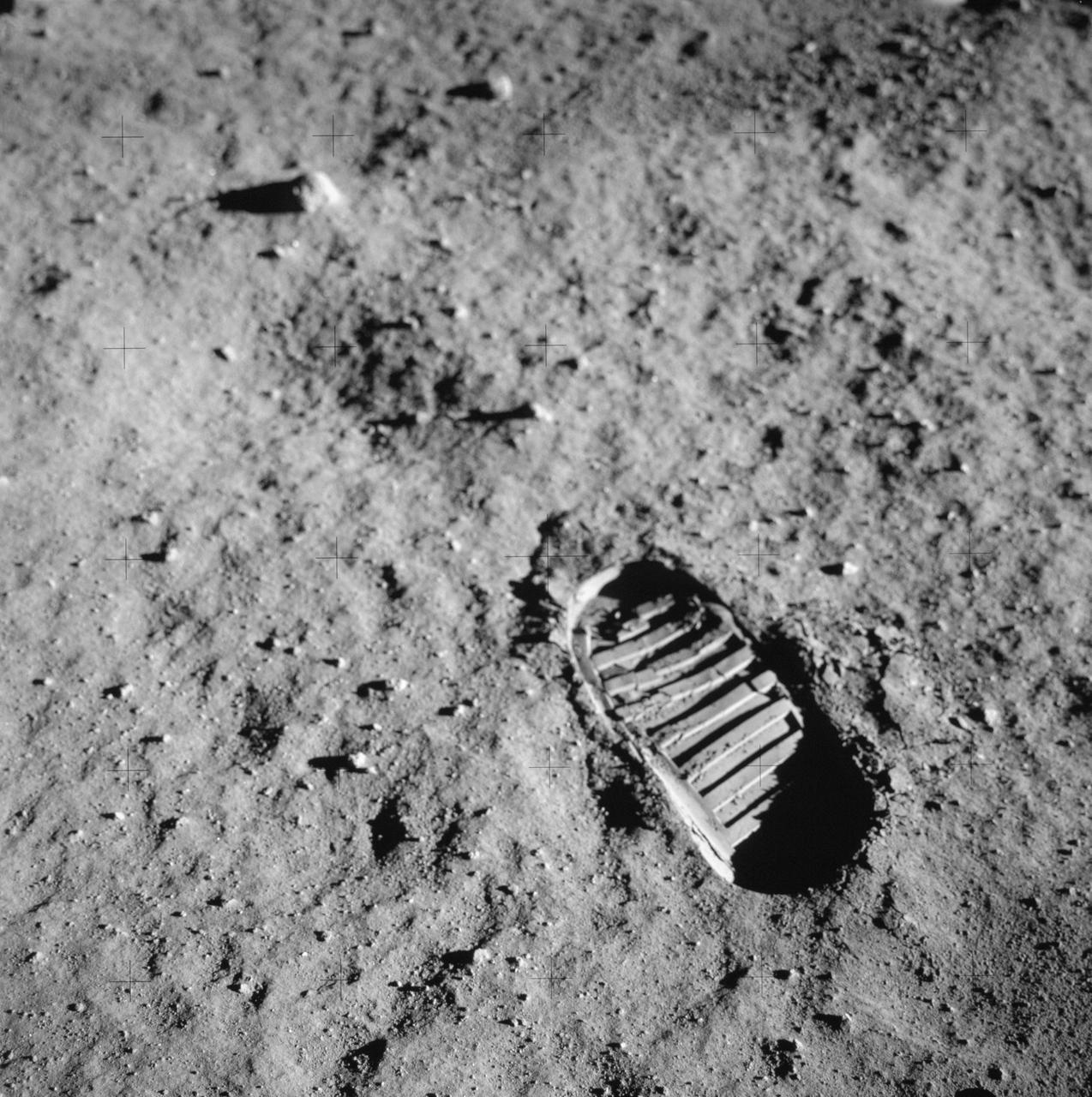
In the lower right of the photograph is a hollow about the size of a space boot. Light and dark stripes cross it, and small stones lie scattered outside. The camera caught this print by design. In July 1969, Buzz Aldrin of Apollo 11 chose a patch of undisturbed ground and photographed it. He stepped on it, backed away, and photographed the spot again. This is one frame from the experiment, AS11-40-5878.
Pick one groove left by the boot and follow it to the end. A narrow line runs straight for a while inside the print, then disappears on the rough surface outside. The outline alone suggests someone walked there. The small details of the tread tell us something more. The soil changed shape under pressure and held that shape after the foot lifted, at least until the camera shutter opened.
1. When were the first step and the experimental print made?
This photograph comes from the mission that put the first people on the Moon. It is easy to imagine that the mark records Neil Armstrong’s first step off the ladder. Aldrin’s wrist checklist, however, included a separate task to photograph how far his boot sank into the soil. By the time he chose this patch in front of the lunar module Eagle, both astronauts were already working outside. The checklist and the order of the photographs identify whose print it was more reliably than a guess based on the tread.
The last four digits of the frame numbers let us reconstruct the test. Frame 5876 shows the soil before the step. Aldrin made one print there, stepped back, and photographed the same print in frames 5877 and 5878. He then made a second print farther forward and took frames 5879 and 5880. Consecutive frame numbers do not mean he took a new step for each exposure. The first frame supplies a view of the original surface, and the next two show the result of one step from different viewpoints.
2. Reading the bright bands and the deep shade
The bands across the print are nearly parallel, repeating at fairly regular intervals. Look beyond its edge and the play of light and shade across the pebbles and bumps is much less regular. To trace the outline of the sole, connect the ends of several stripes with your eye. Following only the darkest patches would miss part of it. Deep shade conceals some of the tread at the lower right, but the ends of the visible lines help reveal its shape. A small rock at the upper left also casts a long shadow.
A shadow tells us the surface changes height. The width of a dark patch on its own tells us little about how deep a hollow is. Even the same stone casts a longer shadow when light strikes at a shallower angle. The angle from which the camera looks down also affects its apparent length. Measuring groove depth in units of length requires a known dimension for scale and the geometry of the photograph. Zooming in makes bright edges easier to distinguish from dark grooves, without supplying the missing height information.
3. How dry lunar soil held the pattern
Fine grains mixed with small stones of different sizes covered the surface at the landing site. Under the boot, loose grains shifted and packed closer together as the raised tread pushed into the soil. If the compressed grains stay in place when the sole lifts, they preserve an impression that fits the underside of the boot. NASA’s account of the photograph describes a shallow, sharply defined print made by an astronaut’s weight in fine, dry soil. Crisp edges by themselves give no reason to infer that the soil was wet.
The Apollo 11 preliminary science report describes weak cohesion between fine particles at the site. Grains held together in small clumps, some of which broke apart underfoot. Soil can hold a steep face for a time and still change shape readily when stepped on. The print shows where those two properties come together. Determining the size of an individual grain or the strength of the forces between grains from the picture alone is difficult. Collected samples allow those properties to be tested.
4. What lay under the partly shaded floor of the print?
The floor of the print is the surface the boot reached. Other observations are needed to find out whether the material beneath it was equally soft. When the astronauts pushed a hollow sampling tube into the ground near the landing site, it went in readily at first. Deeper down they needed a hammer. The preliminary science report says that as they continued, blows of similar strength drove the tube a shorter distance. Their hands on the tool could feel a change in resistance with depth that scarcely registers in a photograph of a footprint.
The tube and the boot tested different spots. The astronauts’ experience therefore does not show that the tube hit solid bedrock directly under this print. More tightly packed grains could also resist penetration. A way to explore the difference is to press into samples returned to Earth, some loose and some compacted. Even for the same kind of soil, the result depends on how closely the grains are packed. Before applying a laboratory value to the scene in the photograph, it matters where a sample came from and what condition it was in.
5. Why rocks helped researchers find the prints again
In a close-up the tread stands out. In a broad view of the lunar module’s surroundings, the same pattern dwindles to a few small patches of light and shade. Researchers who later examined the Apollo photographs chose small rocks near the prints as landmarks. They first identified the same stones across several frames, then compared the positions of the prints relative to the stones. This connected the two experimental prints in close-ups on the surface, a wider panorama, and photographs taken through the module window after the astronauts had finished working outside.
To try it, open section 4.2 of NASA’s Apollo 11 photogrammetry study. Start with rock 435 in frame 5877, find the same number in panorama frame 5885, then compare the view through the window in frame 5484. The arrangement of the rocks identifies the place even when the height and direction of the view change. The comparison shows that the prints could still be located in photographs taken after the moonwalk. Their appearance today would require an observation from today. How far you can follow the story of these stripes depends on where and when the comparison photographs were taken.