
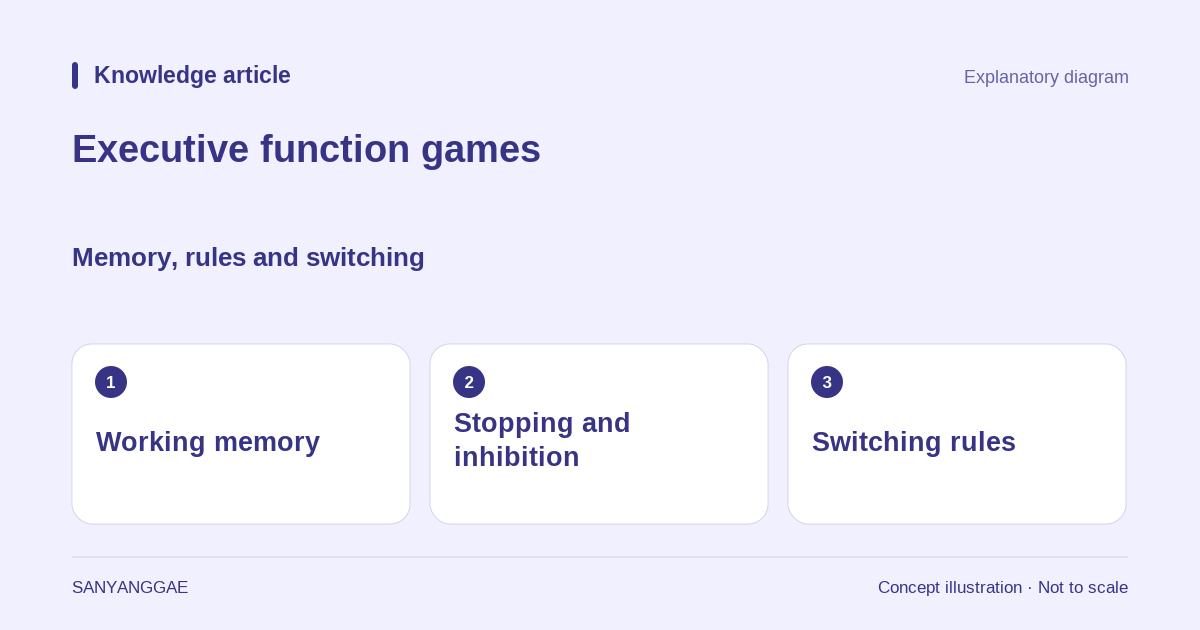
Executive function helps children hold information in mind, manage attention and adjust behavior to a situation. One test score or performance in a game cannot measure a child's development.
A quick response in a freeze game does not mean the child can wait in every situation. A fun game and a rushed morning involve different feelings and demands. Notice the rules and support that helped the child participate instead of treating play as a report card. The same child may need different help when tired or in unfamiliar surroundings. Start by working out what guidance fits the everyday task, so differences between play and everyday life do not get mistaken for failure.
1. Looking at three abilities
Harvard's Center on the Developing Child guide to executive function discusses working memory, flexible thinking and self-regulation. Holding needed information briefly, adapting to a rule change and waiting before acting all draw on these skills.
2. Starting with a short game and one rule
Move to music, then freeze briefly when it stops. Start with one rule. Once the child understands it, try “This time, just move your hands.” Take time to check the rule together instead of competing for correct answers.
3. Using memory in pretend play
Start a pretend shop with a short order such as “One apple, please.” If remembering is hard, use a picture list or reduce the number of items. Accepting help is part of play. Once the child is familiar with the game, switch roles so they can place the order.
4. Adjusting the difficulty
| What you notice | How to adjust |
|---|---|
| Often forgets rules | Use fewer rules and say them together |
| Tires of the activity | Take a break or switch games |
| Struggles with a rule change | Demonstrate both the old rule and the new one |
These are activities to try at home. They are separate from therapy programs and developmental assessments. Avoid claims that a game reliably strengthens a specific brain circuit or guarantees success. If you are concerned about development or everyday functioning, speak with a professional familiar with the child's situation.
5. What to observe when one rule changes
Working memory holds needed information briefly, inhibitory control lets us pause before reacting, and cognitive flexibility helps us adapt our thoughts and actions. These abilities work together in play, so one mistake cannot establish a deficit in any one of them. The child may have missed the rule or misunderstood a word. First ask whether they can explain or show the agreed action in their own way.
On the first day, suppose the rule is to move when music plays and stand still when it stops. After the child understands it, change only the type of movement next time. Changing both the musical signal and the movement rules makes it harder to identify what got difficult. If the child laughs and keeps moving, check whether the cue was audible or the pace made stopping difficult before concluding they ignored the rule. An adult can show the move slowly alongside them.
A pretend shop need not evolve solely by adding more items to the order. After the child remembers one familiar item, move it somewhere else or swap roles. A picture list eases the memory load. Avoid treating the removal of that help as the only proof of skill. People use lists and organized spaces to manage information in everyday life. Learning to ask for an appropriate kind of help is valuable in play, too.
6. Connecting play to everyday tasks without claiming a treatment effect
Following rules in a game is different from organizing one's actions at meals or while getting ready for school. The location, feelings and information involved may change, so learning does not necessarily transfer. Work out support for the specific situation. When getting ready to go out, keep essentials in the same place and show the sequence in pictures. This adapts the everyday setting independently of game scores.
A simple snack can serve as a planning activity. Say together what to eat, which bowls to get and how to tidy the area afterward. An adult handles steps involving knives or heating equipment, and the child chooses what they can do. Check the order together if they forget. The goal is to find information for the next step, without expecting the child to finish alone without mistakes. If the activity drags on, use fewer steps, and try another approach on a tiring day.
Record conditions, such as “They looked at the picture list and got two items,” in place of a broad claim that memory improved. Use the notes to decide whether to maintain the support or try less guidance. Stop repeating the activity for the record if competition or a time limit makes the child uncomfortable. Home games are distinct from standardized assessments and should not become a comparison with other children's scores. Discuss ongoing developmental or learning concerns with a professional using concrete everyday examples.
7. Questions for adjusting difficulty and adult support
At the end, ask which part was fun and what felt hard. A simple choice about playing again can be enough. Adults can reflect on the number of rules, length of instructions and waiting time. Consider how the explanation and space affected participation alongside the child's responses. An adult who gave the wrong signal can acknowledge it and show how to start over.
Adjust support as the child responds. At first, say the rule and move together. Demonstrate less as the game becomes familiar, and step in again when a new rule appears. Development does not require each round to be harder than the last. Repeating an easy activity comfortably or swapping roles with a friend can offer a fresh experience. Look for signs of boredom and signs of avoiding something difficult, and avoid drawing conclusions from one action.
A plan the family can sustain can start with rules already found in daily life, without gathering lots of special equipment. Choose what the child enjoys among songs, stories, tidying and pretend play. Harvard's guide describes chances to practice these abilities and offers no guarantee of future success from a particular product or number of sessions. The American Academy of Pediatrics also values the relationships and exploration that play enables. Give the child a chance to participate, get help and try again without making higher scores the goal.