
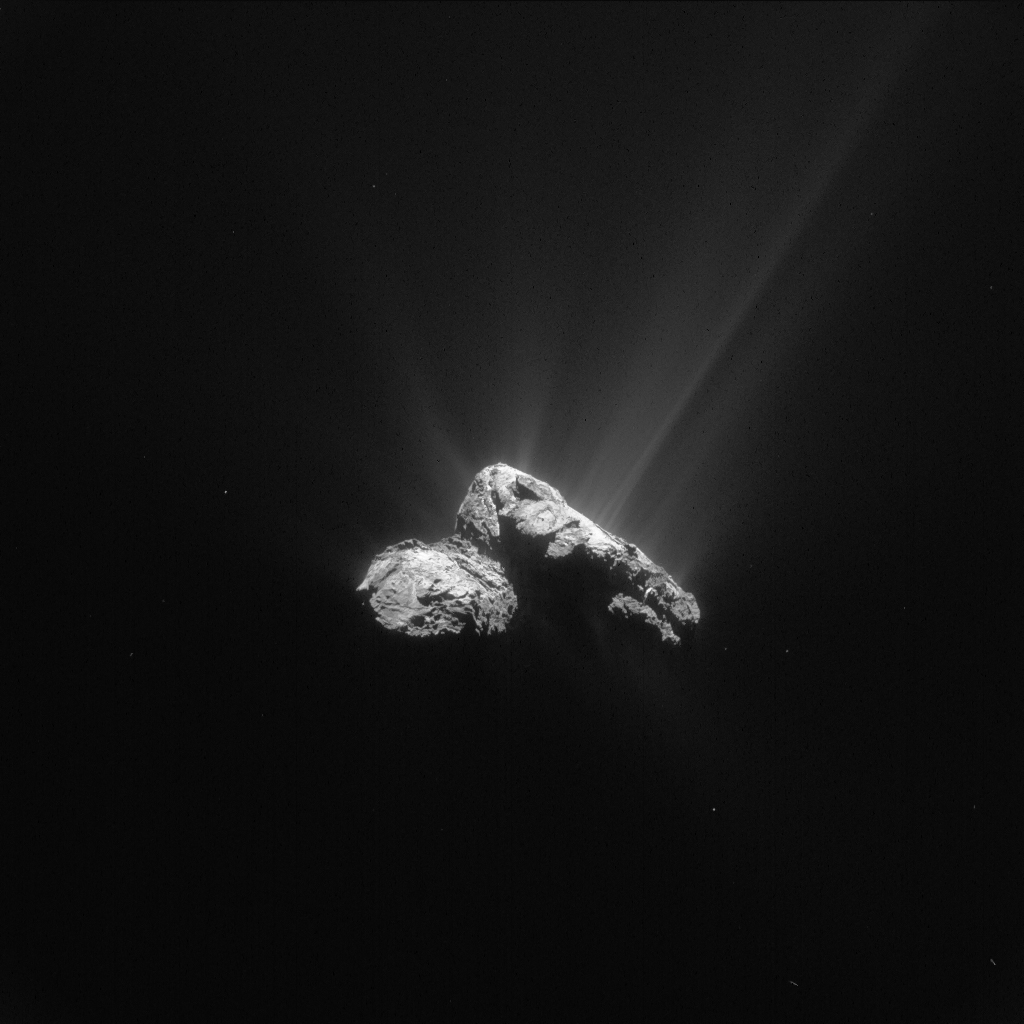
Narrow streaks of light extend from a rugged object suspended in black space. At first glance they may look like rising smoke or the exhaust of a rocket engine. The object is not a spacecraft. It is comet 67P/Churyumov–Gerasimenko. The European Space Agency’s Rosetta spacecraft followed it closely to observe how its ice and dust respond to sunlight.
A comet’s long tail is a familiar sight in the night sky, but images from far away do not readily show where the material comes from or how it escapes. Starting with a photograph of jets near the nucleus, we will look at how a small object produces a large coma and tail. The first step is to distinguish the narrow field of the image from the scale of the tail extending much farther away.
1. What is in the photograph, and how close was the camera?
According to ESA’s image description, Rosetta’s navigation camera, NAVCAM, took this image on July 30, 2015, from 178 km away from the comet’s center. Each pixel spans about 15.2 m, and the full image covers about 15.6 km in width. The solid body at the center is the nucleus. The faint streaks around it show material being released in jets.
The Rosetta mission account of the same observation provides the original and a version with enhanced contrast. This article displays the enhanced version so the faint jets are easier to see. The nucleus resembles bright rock in the image, but that does not make its surface white. The camera’s exposure and subsequent processing affect the tones we can see.
Some streaks reach the edge of the picture. The camera’s field of view ends there, so we cannot tell whether the jets stop there too. Calling this a photograph of the entire long tail would misstate the observation’s scale. The outflow near the nucleus and the faraway tail shaped by the Sun are connected phenomena, but they happen on different scales.
2. Why is the nucleus not white like a snowball?
NASA’s comet overview describes the nucleus as a mixture of ice, frozen gases, and dust. This is why comets are sometimes called “dirty snowballs.” Taking that analogy as a literal description of the surface would make it hard to explain the rough, dark body in the main image. Ice can be present without covering the whole surface in a layer of clean ice.
ESA’s report on exposed surface ice distinguishes a dark dust layer from bright areas that may contain ice. Surface material containing dust and organic matter can cover ice underneath. Ice-rich patches may be exposed where the dust layer has been removed. Rosetta’s high-resolution camera studied these small areas in detail.
It does not follow that any bright point in the main image can be labeled ice. Sunlit slopes and shadows also produce strong contrast. To identify the material at a particular bright spot, scientists need evidence such as more detailed images and reflectance at several wavelengths. A picture of the terrain shows surface structure, but it does not provide a composition analysis for every location.
3. How does sunlight turn ice into gas?
We are familiar with ice melting and then evaporating. At very low pressure, ice can pass straight into the gas phase without becoming liquid. This is called sublimation. As a comet gets closer to the Sun and receives energy, volatile material escapes, and the gas flow can lift small dust particles with it.
ESA’s study of the water-ice cycle on 67P used Rosetta’s spectroscopic observations to investigate changes in ice on and below the surface. As the comet rotates, the same spot passes from sunlight into shadow. Its local day and night and the condition of the overlying dust help explain its activity, along with its distance from the Sun.
The jets are different from combustion. The bright streaks in the image need not be read as flames or smoke from a chimney. Energy from the Sun changes the state of material, and the gas and dust escape into the surroundings. Connecting ice, energy, and gas flow reflects what we observe better than calling it a “burning comet.”
4. Why does the release of material vary across the surface?
Brightness around the nucleus is uneven, and streaks point in several directions. That would be hard to imagine for a smooth ball made of the same material and structure everywhere. The real nucleus has cliffs, depressions, dust-covered patches, and exposed ground. The angle at which sunlight arrives also changes with location and time.
ESA’s study of active pits used high-resolution images to connect some dust jets with sources inside pits. The researchers proposed that a surface can collapse into a subsurface void to form a pit. When sunlight reaches the exposed walls, material can escape and activity can continue.
The study does not say that every jet requires the same kind of pit. The resolution of the main image does not establish which opening each streak came from. A bright jet in one view can include material overlapping along the line of sight. Close-up terrain images, photographs from other times, and lighting conditions together help narrow down the source and structure. Extending a line from the jet straight back to the surface is insufficient.
5. A coma surrounds the nucleus, and a tail stretches far away
Gas and dust leave the nucleus and spread into a fuzzy cloud called the coma. The coma makes up much of what appears to be the bright head of a comet through a telescope. Treating the entire bright patch seen from far away as the solid nucleus would greatly exaggerate the size of the body.
NASA’s Basics of Space Flight explains that dust reflects sunlight and that gases can glow as they interact with light. The material spreads farther under the influence of solar radiation pressure and the solar wind. Its particles differ in size and electric charge, so they do not all move the same way.
Sketch the nucleus, coma, and tail in sequence to see where this image fits. It shows the nucleus and the jets close to it. To map dust and gas across a much larger space, scientists look to additional observations with a wider field of view. Just as a microscope image and a view of a whole laboratory answer different questions, so do close-up spacecraft images and pictures of a long tail taken from Earth.
6. Why doesn’t the tail always trail behind the comet along its path?
NASA Space Place’s comet guide distinguishes dust tails from ion tails. A dust tail is usually broad and curved, as dispersed particles experience the pressure of sunlight. An ion tail consists of electrically charged gas, is strongly affected by the solar wind and magnetic field, and generally extends away from the Sun.
Thinking of a tail as exhaust trailing a moving car makes it hard to explain its direction when the comet is moving away from the Sun. The position of the Sun matters as well as the comet’s direction of travel. Dust particles continue in their orbital motion, so the tail’s curve reflects both the orbit and the forces on the particles. Charged gas and dust do not follow the same motion.
The main image is black and white and covers a small area. It does not let us identify a blue ion tail and a white dust tail separately. That explanation comes from wider observations and accounts of the physics. Distinguishing the streaks in the frame from the structure of tails in general makes it possible to understand the process without reading details into the photo that it does not contain.
7. What following a comet reveals beyond a single flyby
The photograph was taken before 67P passed perihelion, the point in its orbit closest to the Sun, on August 13, 2015. The Rosetta mission account explains that ejected dust made observations by the spacecraft’s navigation star trackers more difficult, so the spacecraft had to keep a safer distance. The spectacular jets provided science data and changed the conditions in which the spacecraft had to operate.
Changes over time are best compared under comparable observing conditions. A brighter streak in an image from a particular day does not necessarily mean more material was released. The direction of sunlight on the particles, the position of the spacecraft, the exposure time, and the image contrast may all differ. These differences have to be considered when using repeated observations to study changes in the jets.
Look again for the bright and dark sides of the nucleus and the faint streaks extending from it. Follow three stages: the solid surface, material leaving it, and the Sun’s influence on that material farther away. A comet’s tail is a structure that develops as ice and dust respond to their surroundings, rather than a feature that was there from the beginning.
The main image is ESA’s contrast-enhanced release, used without further editing. The image provider is ESA - European Space Agency and the credit is ESA/Rosetta/NAVCAM. The CC BY-SA 3.0 IGO license sets out the conditions for reusing the photograph.