
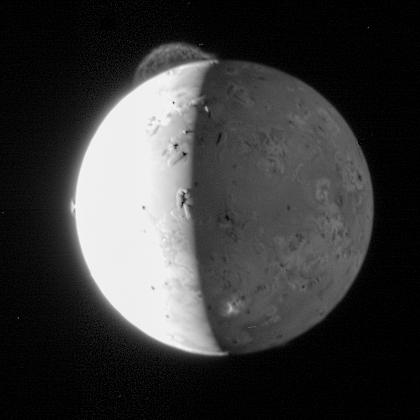
Look closely at the upper left of the round world in the photograph. Something like a translucent umbrella rises beyond the outline of its surface. It might look like a passing cloud, but this is the eruption plume of Tvashtar, a volcano on Jupiter’s moon Io. A spacecraft caught material from solid ground soaring well beyond the moon’s outline.
Such a powerful volcano seems surprising on a small moon far from the Sun. Daylight alone offers little clue to how its interior can stay so hot. To understand Io, look both at the shape of the eruption in the image and at what happens inside the moon as it orbits Jupiter.
1. A small umbrella at the edge of the disk marks an enormous eruption
According to NASA’s image description, the Long Range Reconnaissance Imager (LORRI) on New Horizons took the main photograph at 11:04 UTC on February 28, 2007. The spacecraft was about 2.5 million kilometers from Io. At eleven o’clock, the Tvashtar plume reaches about 290 kilometers high. A small feature in the frame can be vast in reality.
This grayscale image was processed to bring out the plume. The dayside on the left was deliberately overexposed and appears white, while faint light reflected by Jupiter reveals the nightside on the right. Treating all that white terrain as hot lava, or assuming the whole nightside glows because terrain is visible there, would overlook how the image was made.
Lighting strongly affects the visibility of a plume. As with dust caught in sunlight, the location of the ejected material and the angle at which light strikes it affect its brightness. The pattern of brightness alone cannot yield a temperature map of the volcano. First find the structure extending beyond the limb, then examine the differences in terrain and lighting.
2. What sets volcanically active, rocky Io apart from an icy moon?
NASA’s guide to Io describes it as the most volcanically active body in the solar system. This rocky moon, about the size of Earth’s Moon, has a very different surface environment from Europa, known for the ocean beneath its water ice. The fact that both orbit Jupiter is hardly enough to identify bright areas on Io as ice or snow.
Volcanic material repeatedly reshapes Io’s surface. Flowing lava and accumulating ejecta can cover older landforms, create new patterns and even conceal impact craters. A renewed surface tells us that geological processes have laid fresh material over an ancient body. It does not date the formation of the moon itself to recent times.
Other images show Io in color, with patches of yellow, orange, red and dark terrain. Those colors cannot be read from the grayscale photograph here. The colors of different materials and the outline of the plume in this image come from distinct observations. Keeping them separate helps us avoid imagining details the picture never captured.
3. Gravity pulls unequally across the moon
Jupiter pulls harder on the near side of Io than on the far side. The difference slightly deforms the moon. Just as differences in the Moon’s pull contribute to ocean tides on Earth, tides can deform an entire solid body on Io. There need be no ocean for a tide to occur.
The shape of the orbit also matters. Rather than following a perfect circle around Jupiter under constant conditions, Io follows a slightly elliptical path. Its distance and the stresses that deform it change periodically. NASA’s account of tidal heating explains how this repeated stretching and squeezing generates heat inside.
Think of bending rubber back and forth: some of the work your hand does becomes heat in the material. On Io gravity does the bending, and mechanical energy dissipates as heat as the interior responds. This analogy does not make Io a ball of rubber. Its actual response depends on the temperature and viscosity of the rock and on how much has melted.
4. Regular pulls from neighboring moons shape the orbit
Io does not circle Jupiter in isolation. The gravity of Europa and Ganymede, which orbit farther out, also affects its path. Their recurring orbital configurations help maintain the eccentricity of Io’s orbit. That is why explaining the heat inside Io involves tracing its neighbors’ orbits as well.
The three moons are hardly pulling Io apart in a tug-of-war. Behind that familiar image lie changes in the orbit and deformation that varies over time. Small strains repeated over long periods can matter more than a single powerful tug. The heat is tied to changes in the energy of a system involving both orbit and spin. Gravity does not create an unlimited supply from nothing.
This broadens the scene around the volcano. To understand what happens locally near a vent we must consider the moon’s interior as well as the motions of Jupiter and its other moons. Part of the appeal of studying Io is that a small plume in an image leads straight to the dynamics of a planetary system. The eruption we see and its energy supply span very different scales.
5. The plume is a moving structure
The umbrella shape in the main image can give the impression that material stays suspended there. In fact, the shape appears as material rises, spreads and falls. If an eruption continues, its outline can remain much the same even as the particles inside are replaced. A fountain retains its shape without any one drop hanging in the air forever.
A separate pair of images released by NASA shows Tvashtar on February 28, 2007, at an interval of 50 minutes. The estimated time for a particle to rise and return to the surface is about 30 minutes, so the two images likely contain different particles. The internal detail can change even while the plume’s overall brightness and size remain similar.
The height of about 330 kilometers in that pair should be distinguished from the roughly 290 kilometers in the main image. The times, distances and viewing directions differ. When comparing numbers, identify the image and the particular structure that was measured. The main photograph captures an instant; movement is evident in the separate sequence.
6. High plumes and heat underground call for different observations
A photograph shows the shape and location of erupted material without looking directly underground. How much magma lies below? Do volcanoes have separate reservoirs, or are they connected across wide areas? These questions need other data. Even a large plume at the surface is insufficient evidence for an ocean of magma encircling the moon.
A Juno study announced by NASA in 2024 used gravity data from close flybys to measure Io’s response to tides. The results favored magma reservoirs associated with individual volcanoes over a global magma ocean. They do not rule out every connection between volcanoes, but give reason to reconsider the idea of one continuous ocean inside.
What does it mean for a probe to measure gravity? Io’s gravitational pull slightly alters the spacecraft’s motion. Radio signals exchanged with Earth carry a record of those changes, and researchers compare the measurements with models of the interior. Camera images and radio tracking of the trajectory provide different evidence that together refines our understanding of the surface and what lies beneath.
7. Match the question to the observation
| Question | Observation and interpretation needed |
|---|---|
| Where does the plume rise? | Visible-light images with a known viewing direction |
| Does its shape change? | A sequence of images from different dates or times |
| How much heat leaves the surface? | Thermal observations that account for wavelength and temperature |
| How is magma distributed underground? | Gravity measurements compared with models of deformation and interior structure |
These questions complement one another. A photograph capturing the graceful outline of an eruption need not answer every question about the interior. Nor does proposing an interior model make it directly visible in the main image. Being clear about what was measured makes it easier to see which explanation changes when new results arrive.
Look again at the upper left. The little umbrella now marks a route by which heat inside the moon finds expression at its surface. To understand that heat, connect Io’s deformation with its neighbors’ orbits and the response of the material below. One grayscale image is the starting point. Sequences that record motion and data that measure gravity carry the story of this distant volcanic world further.