
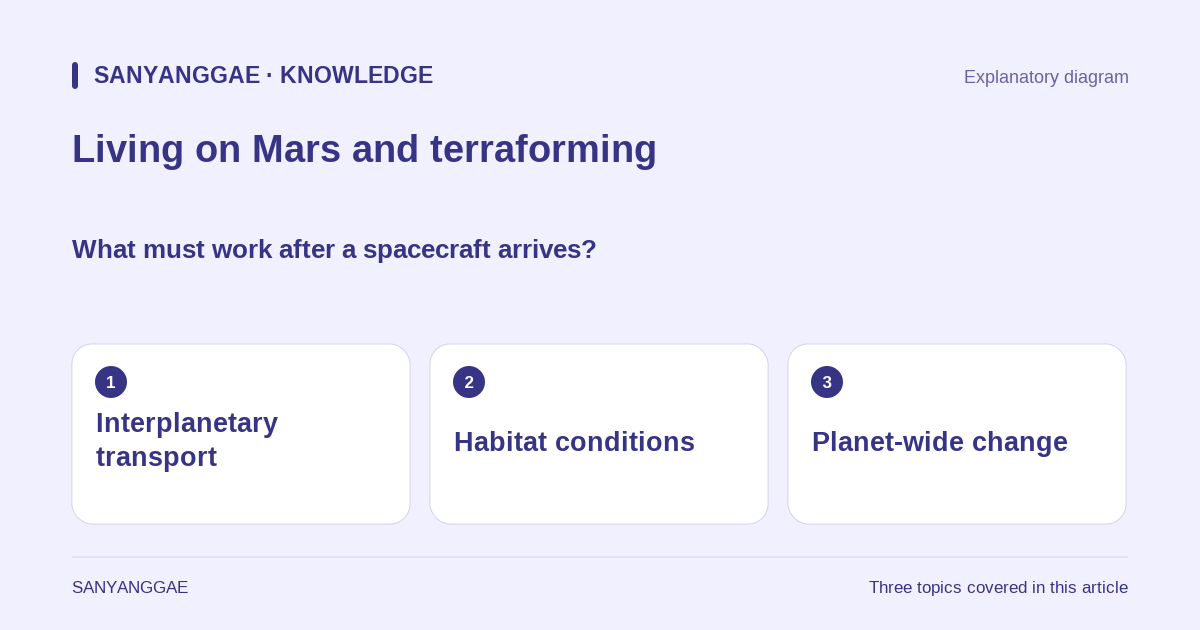
Transporting people to Mars and sustaining them there for long periods are different challenges. A spacecraft development plan alone cannot settle when large settlements or changes to the environment of an entire planet might become possible.
When assessing a hypothetical base, picture a day when something goes wrong alongside an ordinary day. Which functions would continue if power fell and one component became unavailable? Questions like these reveal issues of spares, maintenance and resupply that an attractive habitat illustration can easily omit. They are operational conditions that still need testing after successful transport.
1. What a habitat must provide
A habitat must maintain pressure, temperature and breathable air and secure water, food and energy. Radiation, dust, equipment failure and limited medical support must also be considered. Running a sealed facility locally and creating a planet where people can live outside without protection involve different scales and conditions.
2. Constraints on changing the Martian atmosphere
A 2018 study described by NASA explains why the carbon dioxide accessible on Mars with current technology would be insufficient to thicken its atmosphere enough. When considering an idea for raising the temperature, check the amount of material required, where it would come from and what would sustain the change.
3. Questions for assessing a plan
List transport achievements, technologies tested on the Martian surface and technologies still at the proposal stage separately. Return trips, emergencies, supplies and maintenance plans also matter. A company’s long-term goal can indicate a direction for research and development without demonstrating a completed technology or setting a firm date for migration.
4. Assessing the ability to land separately from the ability to sustain life
An early illustration of a Mars plan may show a large spacecraft beside a spectacular habitat. Yet from the moment of arrival, air, water and power must be continuously available. Consumables and failed parts must be managed. Total transport capacity and the mass available for living supplies are different figures. Packaging, mounting equipment and spares may all be necessary. Look at the list of resources and functions before relying on the picture.
In a hypothetical early habitat, list normal and emergency consumption separately. Recycling air and water does not make losses exactly zero. The plan must cover energy and parts for maintenance and ways to handle contamination. Even if a facility is called a “closed ecosystem,” check what outside supplies it needs and how much. A short laboratory demonstration and the operational capability to sustain people long term represent different stages.
Installing a generator does not settle the question of power. The habitat must supply and store the energy needed at the right times and adjust priorities during a failure. Operations must account for observed Martian days and nights, dust and other environmental conditions. Whatever the power source, average output alone makes readiness hard to assess if peak demand and interruptions are left out. Look at the conditions for keeping a function running, beyond the name of its technology.
Medical care and communications cannot simply be carried over from life on Earth. Distance introduces communication delays and limits opportunities for transport. A plan that assumes immediate support is vulnerable. Check whether decisions can be made locally and how equipment failures and health problems would be handled. Getting people there is a distinct achievement from demonstrating safe, independent, long-term habitation.
5. Local habitats and planet-wide environmental change
A sealed habitat controls pressure and gas composition in a limited volume. Terraforming proposes to change conditions such as the atmosphere and temperature on the scale of a planet. A technology working in a small space cannot automatically be scaled up into a planetary solution. Total material, energy and the time a change persists can differ enormously with scale. Start by defining what is to change before discussing feasibility.
The study described by NASA examined the resource constraints on using Martian carbon dioxide to thicken the atmosphere and increase the greenhouse effect. Its conclusion that too little is accessible with current technology shows why simply deploying more machines would not immediately solve the problem. Conversely, the study is no mathematical proof that every conceivable future technology will always be impossible. Read the specific methods and resources it assessed.
Suppose someone proposes importing vast amounts of material. Ask about its source, the quantity to be transported, the energy required and the timetable. A proposal calling for “enough material” without specifying the scale may not yet be quantitative. Even if the temperature rose, breathable air, pressure and the radiation environment would each require separate evaluation. A single thermometer reading cannot stand in for several necessary conditions.
Terrain and environmental data matter even for a local facility. The possible location of water, requirements for landing and travel, and the demands of maintaining the facility may conflict. Choosing a flat spot in an illustration is insufficient to establish a suitable base site. Mark which conditions robotic exploration and tests have confirmed and which remain assumptions to distinguish a future concept from a present achievement.
6. Reading company announcements and exploration architectures
A development goal indicates where a technology is meant to go. Demonstrated capabilities require evidence. A launch vehicle test flight, orbital operations and safely landing heavy cargo on Mars require different tests. When a successful test is announced, check the flight environment, the equipment carried and the purpose of the test. Astronauts in a planning illustration do not establish that crewed operations have been validated.
NASA’s Moon to Mars Architecture connects exploration goals with the functions needed to achieve them. Breaking them down shows that transport must be accompanied by habitation, power and surface activities. When comparing the architecture with companies’ long-term goals, compare the same functions at the same level of validation. Confident wording in an announcement does not establish higher technical readiness.
For a practical reading table, use four columns: tested on Earth, demonstrated in space, confirmed on Mars and still proposed. Give each item a date and an environment, and connect it to the next test needed. The table keeps different achievements from being conflated. It is not a tool for predicting whether a particular venture will succeed. A failed test can also supply important evidence about a risk it revealed.
The question of living on Mars goes beyond “When will we move?” The requirements depend on who would stay, for how long and under what resupply conditions. Discuss a short expedition, a long-term base and changes to the planetary environment separately. Examining the specific challenges that remain after transport allows us to assess what research has achieved and identify what is still a task for the future.