
In photographs, Saturn looks as though it has an enormous disk attached to it. Yet the disk is no solid plate. Countless ice particles travel along their own orbits. Seen together from far away, their distribution gives the rings their appearance. Why, then, are there long, dark gaps among the regions occupied by particles? The answer involves what the rings are made of, how the particles move and how nearby moons pull on them.
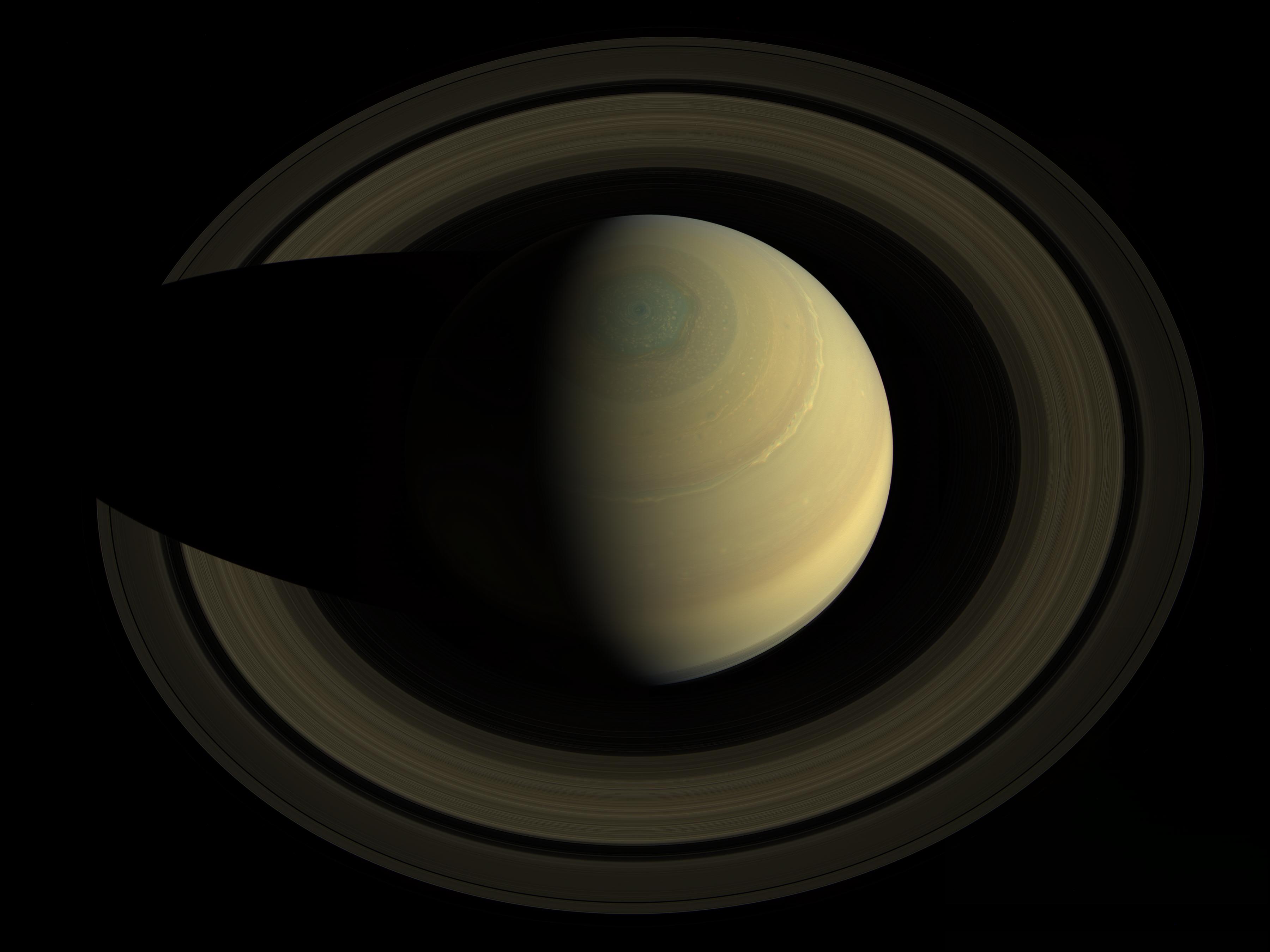
The opening image is an actual observation by the Cassini spacecraft from high above Saturn’s northern hemisphere. Start by picking out the bright rings and the dark bands, then consider what their differences can tell us.
1. Distinguishing a gap from a shadow
According to the original NASA/JPL image description, this natural-color mosaic combines 36 images taken through three color filters on October 10, 2013. Moving outwards from the planet, you can see the C, B and A rings. A relatively dark band runs between the bright, broad B ring and the A ring beyond it. This band is the Cassini Division.
A large, black, fan-shaped patch stands out on the left. It has a different origin. Saturn blocks the sunlight, casting its shadow across the rings. The Cassini Division follows a band at a particular distance from Saturn’s center. The shadow, by contrast, depends on how the Sun, the planet and the rings are positioned relative to one another. Telling them apart helps you avoid assuming that every dark area is empty of material.
2. The rings are collections of particles
NASA’s guide to Saturn describes ring particles made mainly of ice and rock, ranging from dust-like grains to chunks as big as a house. The ability of water ice to reflect sunlight contributes much of the rings’ brightness. But the particles vary in size and composition, and the angles at which light strikes them and reaches the observer vary too. Different parts of the rings therefore look different.
The letters used for the rings do not start at the outer edge and work inwards. They reflect the order of discovery. Travelling away from Saturn, for example, you encounter D, C, B and A. To find a ring in the picture, use its distance from the planet’s center rather than its place in the alphabet.
The fact that there are many separate particles is the starting point for understanding gaps. If the rings were a rigid plate, you might imagine cracks forming or pieces breaking off. In a collection of particles, the useful question is which orbits retain a great deal of material and which lose it to other regions. The stripes in the rings tell a story about the material and its motion.
3. Inner and outer particles orbit at different speeds
A particle’s orbital period around Saturn depends on its distance from the planet. Particles on inner orbits complete a revolution more quickly than those farther out. Thinking of the rings as a vinyl record turning at a single angular speed makes it hard to understand the interactions between particles and moons.
The Cassini mission’s overview of ring science describes how particles just inside and just outside a small moon’s orbit move differently relative to it, and how gravity produces patterns. The images include “propellers” created when a small object changes the distribution of surrounding material. The name describes their appearance. The pattern does not spin like a propeller.
You can connect this principle to the photograph. Think of each narrow band as a difference in the density of particles moving at different speeds, rather than a fixed groove. It becomes easier to see how repeated tugs from a moon might produce waves or boundaries at particular locations.
4. Orbital resonance gives gravity a rhythm
Orbital resonance helps explain repeated gravitational effects when orbital periods are related by a simple ratio of whole numbers. If a particle makes two circuits during one orbit of a moon, for example, the moon’s influence can recur with a regular rhythm. Think of pushing a swing at the right moment on each pass. Even a small push can have a cumulative effect. Calculations for real rings must also account for the shapes and orientations of the orbits and for interactions between particles. The swing illustrates the timing, but cannot replace those calculations.
Hedman and colleagues’ study of the Cassini Division discusses the outer edge of the B ring, which lies near a 2:1 resonance with the moon Mimas. The paper suggests that several edges within the division might be explained by resonances involving both Mimas and disturbances at the B ring’s edge.
Picturing Mimas as a broom that swept the whole division clean misses much of its structure. Mimas does not travel through the division. Its gravitational pull can act repeatedly on distant orbits. The dark band itself contains narrower ringlets and gaps, another clue to the limits of the sweeping analogy.
5. Different gaps have different origins
Compare the Cassini Division with the Encke Gap in the A ring. NASA’s description of an Encke Gap image explains how the gravity of the small moon Pan creates wavy features on the gap’s inner and outer edges. Here we can study the direct gravitational interaction between a moon orbiting inside a gap and the surrounding particles.
Similar-looking dark lines can thus arise under different dynamical conditions. To explain a particular feature, look up where the moon orbits, how its orbital period relates to that of the particles and how the edges move. The opening photograph is a wide view of Saturn and its main rings. It does not resolve the small moon near the Encke Gap or the detailed waves there.
| Feature in an image or other observation | Question to ask |
|---|---|
| Dark band between the B and A rings | Why are the particles distributed differently there? |
| Broad planetary shadow across the rings | Which direction does the sunlight come from? |
| Wavy edge in a close-up view | How does a nearby moon’s gravity act on the particles? |
| A narrow ringlet within a gap | Is the dark region really completely empty? |
6. Measuring the distribution of ring particles
Image brightness alone does not give a direct count or mass for the particles. The reflectivity of ice, particle size and the viewing angle all play a role. Cassini also watched how much a star dimmed as it passed behind the rings. Such observations, called stellar occultations, measure how much light passes through at a particular location. They offer another way to investigate how material is distributed.
Return to the opening image and find the two kinds of dark area. The division that follows the rings raises questions about particle orbits and distribution. The broad shadow raises questions about lighting and geometry. Even where both look black, they call for different explanations. Once you see the distinction, Saturn’s rings become more than a decorative disk: they reveal a changing world shaped by orbiting ice particles and the gravity of moons.