
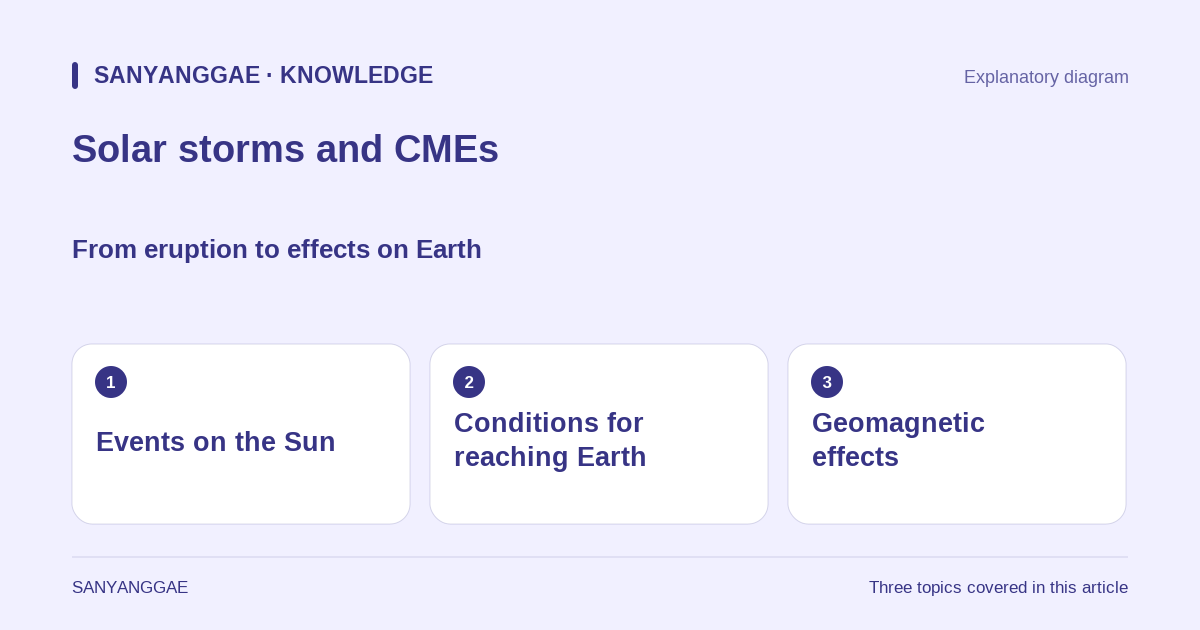
News of increased solar activity does not necessarily mean that communications networks around the world will fail. What happened on the Sun? Is anything heading towards Earth? What effects are being forecast? Each question needs a separate answer.
A single report may show images of the Sun’s surface, a prediction of how material will move through space and measurements made near Earth. These data describe different places at different times. However striking an image looks, check the direction of the ejection and its expected effects on Earth separately. Find out which phenomenon the forecast rating refers to. Start by marking what has already been observed and what is still a prediction. When a new observation changes the forecast, you can see exactly what was revised. It also becomes easier to tell a description of a major historical event from a prediction of damage today.
1. Flares and coronal mass ejections
A flare involves an intense burst of electromagnetic radiation. A coronal mass ejection (CME) carries plasma and its magnetic field away from the solar corona. The two can occur together. Using their names interchangeably makes it easy to miss the difference between the arrival time of a radiative signal and that of ejected material.
2. What determines the effects on Earth?
The direction, speed and magnetic field of a CME all matter. Even when a CME reaches Earth, the resulting geomagnetic disturbance can vary in strength from one event to another. Descriptions of potential effects on satellite operations, navigation and power grids need to reflect the type and intensity of the event.
3. Reading forecasts and historical accounts
The Carrington Event of 1859 is often mentioned in discussions of major solar storms. It cannot tell us that the same damage will recur on a particular date. Consult NOAA’s descriptions and current forecasts to identify the issue time, the phenomenon being forecast and its intensity category. Keep observations and future possibilities distinct when describing them.
4. Light, particles and CMEs arrive on different schedules
Electromagnetic radiation from a flare travels at the speed of light. By the time we observe the flare from Earth, its light has already travelled the distance to us. It would therefore be incorrect to say that the electromagnetic signal from a flare we have just seen will first reach Earth several days later. With a CME, plasma and magnetic structures travel outwards. Their direction and speed help forecasters estimate whether and when they will arrive.
Energetic particles released by the Sun can have effects of their own. Grouping everything under the term “solar storm” obscures which equipment and operations are affected. NOAA uses different scales for geomagnetic storms, solar radiation storms and radio blackouts for this reason. A high rating for one phenomenon cannot be read as the rating for another.
Suppose a report announces that observers have seen a strong flare. Has an Earth-directed CME been confirmed? What do particle measurements show? A single image of a bright flare cannot establish how strong a geomagnetic storm will be several days from now. Write down which event has been observed and which is still being forecast. That distinction keeps a report of an eruption from turning into an unsupported claim of worldwide communications failure.
Even when a CME appears to be heading towards Earth, its arrival time is uncertain. Conditions between the Sun and Earth and changes in the ejected structure can affect how it travels. Once it arrives, the orientation of its magnetic field and its interaction with Earth’s field also matter. The likelihood of arrival, the time of arrival and the eventual severity of the effects are related but distinct predictions. Confirmation of one does not settle the others.
5. What do NOAA’s scales tell us about the effects?
NOAA’s G scale refers to geomagnetic storms, its S scale to solar radiation storms and its R scale to radio blackouts. Identify the phenomenon before comparing numbers. The same number on two scales can describe different physical quantities and different effects. Check when a forecast was issued, how long it is valid and whether a figure is an observed value or a predicted maximum.
Descriptions of flare-related radio blackouts mainly concern changes in Earth’s sunlit ionosphere and the effects on particular radio bands. The mention of radio communications does not imply that every household internet connection will fail in the same way. The consequences depend on the system’s frequencies and signal paths. If a news story leaves out the type of system, check what the original claim actually covers.
Geomagnetic storms can affect power grids, satellite operations and navigation. The effect varies with the region and the system. NOAA’s tables describe possible consequences at each level. Facilities in the same area will not necessarily suffer identical damage. In specialist operations such as power grid management, the operators’ own observations and procedures matter. Readers can start by checking the latest official guidance and the context in which it was issued.
An aurora photograph cannot gauge the whole event either. The sight varies with location, time, cloud cover and photographic conditions. Seeing a bright aurora and establishing that a particular facility was damaged require separate evidence. Conversely, the absence of a visible aurora where you live does not rule out changes in space weather. A beautiful photograph and an assessment of operational risk rely on different information.
6. What can the Carrington Event tell us about future risk?
The Carrington Event of 1859 is an important historical example of intense solar activity affecting Earth. The records made at the time came from a different observing system than the instruments used today. Estimates of the event’s size are limited by the available evidence and its interpretation. Modern power grids and the present-day satellite environment also differ from the circumstances of 1859. Scaling up the historical damage in direct proportion is a poor way to estimate the cost today.
Historical events provide a starting point for studying what severe events can do and discussing preparations. They do not set a timetable on which the same storm returns at a fixed point in a cycle. When a study gives an average frequency or long-term probability, check its definitions and data. A small probability does not make an event impossible. An event being possible does not mean it is forecast to happen soon.
Imagine a headline that reads “Solar storm to cause worldwide blackout this week.” Ask three questions. What was actually observed? What level and time window does the official forecast give? Which agency discussed a blackout, and under what conditions? Placing an account of the worst historical event alongside a current forecast does not establish that the worst damage will occur now. Look for evidence connecting the known facts to the possible outcome.
When reading news of solar activity, work through the event, its direction, its arrival and its effects in that order. Mark each entry as an observation or a prediction and note its issue time. If further measurements change the forecast, you can compare the entries and see what was updated. This approach takes solar activity seriously without turning every report into an immediate disaster warning.