
Mammals (Cattle)
American bison
American Bison
Classification and scientific name: Bison bison
Sources checked:
High shoulders, thick hair on the forequarters and short curved horns are characteristic
The American bison is a wild member of the cattle family from North America. It should be understood as a separate species rather than placed among domestic cattle breeds. High shoulders, thick hair on the forequarters and short curved horns are characteristic. Differences in hair and build between front and rear are conspicuous.
Origins and distribution
North America
- Bison bison
- North America
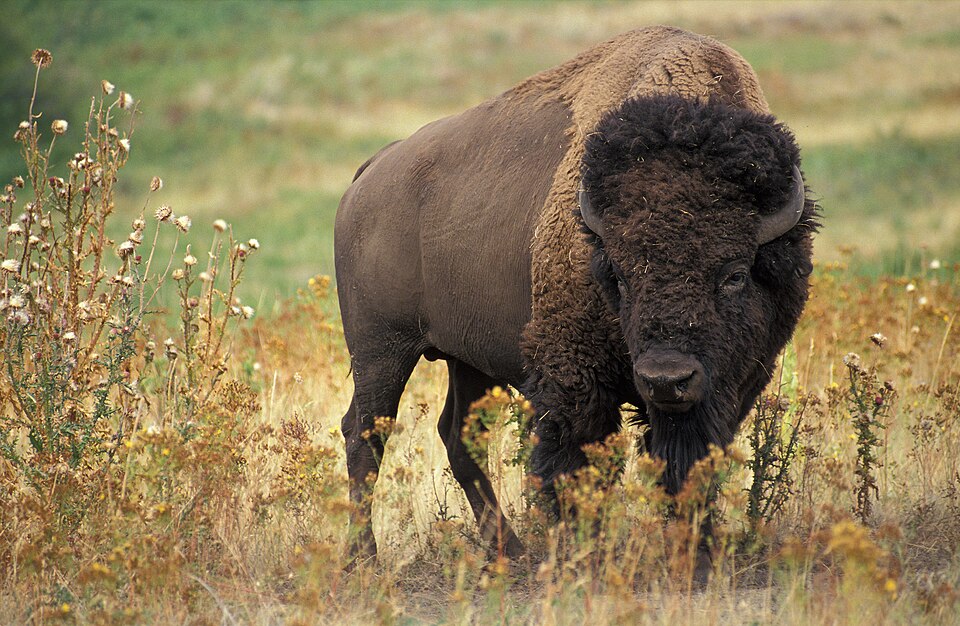
Reference photograph
Reference photograph of American bison. Examine this individual’s color and form alongside the identification descriptions in the text.
Source: Jack Dykinga · Original material · Public domain
1. Classification, origins and habitat
The American bison is a wild member of the cattle family from North America. It should be understood as a separate species rather than placed among domestic cattle breeds.
Bison are a separate species, not a domestic cattle breed, and connect to North American grasslands, Indigenous cultures and conservation history. Distinguish farmed individuals from wild populations in protected areas; a livestock-like appearance behind a fence does not explain the species’ ecology.
2. Appearance and identification
High shoulders, thick hair on the forequarters and short curved horns are characteristic. Differences in hair and build between front and rear are conspicuous.
High shoulders, a large low-held head and thick forequarter hair stand out most. The hindquarters have relatively short hair, creating contrast. Bulls, cows and young animals differ in build; do not assume seasonal shedding is a skin disease.
Despite the English name buffalo, this is a different lineage from Asian domestic water buffalo. Observe high shoulders, long forequarter hair and relatively short horns together. The volume of hair over the back can vary with summer shedding and season.
3. Behavior and way of life
Bison graze in herds whose composition changes with season and breeding period. Despite large, heavy bodies, they can move quickly.
As herbivores feeding mainly on grass, they move in search of food and show seasonal herd changes. Even an animal grazing slowly at a distance can move rapidly; apparent calm is not permission to approach. Breeding-season reactions can also differ from ordinary behavior.
4. Observation, conservation and care
Observe bison in the context of grassland ecosystems and conservation. Do not approach or feed them as domestic cattle; follow designated viewing distances in protected areas.
In national parks and protected areas, follow on-site viewing distances and rules for vehicles and walking. Do not split a herd or approach calves for a photograph. Conservation involves grasslands for movement and genetic diversity as well as population numbers.
Evidence and references
- National Park Service — Bison bison
Classification, origins, appearance, ecology or uses of the breed
- National Park Service — Safe bison observation
Principles for keeping a distance from wildlife while observing in protected areas