
Mammals (Cattle)
Yak
Yak
Classification and scientific name: Bos grunniens
Sources checked:
Long hair, a thick body, short legs and horns are characteristic.
Yaks are high-altitude bovids; domestic and wild yaks are distinct. Calling them a breed of ordinary European domestic cattle is inaccurate. Long hair, a thick body, short legs and horns are characteristic. The hanging coat protects the body in cold environments.
Origins and distribution
Central Asian highlands
- Yak
- Central Asian highlands
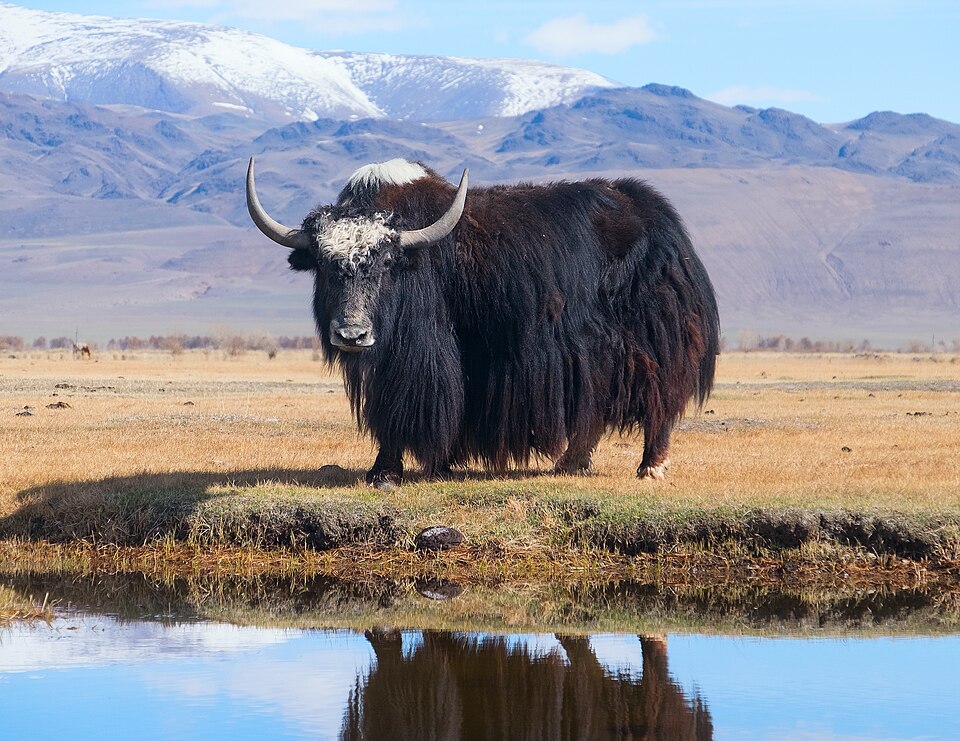
Reference photograph
Reference photograph of Yak. Compare the color and form of the individual shown with the identification notes in the text.
Source: Alexandr frolov · Original material · CC BY-SA 4.0
1. Classification, origins and habitat
Yaks are high-altitude bovids; domestic and wild yaks are distinct. Calling them a breed of ordinary European domestic cattle is inaccurate.
This entry focuses on domestic yaks. Distinguish material about the domestic Bos grunniens from the wild yak, Bos mutus. Highland communities’ use of yaks for transport, dairy products and fiber provides domestication context that the distinctive long coat alone cannot reveal.
2. Appearance and identification
Long hair, a thick body, short legs and horns are characteristic. The hanging coat protects the body in cold environments.
Long hair hanging from the chest and underside can obscure part of the legs. Domestic yaks have several colors beyond dark coats, and horn shapes also vary. When comparing them with short-haired domestic cattle, distinguish the actual outline of the body from the ends of the coat.
3. Behavior and way of life
Domestic yaks are used for milk, hair, transport and other purposes. Do not generalize wild populations’ ecology and domestic animals’ lives as identical information.
In highlands they provide milk and fiber and carry loads, among other uses. Adaptation to high altitude must not become a claim of tolerating low oxygen or cold without any limits. The setting of a photograph is important context for distinguishing domestic animals from wild ones.
4. Observation, conservation and care
Because these animals are adapted to cold, temperature management is especially important in hot environments. Do not portray high-altitude adaptation as hardiness in every environment or immunity to disease.
The advantages of a long coat can become a burden in heat, so examine cooling, shade and activity conditions carefully. Conservation of wild yaks and keeping domestic yaks have different aims. Considering the large horns and body, observe from the designated distance rather than approaching directly.
Evidence and references
- Oklahoma State University — Yak
Classification, origins, appearance, ecology or uses of the breed
- Defra — Cattle behavior, feed and environmental welfare guidance
General principles for feed, water, rest and handling. This is UK material, not guidance on Korean law.