
Other Mammals
Water Deer
Water Deer
Classification and scientific name: Hydropotes inermis
Sources checked:
A small deer distinguished by long canine teeth instead of antlers
Explore water deer classification, grassy habitats and features that distinguish them from roe deer. Learn about the life of this herbivore with canine teeth and ways to observe it without disturbance.
Origins and distribution
Native to the Korean Peninsula and China; distinguish these populations from introduced populations in Britain and elsewhere.
- Deer family
- No antlers
- Herbivore
- Watersides and tall grass
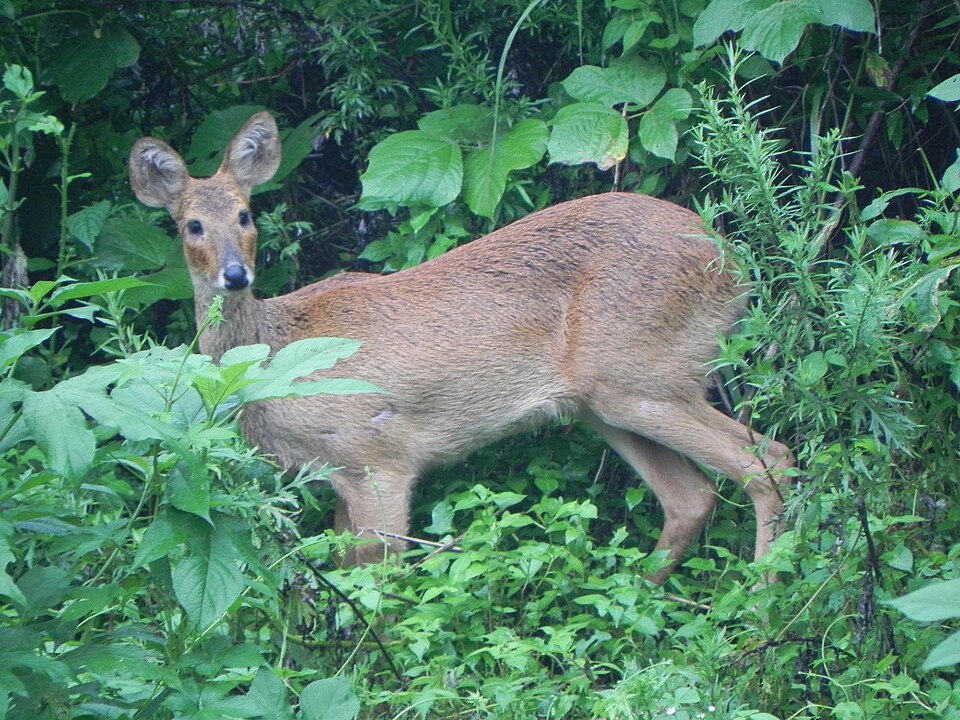
Reference photograph
A female water deer photographed in Korea. Reduced in size while preserving the original proportions.
Source: Daniel.j.silvia — Korean Water Deer.JPG · Original material · CC0 1.0
1. Classification, origins and habitat
The water deer belongs to the deer family and has the scientific name Hydropotes inermis. It is native to the Korean Peninsula and China; Korean references sometimes distinguish Korean and Chinese water deer as geographical subspecies. Established populations in Britain descend from introduced animals, so their distribution there must not be interpreted as part of the natural native range. Water deer use environments where feeding areas connect with vegetation that provides cover, including waterside reed beds, tall grass on low hills and areas around farmland. Although its name refers to water, it does not live exclusively in water.
2. Appearance and identification
Neither males nor females have antlers, and the tail is short. Males often have upper canine teeth that extend visibly beyond the mouth; these are different structures from deer antlers. Having canine teeth does not make an animal carnivorous. The coat is brownish, with color and texture varying by season and age. White spots on the back of a young fawn disappear as it grows. Female or young roe deer may also lack obvious antlers, so antlers alone are insufficient for identification. Examine the face, ears, rump and tail together, and avoid determining species or sex from a blurred photograph or tracks alone.
3. Behavior and way of life
Water deer are herbivores that selectively eat grasses, leaves and young parts of various plants. Their long canine teeth are not hunting tools; they are features to consider when understanding displays and competition between males. Water deer can swim across water, while tall vegetation provides cover as they move. An animal suddenly emerging from grass is not necessarily trying to approach people. Visible behavior may vary with available food and cover, the season and nearby disturbance. A single brief sighting does not justify assuming that all water deer are active at the same time or form the same kinds of groups.
4. Observation, conservation and care
Observe from a trail with binoculars or a telephoto lens, and increase your distance if a water deer raises its head in alarm or changes direction. Do not herd it into tall grass or lure it with food for a closer photograph. A resting fawn is not necessarily abandoned simply because it is alone; do not take it away on that assumption. If it is injured or in danger, report its location and condition to a local wildlife rescue organization. On roads, do not stop abruptly to watch or chase the animal. Protecting cover such as reeds and tall grass and keeping to designated paths are more appropriate ways to observe than touching wildlife.
Evidence and references
- National Institute of Biological Resources — Mammal Field Survey Guide: Water Deer
Scientific name, Korean Peninsula subspecies, habitat, canine teeth, juvenile markings and the limits of identifying field signs.
- British Deer Society — Water Deer
Introduced populations in Britain, plant foods and the distinction between antlers and canine teeth. British measurements and figures are not generalized to Korean populations.
- U.S. National Park Service — Wildlife Watching Guidelines
Keeping a distance, avoiding feeding, touching and luring, and observing from trails. U.S. park regulations and numerical guidance are not applied directly to Korea.