
Dinosaurs
Apatosaurus
Apatosaurus
Classification and scientific name: Apatosaurus
Sources checked:
A thick neck, large torso and a classification history connected with Brontosaurus
Apatosaurus is a sauropod related to Diplodocus; its naming relationship with Brontosaurus reflects changes in taxonomic research.
Origins and distribution
Late Jurassic North America
- Apatosaurus
- Extinct animal studied through fossils
- Distinguishing reconstruction from evidence
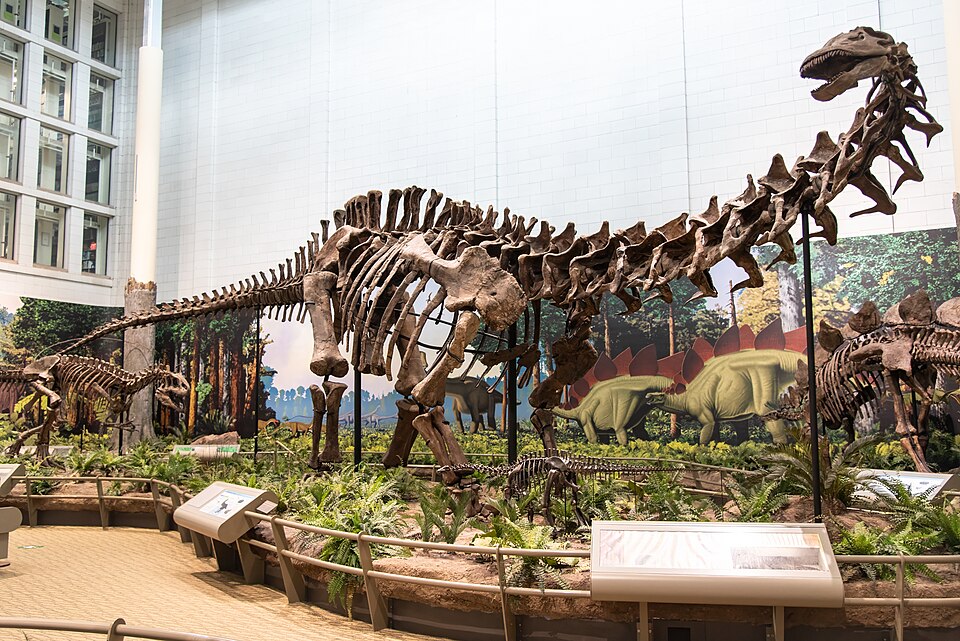
Fossil or skeletal specimen
Apatosaurus fossil and skeletal exhibition material. Displays may include replicated or supplemented parts; this is not a photograph of a living individual.
Source: AbstractionBlue · Original material: Apatosaurus_louisae_-_CM.jpg · CC BY-SA 4.0
1. Classification, discovery and geological context
Apatosaurus is a sauropod related to Diplodocus. Its naming relationship with Brontosaurus connects with changes in classification research.
It is a Late Jurassic Morrison Formation sauropod in a lineage close to Diplodocus. Its relationship with the name Brontosaurus has changed through taxonomic history, so compare older signs with recent sources. Not every historical Brontosaurus account represents the same specimen of this genus. Naming changes concern comparisons of bones and criteria for separating species.
2. Appearance and identification
A thick neck, large torso, long tail and four weight-supporting limbs are characteristic.
Even among long-necked dinosaurs, its neck and torso appear more robust than those of Diplodocus. Read the column-like supporting legs, small head and extended tail as proportions of one body. The skeleton also shows structures related to respiration and reducing body weight. Reconstructed soft-tissue thickness and overall mass differ from measurements made directly on fossils, and comparison methods need to be identified.
3. Evidence for ecological interpretations
Apatosaurus is interpreted as herbivorous. The old explanation that its large body required every activity to occur in water is not the current basic interpretation.
Sauropod teeth and jaws connect with plant feeding. Bone tissue from young animals helps study growth rates, but one growth duration does not apply identically to every specimen. Old pictures showing an animal confined to water by its weight should be distinguished from skeletal and footprint research indicating terrestrial walking. Travel routes and group behaviour require separate evidence too.
4. Limits of the fossil record and reconstructions
Skeletons, footprints and surrounding sediments are studied together. Distinguish it from armoured dinosaurs and avoid treating mass estimates from incomplete fossils as fixed measurements.
Comparing modern skeletal displays with neck and tail held above the ground against older illustrations reveals changes in interpretation. Check the displayed scientific name, specimen number and fossil-bearing strata together. Photographs of extinct animals depict fossils or reconstructions rather than observations of living individuals. Do not read partly inferred skin textures and body colours in illustrations as established ecological information.
Evidence and references
- Natural History Museum — Apatosaurus
Classification, origin, appearance and ecology
- UC Museum of Paleontology — Sauropod dinosaurs
Sauropod lineages, quadrupedal walking and basic long-neck anatomy