
Dinosaurs
Argentinosaurus
Argentinosaurus
Classification and scientific name: Argentinosaurus huinculensis
Sources checked:
Giant vertebrae reveal immense scale and the limits of estimation
Argentinosaurus is a titanosaurian sauropod discovered in Argentina, known as a very large herbivorous dinosaur.
Origins and distribution
Cretaceous South America
- Argentinosaurus huinculensis
- Extinct animal studied through fossils
- Distinguishing reconstruction from evidence
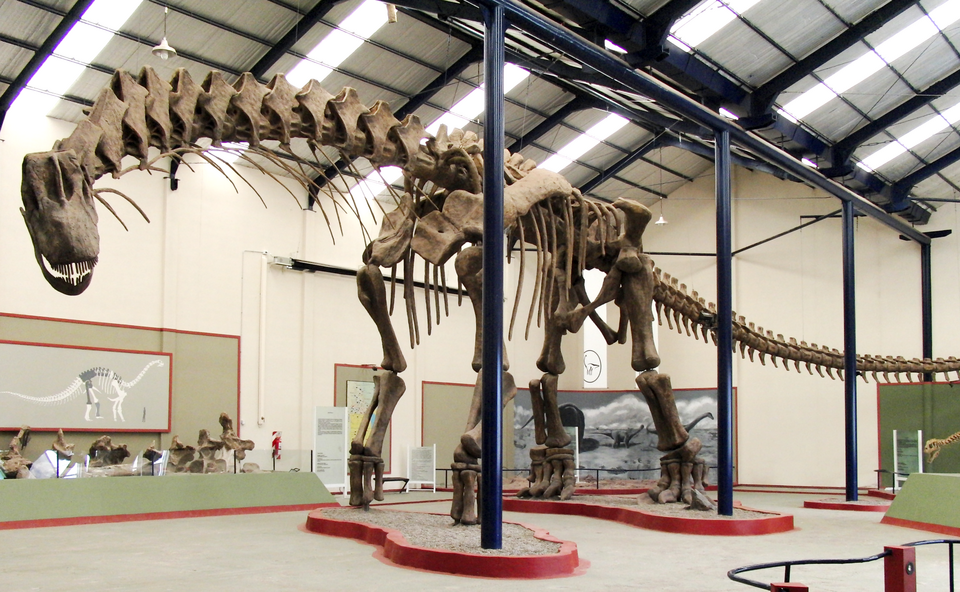
Fossil or skeletal specimen
Argentinosaurus fossil and skeletal exhibition material. Displays may include replicated or supplemented parts; this is not a photograph of a living individual.
Source: William Irvin Sellers, Lee Margetts, Rodolfo Aníbal Coria, Phillip Lars Manning · Original material: Argentinosaurus_skeleton,_PLoS_ONE.png · CC BY 2.5
© 2013 Sellers et al.
Modification notice from the source: Cropped 18 % vertically using CropTool with precise mode.
PLoS ONE · doi:10.1371/journal.pone.0078733 · doi:10.1371/journal.pone.0078733 · PLOS · March of the Titans: The Locomotor Capabilities of Sauropod Dinosaurs
1. Classification, discovery and geological context
Argentinosaurus is a titanosaurian sauropod discovered in Argentina. It is known as a very large herbivorous dinosaur.
This titanosaur comes from Cretaceous Patagonian strata. Its name connects with the country of discovery, and the enormous surviving bones help investigate the size attainable by terrestrial animals. However, the discovered portions represent only part of the body. This differs from finding a complete giant skeleton and directly measuring it from snout to tail tip.
2. Appearance and identification
A large body is reconstructed from surviving vertebrae, limb bones and other parts. Do not describe a complete skeleton as having been found.
Large vertebrae and limb bones provide starting points for estimating a whole body with a long neck, large torso and columnar legs. Reconstructed length varies with the relatives' proportions used to fill the missing head, tail and torso. If a display has a diagram marking actual discoveries, compare it first. A replica's entire length does not mean that the whole body survived as fossils.
3. Evidence for ecological interpretations
Argentinosaurus is interpreted as using plant foods. Exact behaviour cannot be observed directly and is studied through related lineages and environmental evidence.
Distinguish an interpretation as a plant-feeding sauropod from an exact dietary list. Food requirements and growth rates for an enormous body involve calculations from bone tissue, comparative physiology and environmental evidence. Relationships with large regional predators cannot be reduced to contests of size. When information on eggs and young is drawn from other titanosaurs, state whether it is direct evidence for this species.
4. Limits of the fossil record and reconstructions
Length and mass vary with reconstruction method. Do not classify it as a carnivorous theropod or present one maximum mass as an established value.
Checking the specimen and estimation method is more useful than simply saying world's largest. Rankings and estimates can change with new fossils. Images on this page show discovered fossils, skeletal reconstructions or scientific life reconstructions rather than photographs of living giant dinosaurs. Observe the remaining bones separately from interpretations filling the gaps.
Evidence and references
- Natural History Museum — Argentinosaurus
Classification, origin, appearance and ecology
- UC Museum of Paleontology — Sauropod dinosaurs
Sauropod lineages, quadrupedal walking and basic long-neck anatomy