
Dinosaurs
Diplodocus
Diplodocus
Classification and scientific name: Diplodocus
Sources checked:
A sauropod with a long slender neck and tail, and teeth concentrated at the front
Diplodocus is a long-necked sauropod discovered in North American Jurassic sediments.
Origins and distribution
Late Jurassic North America
- Diplodocus
- Extinct animal studied through fossils
- Distinguishing reconstruction from evidence
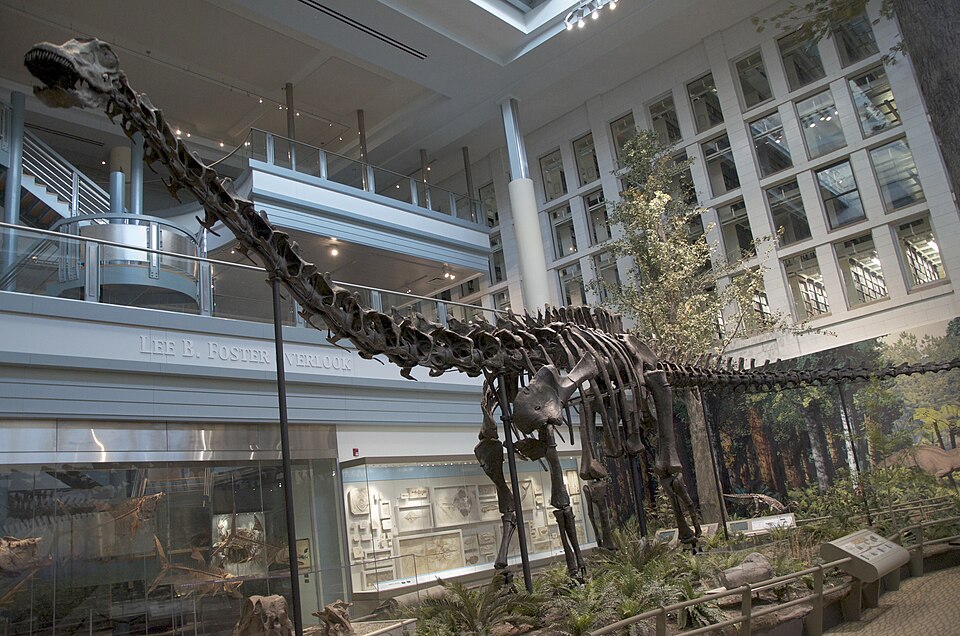
Fossil or skeletal specimen
Diplodocus fossil and skeletal exhibition material. Displays may include replicated or supplemented parts; this is not a photograph of a living individual.
Source: ScottRobertAnselmo · Original material: CM_Diplodocus.jpg · CC BY-SA 3.0
1. Classification, discovery and geological context
Diplodocus is a long-necked sauropod. It was discovered in North American Jurassic sediments.
It is a representative sauropod of the Late Jurassic Morrison Formation in North America. Replicated skeletons in many museums made it widely known, but the country hosting a replica is not necessarily a fossil locality. Distinguish species and specimens to compare length records accurately. Together with the related Apatosaurus, it helps investigate varied body proportions within the same lineage.
2. Appearance and identification
An extremely long neck and tail, small head and column-like supporting legs are characteristic.
Observe the slender elongated teeth concentrated at the front of the small head. They suggest food handling different from animals chewing leaves with thick teeth. An extremely long neck and tail do not mean that the head was always held vertically high. Posture is reconstructed from vertebrae and the positions of ligaments and muscles; skeletal spaces are studied in relation to functions in the living body.
3. Evidence for ecological interpretations
Diplodocus is interpreted as feeding on plants, with neck posture and feeding height studied through anatomy and biomechanics.
Tooth shape and wear provide clues to bringing plants into the mouth. The use of low versus high vegetation requires considering neck movement range together with environmental evidence. Functional research into whether the long tail could act like a whip differs from establishing that it actually made a loud sound. A long neck alone does not justify directly applying modern giraffe feeding behaviour.
4. Limits of the fossil record and reconstructions
Distinguish Diplodocus from dinosaurs with armour or tail clubs. Tail-use interpretations include research hypotheses rather than an established particular sound.
Comparing other giant herbivores from the same strata invites questions about different body structures. In displays, check how much of the tail is reconstructed and the proportions of original and replicated material. This page shows fossils or scientific reconstructions. Skin colours and the size of a line of walking animals in an illustration are not photographically observed facts.
Evidence and references
- Natural History Museum — Diplodocus
Classification, origin, appearance and ecology
- UC Museum of Paleontology — Sauropod dinosaurs
Sauropod lineages, quadrupedal walking and basic long-neck anatomy