
Amphibians
Hellbender
Hellbender
Classification and scientific name: Cryptobranchus alleganiensis
Sources checked:
Spaces beneath rocks and folded skin matter for a large North American salamander
The hellbender is related to giant salamanders of Japan and China but is a separate species.
Origins and distribution
Eastern United States
- Cryptobranchus alleganiensis
- Eastern United States
- Observing species-specific ecology
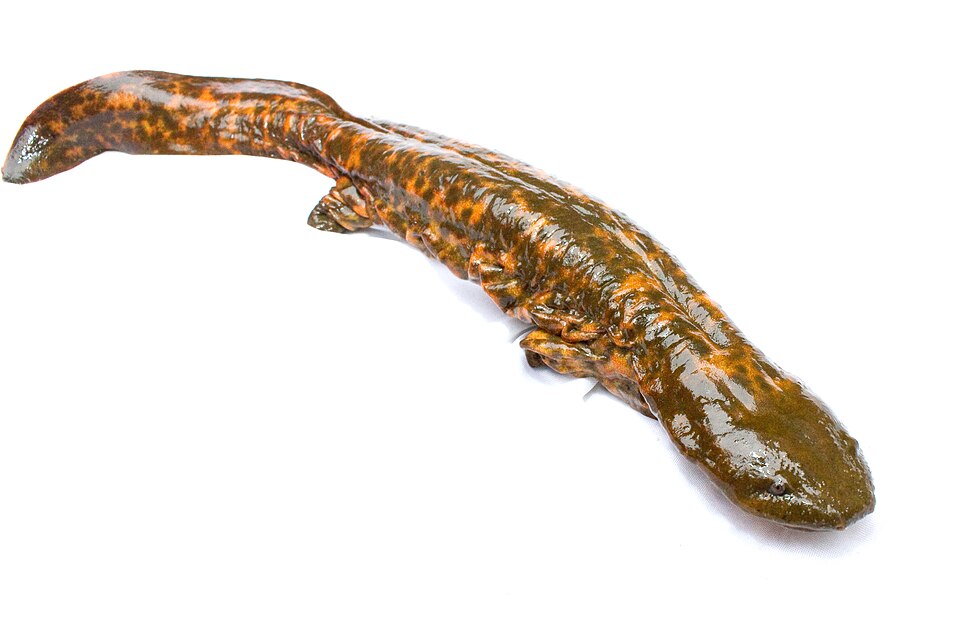
Reference photograph
Reference photograph of a hellbender. Compare its colours and form with the identification details in the text.
Source: Brian Gratwicke · Original material: Hellbender.jpg · CC BY 2.0
1. Classification, origins and habitat
The hellbender is a large North American salamander. It is related to giant salamanders of Japan and China but is a separate species.
This eastern United States species shares the family Cryptobranchidae with Japan's Andrias japonicus but belongs to a different genus. An unusual name does not establish danger or a temperament inclined to harm people. Regional populations and river conditions differ, so numerous sightings at one site do not establish species-wide stability.
2. Appearance and identification
A flattened head and body and folded flank skin are characteristic. Adults retain a tail.
Observe the broad flat head, flank folds, four limbs and long tail. Folds increase surface contacting water and connect with respiratory research. This differs from a body always showing conspicuous adult external gills like a mudpuppy's. Colour and spots vary with substrate and light; do not identify every large salamander photograph as this species.
3. Behavior and way of life
Hellbenders live underwater and use crayfish and other foods. Spaces beneath large rocks relate to shelter and breeding.
They hide under rocks and use aquatic prey, with breeding sites also connected to riverbed cover. Limited daytime movement should be read alongside nighttime feeding. Flow and flattened form can be studied together, but lifting large rocks to inspect animals can damage habitat structure.
4. Observation, conservation and care
Oxygenated rivers and spaces between rocks matter. Explain skin respiration in connection with water conditions.
Oxygen, bottom crevices and sediment quantity all matter. Clear-looking water can still contain problems if spaces beneath large rocks are filled. Distinguish research and surveys from ordinary observation, without pulling hidden animals out. Accurate captions avoid combining this species' size with larger Japanese or Chinese salamander records.
Evidence and references
- Animal Diversity Web — University of Michigan — Cryptobranchus alleganiensis
Classification, origin, appearance and ecology
- American Museum of Natural History — Cryptobranchus alleganiensis
Current scientific names, synonyms, natural distribution and taxonomic research