
Amphibians
Japanese giant salamander
Japanese Giant Salamander
Classification and scientific name: Andrias japonicus
Sources checked:
A flattened body in flowing water: distinguish Japanese from Chinese giant salamanders
This page uses the Japanese giant salamander, Andrias japonicus, as its representative of the broad giant salamander name. It is a large amphibian associated with Japanese rivers, rather than the same species as ordinary salamanders native to Korean valleys.
Origins and distribution
Mountain streams of Japan
- Andrias japonicus
- Japanese mountain streams
- Observing species-specific ecology
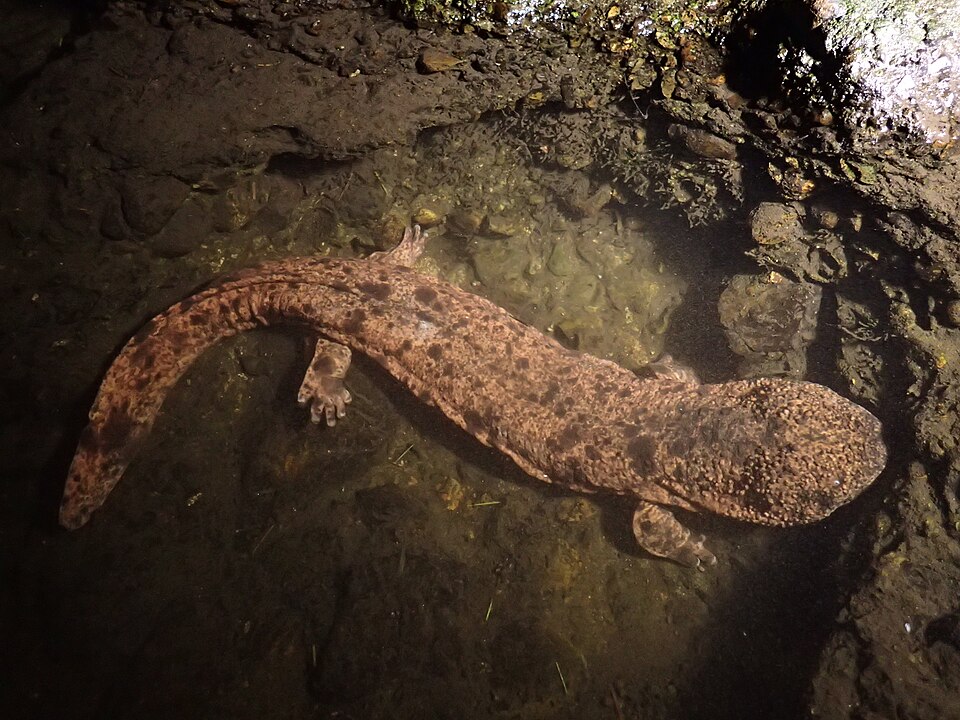
Reference photograph
Reference photograph of a Japanese giant salamander. Compare its colours and form with the identification details in the text.
Source: Salamandra2021 · Original material: Japanese_giant_salamander_in_Tottori_Prefecture,_Japan.jpg · CC BY-SA 4.0
1. Classification, origins and habitat
Within the broad giant salamander name, this page uses the Japanese giant salamander, Andrias japonicus, as its representative. It is a large amphibian associated with Japanese rivers, rather than the same species as ordinary salamanders naturally occurring in Korean valleys. Distinguish it from China's several Andrias species too. Living fossil does not mean entirely unchanged or the same species surviving since the Palaeozoic.
2. Appearance and identification
A broad flattened head, large mouth, small eyes, long tail and folded skin along the sides are characteristic. The folds help explain water-contact surface and respiration. This is a salamander retaining four limbs, rather than a finned fish. Separate specimens and growth stages without making the longest individual the average for all adults. Mere resemblance to a Chinese giant salamander in a photograph cannot establish exact species.
3. Behavior and way of life
Japanese giant salamanders use fish, crustaceans and other prey in flowing water and may shelter beneath rocks. Skin and aquatic conditions are closely related, and metamorphosis does not involve losing the adult tail as in frogs. Stream cover and males' egg-related behaviour are studied in reproduction. Distinguish prey capture and rest rather than turning slow rest into gentleness or ease of touching.
4. Observation, conservation and care
Flow, oxygen conditions, spaces between rocks and stream connectivity matter. Dams, river structures and water changes can affect prey and breeding places. Relationships with captive or transported Chinese lineages are also a distinct conservation issue. Follow managing organisations' guidance without lifting rocks or animals. Match text and photographs to the Japanese representative rather than presenting other countries' giant salamander information as ordinary Korean ecology.
Evidence and references
- University of Michigan, Animal Diversity Web — Andrias japonicus
The species' distribution, appearance, food, breeding and life history
- American Museum of Natural History — Andrias japonicus
Current scientific names, synonyms, natural distribution and taxonomic research