
Amphibians
Fire-bellied newt
Fire-bellied Newt
Classification and scientific name: Hypselotriton orientalis
Sources checked:
Warning colours on the belly and seasonal life in water and on land
Fire-bellied newt names several similarly coloured newts; this page uses the Chinese species Hypselotriton orientalis, formerly Cynops orientalis.
Origins and distribution
East-central China
- Hypselotriton orientalis
- East-central China
- Observing species-specific ecology
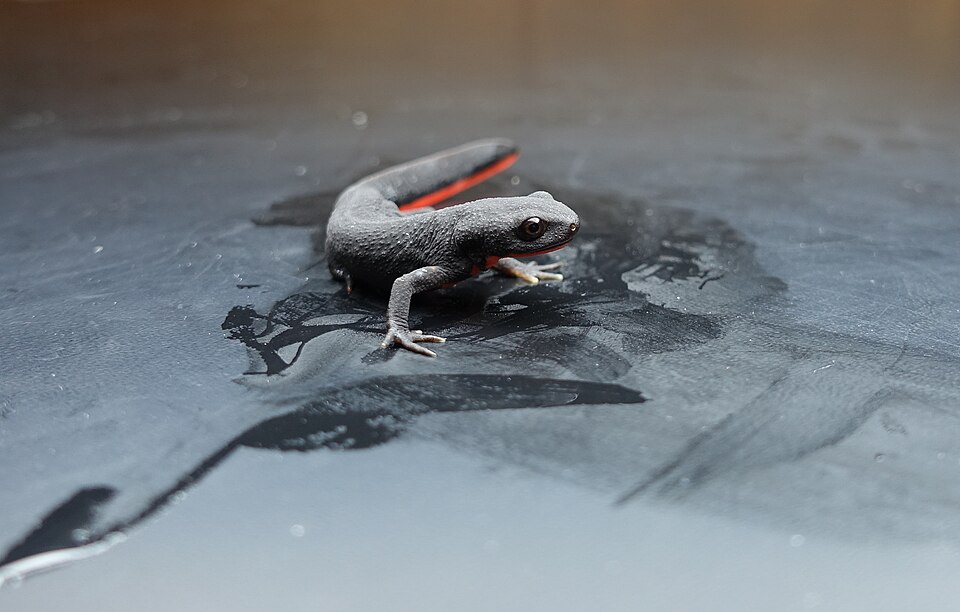
Reference photograph
Reference photograph of a fire-bellied newt. Compare its colours and form with the identification details in the text.
Source: Jeff Lorch, USGS. Public domain. · Original material: Chinese_firebelly_newt_(2).jpg · Public domain
1. Classification, origins and habitat
Fire-bellied newt is used for several newts with similar belly colours. This page uses the Chinese fire-bellied newt, Hypselotriton orientalis, as its representative, connecting it with the old name Cynops orientalis. Do not combine it as one species with Japan's Cynops pyrrhogaster. Classification changes in related groups mean that older broad accounts need checks of locality and scientific name before comparison with present species distributions.
2. Appearance and identification
An orange-to-red belly contrasting with a dark back, a continuous tail and four limbs are characteristic. Skin differs from a lizard's scaled surface, and black belly patterns vary among individuals. Skin condition and tail outlines can look different between aquatic and terrestrial stages. Observe contrasts in sourced photographs rather than catching, turning over or stimulating animals to show the underside.
3. Behavior and way of life
These newts seek small aquatic invertebrates and move between water and land. Underwater courtship and egg attachment during breeding are important in their life cycle. Aquatic larvae and post-metamorphic animals differ in gills and habitat use. Bright belly colours relate to defensive signalling rather than decoration for people or suitability as a pet. Skin secretions also make touching to inspect the surface inappropriate.
4. Observation, conservation and care
Consider environments connecting breeding water, surrounding cover and seasonal change. Native waters and pet-aquarium photographs show different conditions; one scene should not determine an entire lifetime. Check whether a photo identifies the Chinese species or another Japanese newt to match this text. A red belly alone cannot identify species, and one water temperature or aquarium arrangement should not be offered as common management for every newt.
Evidence and references
- U.S. Geological Survey — Oriental Fire-bellied Newt
Chinese fire-bellied newt classification, form, aquatic life and introductions
- American Museum of Natural History — Hypselotriton orientalis
Current scientific names, synonyms, natural distribution and taxonomic research