
Dinosaurs
Ankylosaurus
Ankylosaurus
Classification and scientific name: Ankylosaurus magniventris
Sources checked:
An armoured dinosaur with bony armour and a clubbed tail
Ankylosaurus lived in North America at the end of the Late Cretaceous; despite its familiar name, no fully complete skeleton is known, and reconstruction also compares close relatives.
Origins and distribution
Late Cretaceous North America
- Ankylosaurus magniventris
- Extinct animal studied through fossils
- Distinguishing reconstruction from evidence
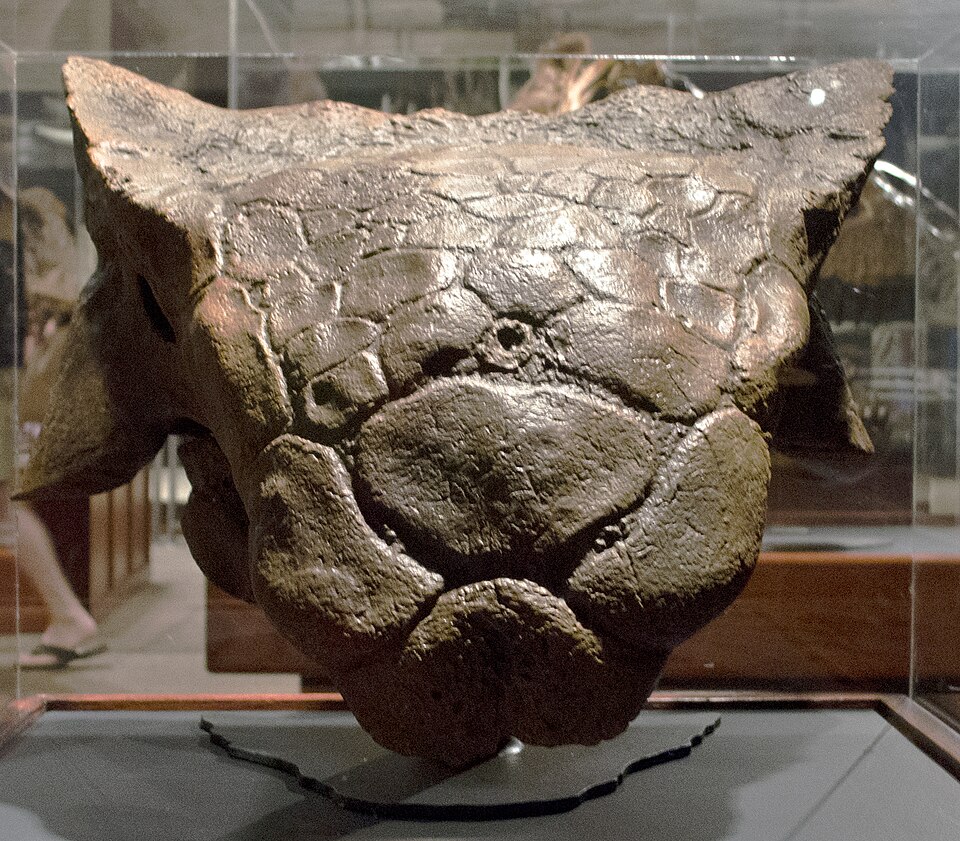
Fossil or skeletal specimen
Ankylosaurus fossil and skeletal exhibition material. Displays may include replicated or supplemented parts; this is not a photograph of a living individual.
Source: Tim Evanson · Original material: Ankylosaur head - cast - Custer County Montana - Museum of the Rockies - 2013-07-08.jpg · CC BY-SA 2.0
Modification notice from the source: Made details more visible.
Ankylosaur head — cast · Tim Evanson · Tim Evanson — Ankylosaur head - cast - Custer County Montana
1. Classification, discovery and geological context
Ankylosaurus was an ankylosaur of North America at the end of the Late Cretaceous. Although a familiar name within the group, it is not known from a fully complete skeleton; reconstruction also compares related ankylosaurs. This page focuses on Ankylosaurus magniventris. Using the broader group and the particular genus as interchangeable names can mix in other species' armour or head shapes. Checking locality and age also distinguishes it from the Jurassic Stegosaurus.
2. Appearance and identification
A broad, low body, four sturdy legs, bony armour within the skin and a large club at the tail tip are characteristic. The head also has bony ornaments and protective structures, but the armour should not be imagined as a continuous shell of metal plates. Considering the thickened tail-tip bones and the supporting structures in front of them helps explain the club's connection to the body. Fossil armour pieces can be found displaced from their original positions, making interpretation part of reconstructing the overall arrangement. Body mass and thickness also cannot be measured directly from bones alone.
3. Evidence for ecological interpretations
The snout and teeth are interpreted as adaptations for plant feeding. Low head height and a broad body are studied together to investigate feeding near the ground, but do not establish a diet limited to one particular plant. Research considers defence and interactions between individuals as possible functions of the tail club. Hard armour does not mean immunity to every attack, nor does it establish an always aggressive or always gentle temperament. Investigating movements made possible by anatomy differs from directly observing the behaviour.
4. Limits of the fossil record and reconstructions
The fossil-bearing strata and associated organisms provide evidence for interpreting ecosystems at the end of the Cretaceous. Comparing armour pieces, tail joints and skulls helps distinguish more certain and supplemented parts of life reconstructions. Check scientific labels so an almost complete fossil of a different ankylosaur is not called an Ankylosaurus specimen. This page's visual materials are fossils or scientific reconstructions of an extinct animal, rather than proof of skin colour and specific behavioural scenes. Husbandry for living reptiles should not be applied as management advice for this extinct animal.
Evidence and references
- Natural History Museum — Ankylosaurus
The genus's discovery regions, age, skeleton and interpretations of diet
- Natural History Museum — Ankylosaurs: dinosaurs with built-in armour
Ankylosaur armour and tail structures, and comparisons among lineages