
Dinosaurs
Parasaurolophus
Parasaurolophus
Classification and scientific name: Parasaurolophus
Sources checked:
A long hollow crest behind the head and jaws for processing plants
Parasaurolophus was a hadrosaurid ornithischian, a herbivore different from long-necked sauropods.
Origins and distribution
Late Cretaceous North America
- Parasaurolophus
- Extinct animal studied through fossils
- Distinguishing reconstruction from evidence
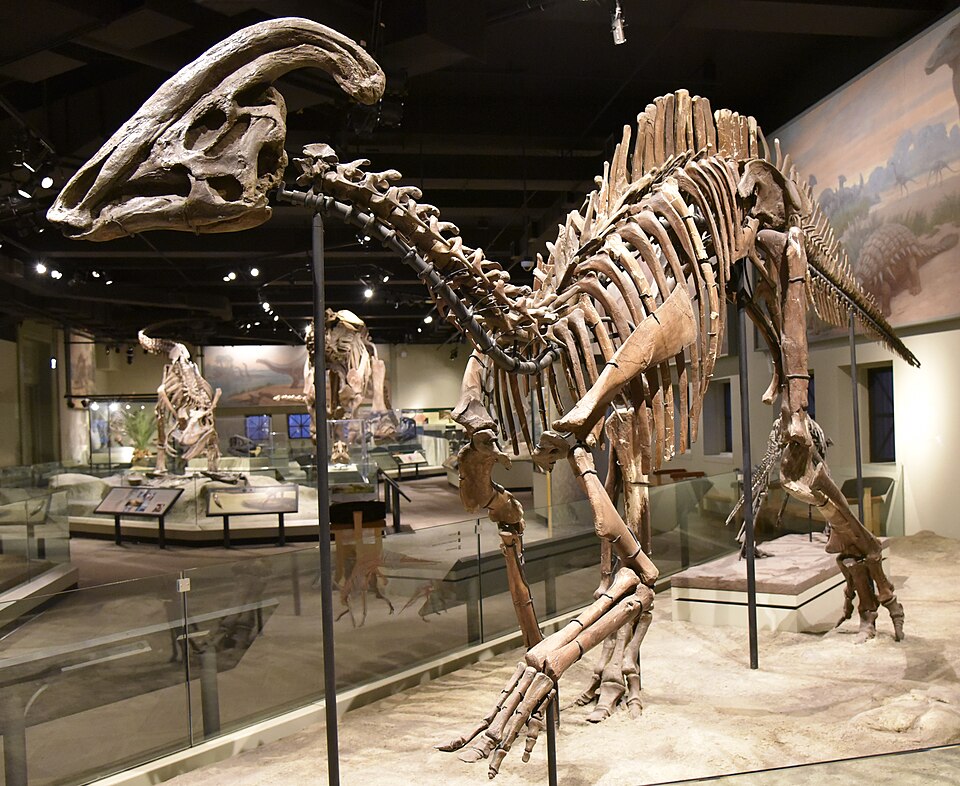
Fossil or skeletal specimen
Parasaurolophus fossil and skeletal exhibition material. Displays may include replicated or supplemented parts; this is not a photograph of a living individual.
Source: Zissoudisctrucker · Original material: FMNH_Parasaurolophus_fossil.jpg · CC BY-SA 4.0
Modification notice from the source: Cleand up over exposer
1. Classification, discovery and geological context
Parasaurolophus was a hadrosaurid ornithischian dinosaur. It was a herbivore different from long-necked sauropods.
This Late Cretaceous North American hadrosaurid is also called duck-billed because of its broad snout. The duck comparison concerns appearance, rather than a bird confined to water. Crest shapes differ among species within the genus, and between young and adults. Localities and growth stages must be considered together to compare reconstructions accurately.
2. Appearance and identification
A hollow crest extending far behind the head and a broad snout are characteristic.
Complex air passages run inside the long backward-curving crest. Its structure differs from a large solid horn. Many jaw teeth and a broad snout relate to processing plant foods. Strong hind limbs and forelimbs capable of supporting the body mean it should not simply be placed into an exclusively bipedal or quadrupedal category.
3. Evidence for ecological interpretations
The crest is studied for functions including sound and signalling. Exact calls should not be described as established like modern recordings.
Models of the crest's passages allow investigation of sound resonance. These are estimates based on physical models, rather than recordings of actual calls. Other crest functions, including signalling and species recognition, are also considered. The balance of two-legged and four-legged movement is interpreted through anatomy and locomotor research; one illustration cannot fix habitual posture.
4. Limits of the fossil record and reconstructions
Examine body structures that processed plants through numerous teeth. Crest length and shape can vary with species and developmental stage.
Skin impressions and skeletons provide different evidence for scaled surfaces and basic anatomy. In exhibits, distinguish models showing the crest's internal cross-section from its external appearance. Check labels identifying a photographed fossil versus a whole-body reconstruction. Connect skin-colour and call-recreation videos with the text on the understanding that they are not records of living individuals.
Evidence and references
- Natural History Museum — Parasaurolophus
Classification, origin, appearance and ecology
- UC Museum of Paleontology — Ornithischian dinosaurs
Distinctions among ornithopod, ceratopsian, stegosaur and ankylosaur lineages