
Dinosaurs
Maiasaura
Maiasaura
Classification and scientific name: Maiasaura peeblesorum
Sources checked:
Nests and fossils of different growth stages provide clues to reproduction
Maiasaura is a hadrosaur known from nests and young individuals, with a name related to interpretations of breeding behaviour.
Origins and distribution
Late Cretaceous North America
- Maiasaura peeblesorum
- Extinct animal studied through fossils
- Distinguishing reconstruction from evidence
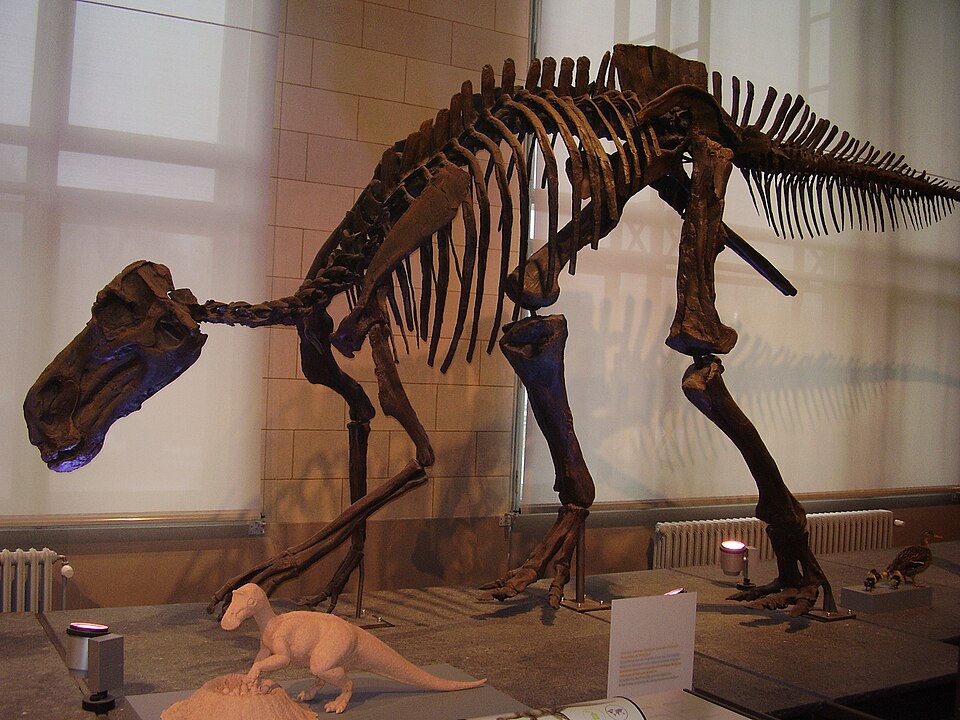
Fossil or skeletal specimen
Maiasaura fossil and skeletal exhibition material. Displays may include replicated or supplemented parts; this is not a photograph of a living individual.
Source: Meridas (Vladimír Socha) · Original material: Maiasaura_skeleton.jpg · CC BY-SA 4.0
1. Classification, discovery and geological context
Maiasaura is a hadrosaur known from nests and fossils of young individuals. Its name relates to interpretations of breeding behaviour.
This hadrosaur is known from Late Cretaceous Montana fossils. Its good-mother name connects with the history of interpreting nest and young-animal discoveries. The reason for a name and the exact form of parental care are separate questions. Fossils of different ages from one area allow investigation of growth that a single adult skeleton cannot reveal.
2. Appearance and identification
A broad snout, large torso and relatively small head crest are characteristic.
Observe the broad snout, plant-processing jaws, large torso and sturdy legs. The head lacks Parasaurolophus's long crest and has relatively small ornamentation. Young animals are not simply scaled-down adults; head and limb proportions may differ. Check labels identifying actual eggs and bones versus replicated models in nest displays.
3. Evidence for ecological interpretations
Nests and fossils at different growth stages are used to study breeding groups and development of young. They do not establish parental care exactly like that of modern animals.
Clusters of nests and young bones provide evidence for interpreting breeding groups, growth and time spent in nests. They should not be converted into scenes identical to parental care in modern birds or mammals. Details such as placing food directly into a youngster's mouth require additional evidence. Assess possible explanations using growth traces in bones alongside their distribution within nests.
4. Limits of the fossil record and reconstructions
Fossils and sediments are used to investigate herbivorous-dinosaur breeding environments. Distinguish the discovery of nests from inference about exact parental care.
Eggshell, nest shape and surrounding sediments provide different information best read together. If an exhibit arranges an adult and young as one family, check whether it is an educational reconstruction. Images on this page likewise show fossils or scientific reconstructions. Prioritise research-supported evidence for breeding sites and growth rather than replacing it with a judgement of human-like affectionate temperament.
Evidence and references
- Natural History Museum — Maiasaura
Classification, origin, appearance and ecology
- UC Museum of Paleontology — Ornithischian dinosaurs
Distinctions among ornithopod, ceratopsian, stegosaur and ankylosaur lineages