
Dinosaurs
Pachycephalosaurus
Pachycephalosaurus
Classification and scientific name: Pachycephalosaurus wyomingensis
Sources checked:
Studying the function and growth of a thick-skulled dinosaur
Pachycephalosaurus was an ornithischian with a thick skull, rather than a long-necked sauropod.
Origins and distribution
Late Cretaceous North America
- Pachycephalosaurus wyomingensis
- Extinct animal studied through fossils
- Distinguishing reconstruction from evidence
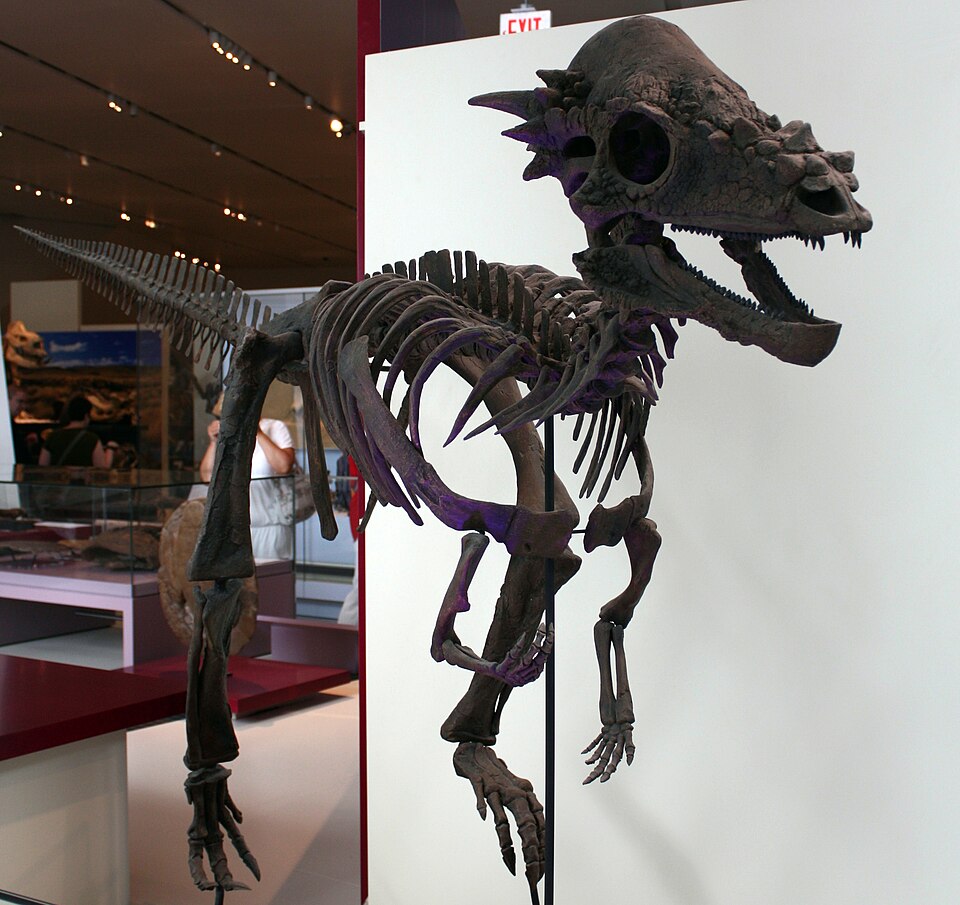
Fossil or skeletal specimen
Pachycephalosaurus fossil and skeletal exhibition material. Displays may include replicated or supplemented parts; this is not a photograph of a living individual.
Source: IJReid · Original material: Pachycephalosaurus_wyomingensis_ROM.jpg · CC BY 4.0
1. Classification, discovery and geological context
Pachycephalosaurus was an ornithischian dinosaur with a thick skull. It was not a long-necked sauropod.
This pachycephalosaur lived in North America at the end of the Late Cretaceous. Its thick-headed name relates to the domed skull, and its lineage differs from giant sauropods. Skull fossils are important, but no single specimen completely establishes every bone of the body. Research also considers whether some differently shaped skull fossils represent growth stages or separate species.
2. Appearance and identification
A thick dome on the skull and projections around its margins are characteristic.
Consider the combination of a rounded skull dome, small surrounding projections and a bipedal body. Internal skull structure provides more information than an impression of a hard surface. Head proportions and ornaments can change during growth, making distinctions between young and adult important. Read whole-body models as reconstructions comparing related lineages and known bones.
3. Evidence for ecological interpretations
Interpretations of head use include impacts and display. Do not present one fighting method as though behaviour were directly observed.
Skull-to-skull impacts, pushing against flanks and visual display are among the functions discussed. Scenes resembling living mountain goats clashing horns are explanatory comparisons rather than footage of actual contests. Bone damage, joints and impact models offer different evidence for evaluating hypotheses. A possible function should not be extended into an explanation of everyday temperament and every behaviour.
4. Limits of the fossil record and reconstructions
Classification discussions involve skull growth. Consider the problem of interpreting differences between young and adult head shapes as separate species.
For skull specimens, examine preserved portions and reconstructed margins as well as thickness. Discussions of classification and growth can change with new specimens. Photographs and drawings on this page show fossils or scientific reconstructions, rather than living Pachycephalosaurus. Read reconstructions of disputes and skin colours with a distinction between observed bones and interpretation.
Evidence and references
- Natural History Museum — Pachycephalosaurus
Classification, origin, appearance and ecology
- UC Museum of Paleontology — Ornithischian dinosaurs
Distinctions among ornithopod, ceratopsian, stegosaur and ankylosaur lineages