
Dinosaurs
Allosaurus
Allosaurus
Classification and scientific name: Allosaurus
Sources checked:
Reading a Jurassic predator's jaws and three fingers through its skeleton
Allosaurus was a Late Jurassic theropod, a predator from an earlier time than Tyrannosaurus.
Origins and distribution
Late Jurassic North America and other regions
- Allosaurus
- Extinct animal studied through fossils
- Distinguishing reconstruction from evidence
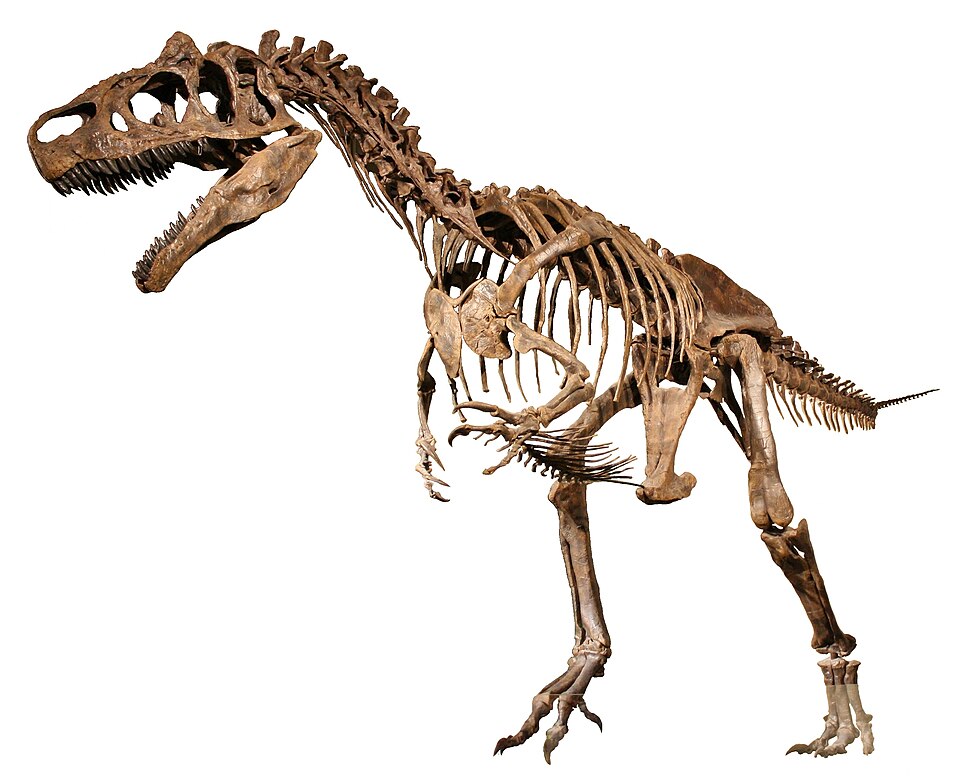
Fossil or skeletal specimen
Allosaurus fossil and skeletal exhibition material. Displays may include replicated or supplemented parts; this is not a photograph of a living individual.
Source: The_Wookies · Original material: WLA_hmns_Allosaurus_White_Background.jpg · CC BY 2.5
WLA hmns Allosaurus.jpg · The_Wookies · WLA_hmns_Allosaurus.jpg · The_Wookies
1. Classification, discovery and geological context
Allosaurus was a Late Jurassic theropod dinosaur. It is known as a predator from an earlier time than Tyrannosaurus.
Specimens from the Morrison Formation in the United States and elsewhere are important for comparing predators in Jurassic terrestrial ecosystems. Begin with the time separating these animals rather than importing traits of the latest Cretaceous Tyrannosaurus. Features also differ among species and specimens within Allosaurus, so the dimensions of one displayed skeleton should not become the size of every individual.
2. Appearance and identification
A large head, sharp teeth and forelimbs with three fingers are characteristic.
Skull projections above the eyes and laterally flattened teeth with serrated edges are also features to observe. The three fingers contrast with Tyrannosaurus's short two-fingered hands. A long tail relates to balance, distinct from the dragging-tail posture in old illustrations. Adding unpreserved muscle and skin produces a reconstruction based on comparison with bones.
3. Evidence for ecological interpretations
Allosaurus is interpreted as carnivorous, but fossils alone do not readily establish the details of solitary or group hunting. Bones at the same site are not automatically evidence of cooperative hunting.
Jaw and neck movements are studied through models using joints and muscle-attachment traces. Bite marks on prey bones show contact but do not always distinguish the moment of killing from feeding on a carcass. Sites containing several individuals' bones first require investigation of deposition. Finding a group alone cannot establish role-sharing hunts like those of wolves.
4. Limits of the fossil record and reconstructions
Jurassic sediments are used to study body structure alongside the ancient environment. Distinguish film depictions of behaviour from features observed in fossils.
Connecting sauropods, stegosaurs and plant fossils from the same strata broadens observation from a simple carnivorous-dinosaur introduction to ancient feeding relationships. For skeletal displays, check scientific names, fossil-bearing strata and original versus replicated bones. Images on this page show specimens or scientific reconstructions of extinct animals. Read skin colour and hunting scenes separately from directly recorded evidence.
Evidence and references
- Natural History Museum — Allosaurus
Classification, origin, appearance and ecology
- UC Museum of Paleontology — Theropod dinosaurs
Theropod skeletal comparisons and evolutionary relationships with birds