
Dinosaurs
Carnotaurus
Carnotaurus
Classification and scientific name: Carnotaurus sastrei
Sources checked:
A South American theropod with horns above its eyes and preserved skin traces
Carnotaurus was an abelisaurid theropod, rather than a long-necked herbivorous sauropod.
Origins and distribution
Late Cretaceous South America
- Carnotaurus sastrei
- Extinct animal studied through fossils
- Distinguishing reconstruction from evidence
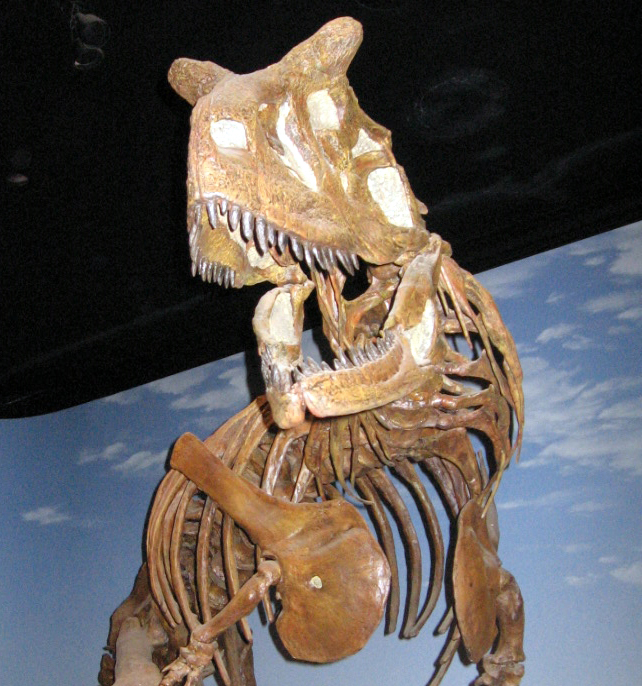
Fossil or skeletal specimen
Carnotaurus fossil and skeletal exhibition material. Displays may include replicated or supplemented parts; this is not a photograph of a living individual.
Source: Carnotaurus_skeleton.jpg : John Barreiros from Norwalk, CT, USA derivative work: Dinoguy2 ( talk ) · Original material: Carnotaurus skeleton cropped.jpg · CC BY-SA 2.0
Modification notice from the source: Crop to remove inaccurately reconstructed hands.
Carnotaurus skeleton.jpg · John Barreiros · Carnotaurus skeleton · Carnotaurus_skeleton.jpg · John Barreiros — Carnotaurus skeleton · Dinoguy2
1. Classification, discovery and geological context
Carnotaurus was a South American abelisaurid theropod. It should not be classified as a long-necked herbivorous sauropod.
The skeleton discovered in Argentina became a reference for understanding the distinctive abelisaurid body. The bull in its name is an appearance comparison based on head horns, rather than a statement that it was herbivorous like cattle. Check its time and lineage separately from other large South American theropods. Incomplete portions are supplemented through comparisons with relatives.
2. Appearance and identification
A pair of horns above the eyes, extremely small forelimbs and long hind limbs are characteristic.
The head is narrow from the front and the snout relatively short. Bony horns above the eyes are established, but their external covering and colour are not preserved unchanged. Skin-impression fossils provide rare evidence for studying a scaled surface, rather than the colour pattern of the entire body. Comparing the very short arms with torso proportions helps reveal a build different from Tyrannosaurus.
3. Evidence for ecological interpretations
Carnotaurus is interpreted as carnivorous, with movement and feeding behaviour studied through skull and limb structure. A maximum running speed cannot be presented as an observed fact.
Research estimates running ability using long hind limbs and tail musculature, but has not measured the animal's actual top speed. Whether skull horns were clashed together or used for display is a behavioural question requiring further evidence. Carnivory should not be extended into a conclusion that every prey item was predetermined. Distinguish possible movement ranges from the actual frequency of behaviour.
4. Limits of the fossil record and reconstructions
Consider preserved skin impressions and bones together. The conspicuous skull horns still involve interpretation of their exact function.
Checking missing skeletal portions and parts filled with replicas makes research limits visible in an image. In particular, a whole-body reconstruction should not be imagined as a complete record made simply by joining all the bones from one known specimen. Comparing skin fossils with body reconstructions reveals the difference between directly preserved surfaces and imagined patterns filling the gaps.
Evidence and references
- Natural History Museum — Carnotaurus
Classification, origin, appearance and ecology
- UC Museum of Paleontology — Theropod dinosaurs
Theropod skeletal comparisons and evolutionary relationships with birds