
Dinosaurs
Archaeopteryx
Archaeopteryx
Classification and scientific name: Archaeopteryx
Sources checked:
An early bird lineage preserving feathers, teeth and a long bony tail together
Archaeopteryx shows traits of early birds and closely related dinosaur lineages; wings do not place it with pterosaurs.
Origins and distribution
Late Jurassic Europe
- Archaeopteryx
- Extinct animal studied through fossils
- Distinguishing reconstruction from evidence
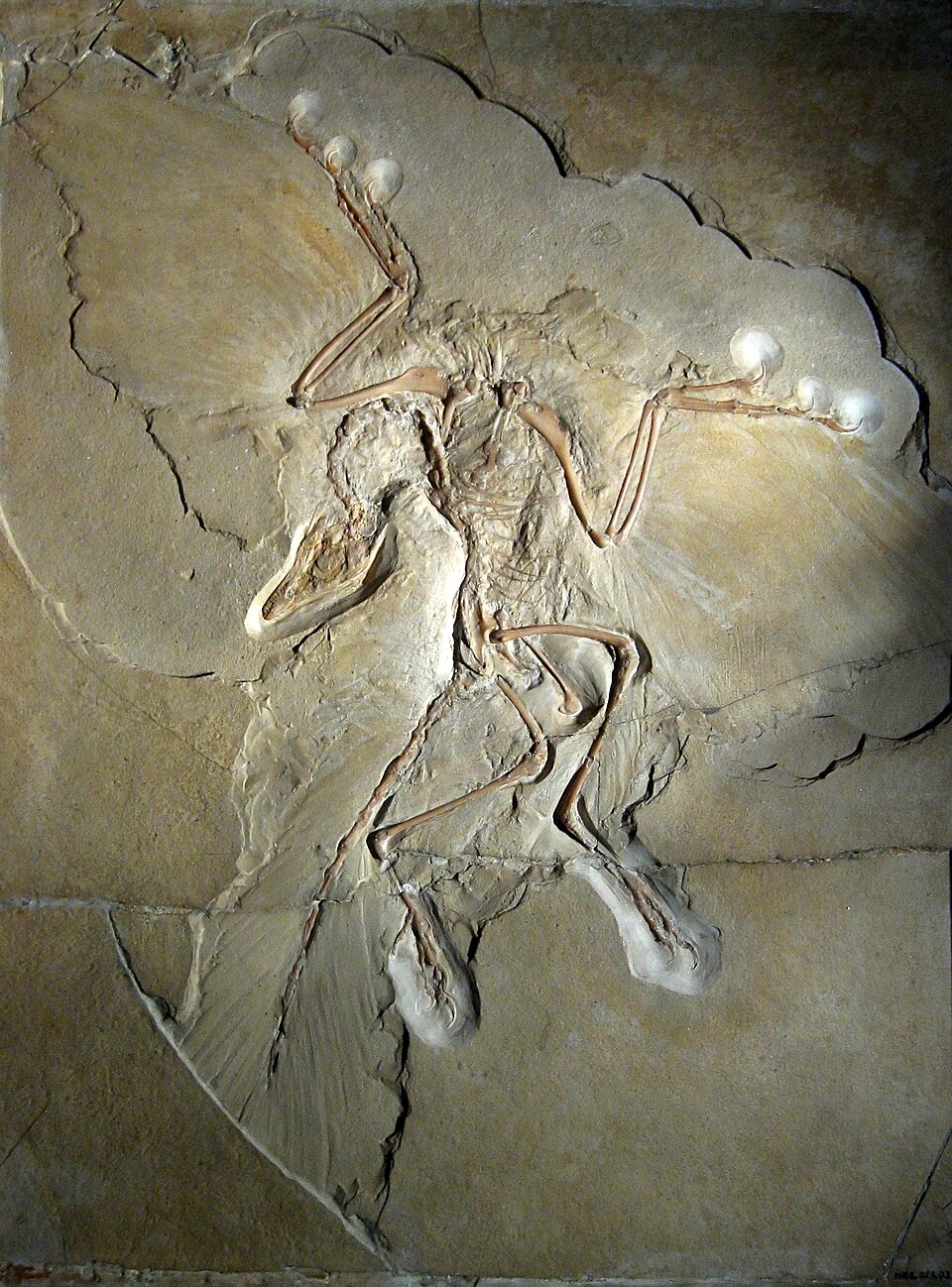
Fossil or skeletal specimen
Archaeopteryx fossil and skeletal exhibition material. Displays may include replicated or supplemented parts; this is not a photograph of a living individual.
Source: H. Raab ( User: Vesta ) · Original material: Archaeopteryx_lithographica_(Berlin_specimen).jpg · CC BY-SA 3.0
Modification notice from the source: Contrast, sharpness
1. Classification, discovery and geological context
Archaeopteryx is a fossil animal showing traits of early birds and closely related dinosaur lineages. Having wings does not place it in the same group as pterosaurs.
Fossils from Late Jurassic German limestone played a major role in discussion of bird–dinosaur relationships. Feathers and skeletons preserved together in slabs show why classification cannot rely on a single feature. The name Archaeopteryx does not automatically establish it as the direct ancestor of every living bird. Compare multiple traits with related early bird lineages.
2. Appearance and identification
Feathers and wings occur alongside teeth, a long bony tail and finger claws.
Following the long wing feathers reveals finger claws, a long bony tail and jaw teeth together. This differs from the combination of reduced tail bones and toothless bills in modern birds. On slab specimens, distinguish compressed traces of bones and feathers, and check for parts added in drawings. A wholly black reconstruction silhouette does not mean that the entire fossil originally preserved that same colour.
3. Evidence for ecological interpretations
Flight ability and locomotion are investigated through fossil feathers and skeletons. Avoid simply stating that it flew exactly like living birds.
Wings, shoulder joints and the degree of feather asymmetry are used to study aerial ability. Even the question of flight includes separate problems of flapping, take-off, gliding and landing. Do not copy the agile flight of a modern small bird directly onto it. Teeth and body structure support interpretations of possible small-animal feeding, but cannot establish every food and behaviour exactly.
4. Limits of the fossil record and reconstructions
Well-preserved limestone fossils reveal anatomical details. When explaining bird evolution, consider combinations of traits together with research uncertainties.
The well-preserving limestone raises questions about why traces of soft structures remained. It does not make a slab a perfect record of one moment in the living habitat. In photographs, distinguish actual fossils from reconstructions based on them. Archaeopteryx images on this page show extinct-animal specimens or scientific reconstructions rather than substituted photographs of modern birds.
Evidence and references
- Natural History Museum — Archaeopteryx
Classification, origin, appearance and ecology
- UC Museum of Paleontology — Theropod dinosaurs
Theropod skeletal comparisons and evolutionary relationships with birds