
Dinosaurs
Baryonyx
Baryonyx
Classification and scientific name: Baryonyx walkeri
Sources checked:
A theropod with a long snout, large hand claw and preserved food traces
Baryonyx was a spinosaurid; British fossils provide important evidence for its diet and anatomy.
Origins and distribution
Early Cretaceous Europe
- Baryonyx walkeri
- Extinct animal studied through fossils
- Distinguishing reconstruction from evidence
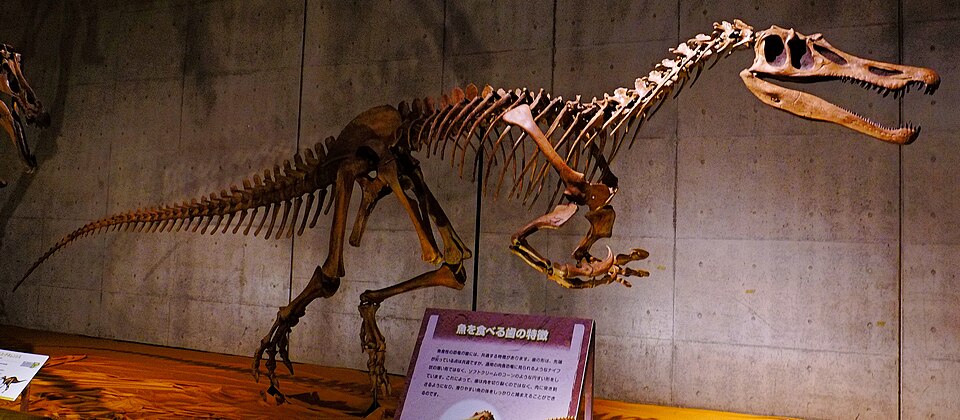
Fossil or skeletal specimen
Baryonyx fossil and skeletal exhibition material. Displays may include replicated or supplemented parts; this is not a photograph of a living individual.
Source: ★Kumiko★ · Original material: Baryonyx_walkeri_mount_NMNS.jpg · CC BY-SA 2.0
Modification notice from the source: This image has been extracted from another file: Baryonyx in Japan.jpg
★Kumiko★ · Baryonyx in Japan.jpg · ★Kumiko★ — Baryonyx walkeri
1. Classification, discovery and geological context
Baryonyx was a spinosaurid theropod. Fossils discovered in Britain provide important evidence for its diet and anatomy.
The British skeleton and related material from Spain and elsewhere in Europe are important for spinosaurid research. Its name means heavy claw, connecting with the actual large hand claw. Early Cretaceous European coastlines differed from today's map, so the present geographical name should not be equated with the ancient climate. Food traces found inside the specimen are especially valuable information.
2. Appearance and identification
A long, low snout, conical teeth and a large hand claw are characteristic.
The snout is elongated, the jaws bear many teeth and a large forelimb claw stands out. Comparing its snout with a crocodile's helps explain function, but does not make Baryonyx a crocodile. Examine the bipedal theropod skeleton alongside the fingers. Distinguish claw bone from the keratinous covering it would have had in life; final claw lengths in reconstructions involve interpretation.
3. Evidence for ecological interpretations
Food traces including fish scales are known, and other foods are also interpreted as part of the diet. It should not be described as eating only fish.
Fish scales and fragments of another dinosaur's bones from the specimen provide direct evidence for studying diet. Avoid simplifying it into an exclusive fish specialist or declaring that the large claw always hooked fish like a fishing hook. Knowing food types and knowing the posture used to catch them are different questions. Adaptations to waterside life are also not complete proof of underwater pursuit ability.
4. Limits of the fossil record and reconstructions
Research investigates feeding associated with waterside environments, without establishing that the animal lived permanently underwater. Distinguish it from sauropods and herbivorous dinosaurs.
When viewing a museum skeleton, connect the snout and hands with material explaining where food remains were found inside the body. Fossils and reconstruction images on this page are research material for an extinct animal. Even a picture set underwater does not mean the whole scene was preserved in a fossil. Do not casually import the tall sail of the related Spinosaurus as an established trait of this genus.
Evidence and references
- Natural History Museum — Baryonyx
Classification, origin, appearance and ecology
- UC Museum of Paleontology — Theropod dinosaurs
Theropod skeletal comparisons and evolutionary relationships with birds