
Dinosaurs
Deinonychus
Deinonychus
Classification and scientific name: Deinonychus antirrhopus
Sources checked:
Understanding a theropod through a large hind claw and balancing tail
Deinonychus was a dromaeosaurid that played an important role in research on dinosaur–bird relationships.
Origins and distribution
Early Cretaceous North America
- Deinonychus antirrhopus
- Extinct animal studied through fossils
- Distinguishing reconstruction from evidence
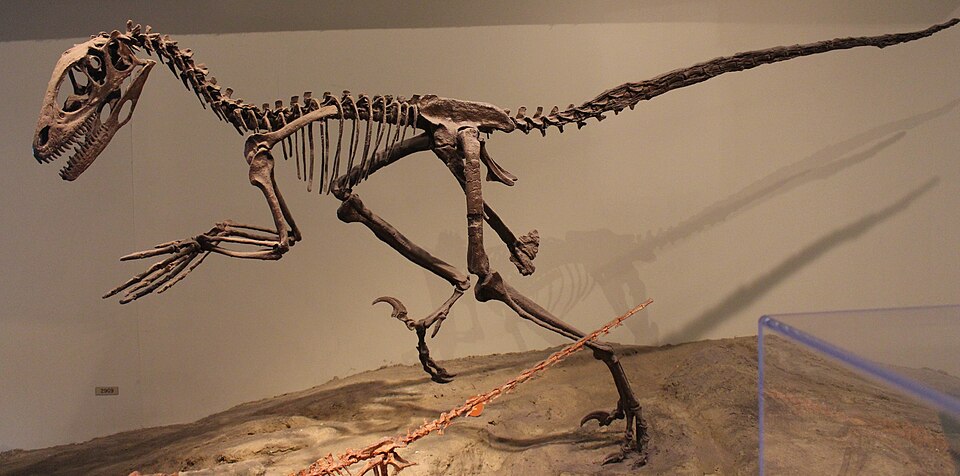
Fossil or skeletal specimen
Deinonychus fossil and skeletal exhibition material. Displays may include replicated or supplemented parts; this is not a photograph of a living individual.
Source: Jonathan Chen · Original material: Deinonychus_FMNH.jpg · CC BY-SA 4.0
1. Classification, discovery and geological context
Deinonychus was a dromaeosaurid theropod. It played an important role in research on the relationship between dinosaurs and birds.
This dromaeosaurid lived in Early Cretaceous North America. Its study helped change the older view of dinosaurs as exclusively slow and sluggish. Although related to Velociraptor, it is a separate genus with a different body size and locality. Do not confuse the fact that film Velociraptors partly drew on its appearance with actual classification.
2. Appearance and identification
A strongly curved hind-foot claw, long tail and grasping forelimbs are characteristic.
The large claw on the second hind toe could be held raised separately from the other toes. A long tail with stiffened portions connects with the balancing meaning within its name. Considering the fingers, arms, feet and their joints together helps explain the body's movement range. Feathered reconstructions use evidence from relatives; colours of every body part are not directly preserved.
3. Evidence for ecological interpretations
Deinonychus is interpreted as carnivorous. Specific claw uses and group hunting are subjects of several hypotheses, rather than established behaviour as depicted in films.
Teeth and bones found around large herbivorous dinosaurs offer clues to feeding relationships. Several individuals at one site do not immediately prove cooperation like modern wolves. The use of hind claws for stabbing, gripping or other actions also belongs to functional hypotheses. Movements allowed by bones, the actual sequence of actions and roles within a group require different levels of evidence.
4. Limits of the fossil record and reconstructions
Compare body structure with related lineages. Deinonychus was not an armoured dinosaur; distinguish observed evidence from inference in skeletal and feathered reconstructions.
Comparing its skeleton with related birds helps make arm, leg and tail features clear. This does not justify applying every behaviour of one living bird species to the dinosaur. Read captions to establish what an exhibited specimen, replica or whole-body reconstruction actually shows. This page's visual material explains fossil evidence rather than providing photographic records of living individuals.
Evidence and references
- Natural History Museum — Deinonychus
Classification, origin, appearance and ecology
- UC Museum of Paleontology — Theropod dinosaurs
Theropod skeletal comparisons and evolutionary relationships with birds