
Dinosaurs
Giganotosaurus
Giganotosaurus
Classification and scientific name: Giganotosaurus carolinii
Sources checked:
Understanding a predator through specimens and estimation methods before giant-size claims
Giganotosaurus was discovered in Argentina and differs in time and lineage from other similarly sized dinosaurs.
Origins and distribution
Cretaceous South America
- Giganotosaurus carolinii
- Extinct animal studied through fossils
- Distinguishing reconstruction from evidence
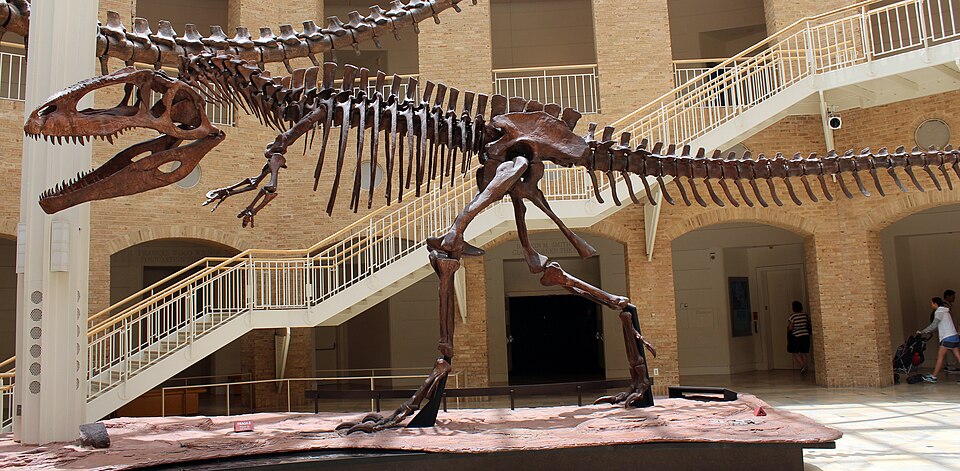
Fossil or skeletal specimen
Giganotosaurus fossil and skeletal exhibition material. Displays may include replicated or supplemented parts; this is not a photograph of a living individual.
Source: Jonathan Chen · Original material: Giganotosaurus_at_Fernbank.jpg · CC BY-SA 4.0
Modification notice from the source: Crop.
1. Classification, discovery and geological context
Giganotosaurus was a large theropod discovered in Argentina. It differs in time and lineage from other similarly sized dinosaurs.
It is a carcharodontosaurid known from Cretaceous fossils in Argentine Patagonia. It belonged to a different lineage from Tyrannosaurus; the two should not be described as competing in the same place and time. Check scientific names and localities to avoid mixing figures for Giganotosaurus with other giant dinosaurs bearing similar names. A complete specimen preserving the whole body is not known.
2. Appearance and identification
A large skull, serrated teeth and a bipedal body are characteristic.
Compare the long, large skull, teeth suited to cutting flesh, small forelimbs and sturdy hind limbs. Equal skull length does not necessarily imply equal body mass. Whole-body length and mass depend on which relatives' proportions supplement missing skeletal parts. Distinguishing a reconstructed silhouette from a diagram marking actually discovered bones helps reveal the range of estimation.
3. Evidence for ecological interpretations
Giganotosaurus is interpreted as a large predator, but particular prey and hunting methods are inferred from limited evidence. Its name should not serve as a strongest-dinosaur ranking.
Feeding relationships of large theropods are investigated through jaws, teeth and evidence for surrounding herbivorous dinosaurs. Sharing a continent with giant sauropods does not establish that it hunted them every time. Discussions of group hunting must also separate grouped fossils of related genera from direct evidence for this species. Rankings by body build are not rankings of combat outcomes or intelligence.
4. Limits of the fossil record and reconstructions
Size estimates come from an incomplete skeleton, so figures can differ among sources. Do not provide a maximum mass without a particular specimen and estimation method.
Patagonian strata invite consideration of differences between the fossil environment and today's landscape. The size of an assembled museum skeleton includes supplementation and replication. Check whether image captions state the genus and specimen type rather than reading the image as a photograph of a living animal. Classification and size interpretations can change as specimens and analytical methods are added.
Evidence and references
- Natural History Museum — Giganotosaurus
Classification, origin, appearance and ecology
- UC Museum of Paleontology — Theropod dinosaurs
Theropod skeletal comparisons and evolutionary relationships with birds