
Dinosaurs
Therizinosaurus
Therizinosaurus
Classification and scientific name: Therizinosaurus cheloniformis
Sources checked:
Long claws alone do not establish a carnivorous dinosaur
Therizinosaurus was a theropod in a lineage interpreted as having plant-feeding adaptations; theropod and carnivorous dinosaur are not exact synonyms.
Origins and distribution
Late Cretaceous Asia
- Therizinosaurus cheloniformis
- Extinct animal studied through fossils
- Distinguishing reconstruction from evidence
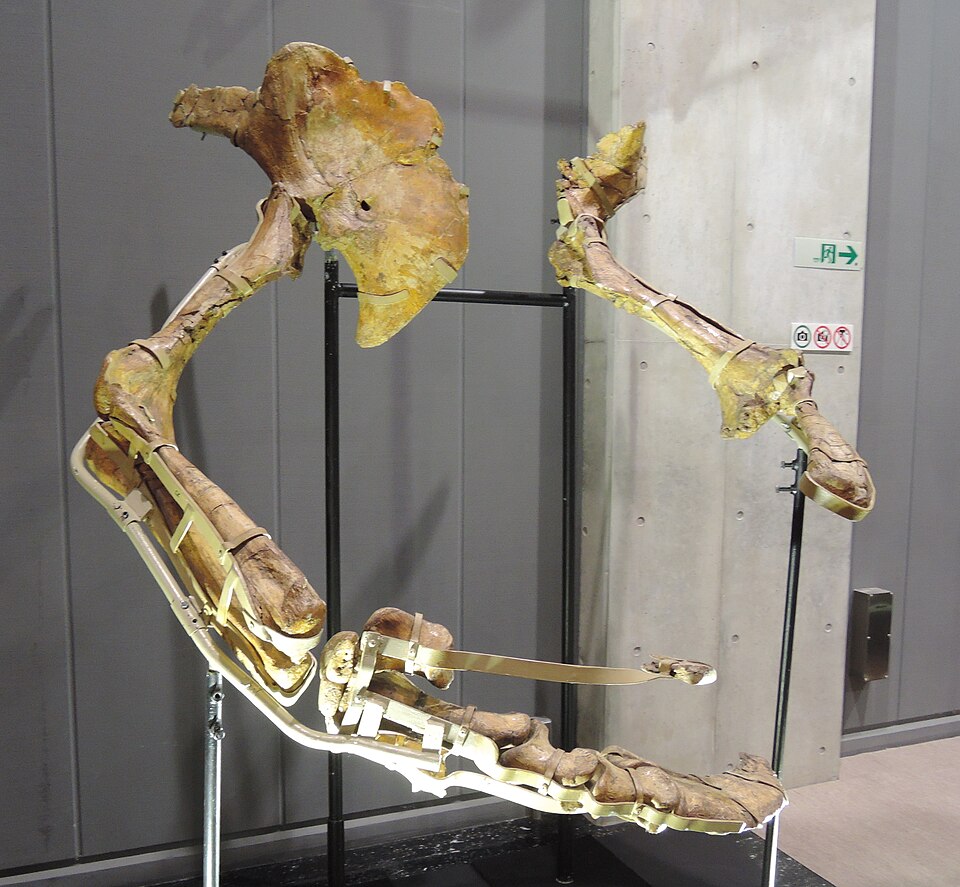
Fossil or skeletal specimen
Therizinosaurus fossil and skeletal exhibition material. Displays may include replicated or supplemented parts; this is not a photograph of a living individual.
Source: Yuya Tamai from Gifu, Japan · Original material: Therizinosaurus_arms.jpg · CC BY 2.0
Modification notice from the source: upload cropped version, operated by User:FunkMonk. Summary: cropped
1. Classification, discovery and geological context
Therizinosaurus was a theropod in a lineage whose form is interpreted in connection with herbivory. Theropod should not be used as an exact synonym of carnivorous dinosaur.
This therizinosaur is known from Late Cretaceous Mongolian fossils. Although its giant claws attract attention first, the old turtle-like idea within its name relates to initially limited evidence. New skeletal discoveries and knowledge of related lineages changed its classification and reconstruction. It illustrates why lineage and actual bones should be examined together rather than dividing dinosaurs solely by impressions of carnivory and herbivory.
2. Appearance and identification
Extremely elongated forelimb claws are characteristic. Much of the body is reconstructed using incomplete fossils and related lineages.
The bones of long foreclaws provide characteristic direct evidence. However, not every part from head to tail is known in one complete specimen. Long necks, large torsos and feathers in whole-body illustrations draw on evidence from related therizinosaurs to fill gaps. Be careful not to read claw-bone length as the same value as length including the external keratinous covering.
3. Evidence for ecological interpretations
Interpretations of herbivory use comparisons of lineage and body structure. The long claws cannot be assigned conclusively to a single behaviour.
Comparing jaws, teeth and torso form in relatives helps explain plant-feeding interpretations. Large claws alone do not prove tearing apart large prey. Researchers investigate functions such as pulling branches, defence and display without establishing one definitive scene. This also illustrates the great diversity of food use across theropods.
4. Limits of the fossil record and reconstructions
Observe directly discovered portions separately from reconstructed ones. Do not describe large claws only as hunting weapons or claim that everything is established from a complete skeleton.
Even if a museum displays only large claws, those parts are important fossil evidence themselves. Compare reconstructions of the missing body with diagrams marking directly discovered bones. Read the text with the same distinction in evidence levels. Images of this extinct animal show fossils, skeletons or scientific reconstructions, never photographs of a living Therizinosaurus in a zoo.
Evidence and references
- Natural History Museum — Therizinosaurus
Classification, origin, appearance and ecology
- UC Museum of Paleontology — Theropod dinosaurs
Theropod skeletal comparisons and evolutionary relationships with birds