
Amphibians
African bullfrog
African Bullfrog
Classification and scientific name: Pyxicephalus adspersus
Sources checked:
Large males and dry-season adaptations distinguish its life from North American bullfrogs
The African bullfrog is a large anuran amphibian of a different species from the North American bullfrog.
Origins and distribution
Southern Africa
- Pyxicephalus adspersus
- Southern Africa
- Observing species-specific ecology
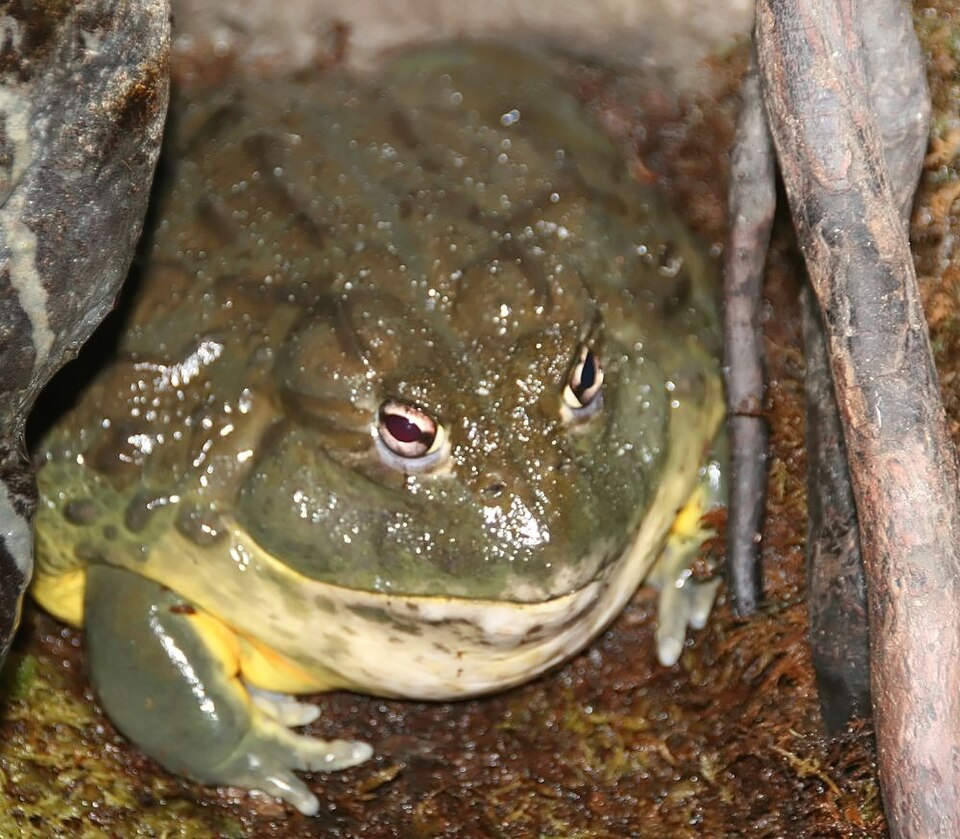
Reference photograph
Reference photograph of an African bullfrog. Compare its colours and form with the identification details in the text.
Source: Photo by David J. Stang · Original material: Pyxicephalus_adspersus_2zz.jpg · CC BY-SA 4.0
1. Classification, origins and habitat
The African bullfrog is a large anuran amphibian. It is a different species from the North American bullfrog.
Sharing the English bullfrog name does not put it in the same lineage as Lithobates catesbeianus. Seasonal rain and grasslands in southern Africa connect with its life. Related Pyxicephalus species can also differ in form and range, so not every photograph of a large African frog depicts this species.
2. Appearance and identification
A rounded body, large mouth and short strong limbs are characteristic. Males tend to be larger than females.
Observe the broad head, large mouth, dorsal skin ridges and strong hind limbs together. Large males are especially conspicuous, making it easy to describe females and young as equally large. Surfaces after prolonged reduced activity may also differ from breeding appearances. An inflated body should not establish ordinary proportions.
3. Behavior and way of life
African bullfrogs eat small animals, and male care of young is known. Do not generalise feeding into an aggressive temperament in every situation.
Males may protect breeding sites and areas around tadpoles. Such behaviour and predation on small animals are different contexts of one life rather than contradictions. Dry-season adaptations involving hiding in soil, reducing water loss and lowering activity are important research subjects. Do not exaggerate these into an ability to survive anywhere without water.
4. Observation, conservation and care
African bullfrogs use seasonally wet grasslands and ground. Burying and reducing activity in dry periods does not mean that water is unnecessary.
Connect shallow rainy-season water with dry-season sheltering soil to understand the life cycle. The duration of temporary water also affects egg and larval development. Avoid provoking an open mouth or making fingers resemble food. This text explains a wild species adapted to seasonal conditions rather than merging it with generic small-tank frog management.
Evidence and references
- Animal Diversity Web — University of Michigan — Pyxicephalus adspersus
Classification, origin, appearance and ecology
- American Museum of Natural History — Pyxicephalus adspersus
Current scientific names, synonyms, natural distribution and taxonomic research