
Amphibians
Bullfrog
Bullfrog
Classification and scientific name: Lithobates catesbeianus
Sources checked:
Large eardrums and a deep call: distinguish native and introduced ranges
This page covers the eastern North American Lithobates catesbeianus, also called Rana catesbeiana in older sources, rather than the African bullfrog.
Origins and distribution
Native to eastern North America; introduced to many countries
- Lithobates catesbeianus
- Eastern North American native; widely introduced
- Observing species-specific ecology
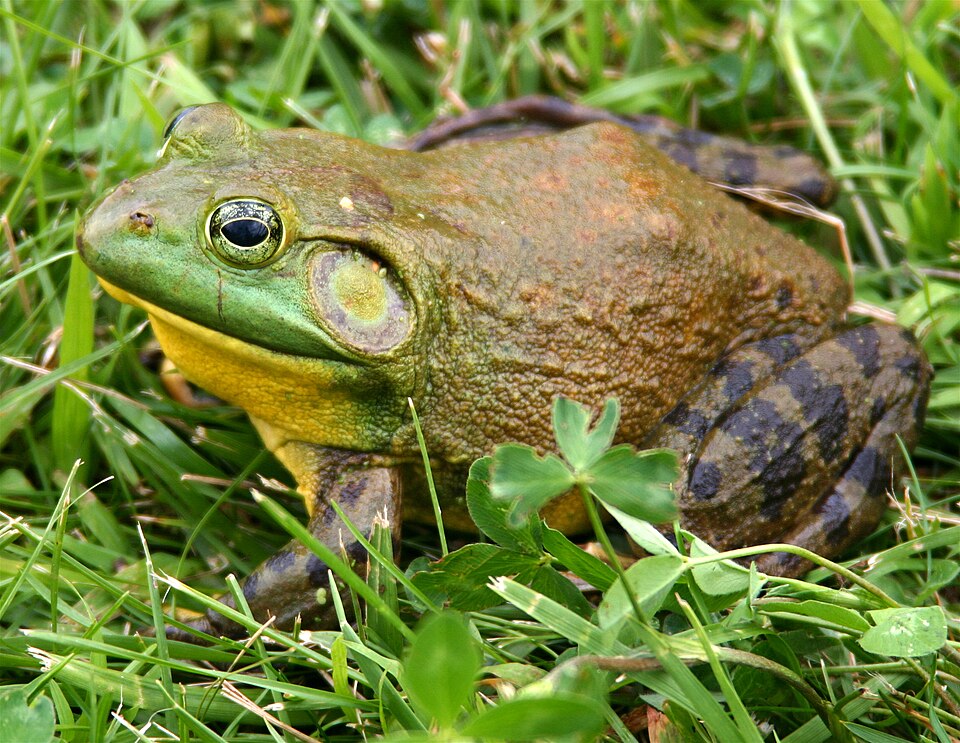
Reference photograph
Reference photograph of a bullfrog. Compare its colours and form with the identification details in the text.
Source: Carl D. Howe · Original material: North-American-bullfrog1.jpg · CC BY-SA 2.5
1. Classification, origins and habitat
The bullfrog is a large frog native to eastern North America; this page describes Lithobates catesbeianus. It connects with Rana catesbeiana in older sources and is a separate species from the African bullfrog. Farming and transport introduced it to many regions, including watersides in Korea. It is important not to equate frequently observed locations today with original distribution.
2. Appearance and identification
A large body, conspicuous round eardrum behind each eye, powerful hind legs and webbing are characteristic. Green-to-brown body colours, throat colour and eardrum proportions vary with sex and growth. One photograph's size and colour should not become averages for every individual. Compare eyes, eardrums and dorsal skin structures together with similarly sized frogs; tadpoles differ from adults in form.
3. Behavior and way of life
Bullfrogs are waterside predators of various small animals, with diet differing by growth stage and region. The male's deep, loud breeding call connects with the bull name without implying actual cattle behaviour or emotion. Consider calls as mate-attraction signals and interactions at breeding sites. Eggs and tadpoles develop in water, and larval duration varies with environment. One breeding site's records should not impose the same calendar everywhere.
4. Observation, conservation and care
Permanent ponds, wetlands and waterside vegetation matter for life and breeding. Outside the native range, prey and competition relationships with native organisms can differ, so do not simply celebrate survival ability. Do not move animals arbitrarily into other waterways during observation or management. Record exact scientific names and regional information without attaching African species photographs or another large frog's maximum size.
Evidence and references
- University of Michigan, Animal Diversity Web — Lithobates catesbeianus
The species' distribution, appearance, food, breeding and life history
- American Museum of Natural History — Lithobates catesbeianus
Current scientific names, synonyms, natural distribution and taxonomic research