
Amphibians
Budgett's frog
Budgett Frog
Classification and scientific name: Lepidobatrachus laevis
Sources checked:
A broad, flattened frog uses seasonal pools
Budgett's frog is associated with the Chaco's seasonal waters and stands out for its large mouth and wide body.
Origins and distribution
South America's Chaco region
- Lepidobatrachus laevis
- South America's Chaco region
- Observing species-specific ecology
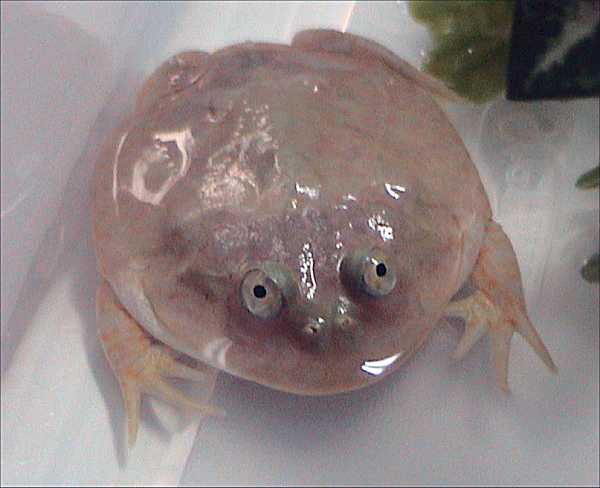
Reference photograph
Reference photograph of Budgett's frog. Compare its colours and form with the identification details in the text.
Source: Dawson · Original material: Lepidobatrachus_laevis.jpg · CC BY-SA 2.5
1. Classification, origins and habitat
Budgett's frog is associated with seasonal waters in the Chaco. Its large mouth and broad body stand out.
It is associated with the Chaco of Paraguay, Argentina and Bolivia. Although in a broader group related to horned frogs, it belongs to a different genus; a trade name does not replace exact species identification. Strong wet and dry seasons are as important to natural history as body appearance.
2. Appearance and identification
A broad flattened body, large head and high-set eyes are characteristic.
The large mouth, high eyes and spreading torso connect with waterside ambush. Inflated defence and relaxed submersion can show different apparent proportions. A rounded wide shape does not make it the same species as a Pacman frog. Angles change the apparent positions of eyes and mouth, making side and overhead views useful together.
3. Behavior and way of life
Budgett's frogs are predators of small underwater animals. Activity and breeding change between dry and rainy conditions.
Adults use small aquatic animals and can respond to approaching prey. Adaptations to burying in the ground and reducing activity during dry periods are known. This does not mean water is unnecessary. Open-mouth defensive scenes or call videos may involve unfamiliar stimuli rather than an always angry temperament.
4. Observation, conservation and care
Seasonal pools and bottom soil matter. Rounded appearance alone does not establish the same species as another horned frog.
Consider rainy-season water duration, bottom soil and dry-season shelter as one life cycle. An underwater photograph does not mean every moment is spent submerged. Do not catch animals to make them inflate or use fingers to trigger feeding. Base descriptions on specimens and observations without mixing other horned frogs' management conditions and lifespan figures.
Evidence and references
- Springer & Schalk (2016), Catalogue of American Amphibians and Reptiles — Lepidobatrachus laevis
Classification, origin, appearance and ecology
- American Museum of Natural History — Lepidobatrachus laevis
Current scientific names, synonyms, natural distribution and taxonomic research