
Amphibians
Goliath frog
Goliath Frog
Classification and scientific name: Conraua goliath
Sources checked:
Flowing rivers and larval food conditions matter as much as a large body
The Goliath frog is associated with rivers in Cameroon and Equatorial Guinea, rather than a salamander lineage.
Origins and distribution
Western Central Africa
- Conraua goliath
- Western Central Africa
- Observing species-specific ecology
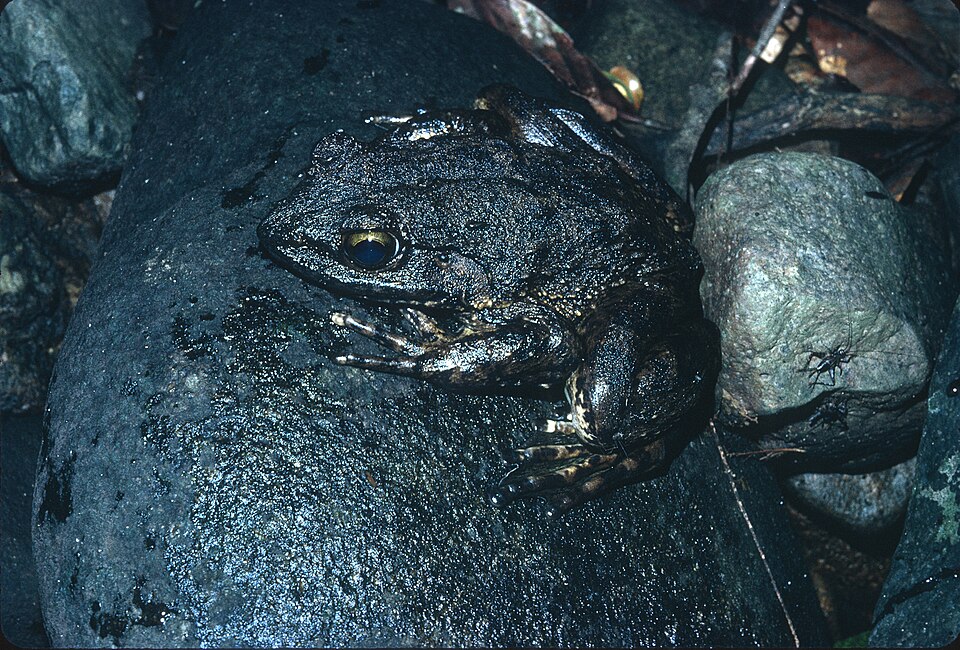
Reference photograph
Reference photograph of a Goliath frog. Compare its colours and form with the identification details in the text.
Source: jeanlouisamiet · Original material: Conraua_goliath_photo_from_iNaturalist_539752953.jpg · CC BY 4.0
1. Classification, origins and habitat
The Goliath frog is a large frog associated with rivers in Cameroon and Equatorial Guinea. It does not belong to a salamander lineage.
It is associated with flowing waters in those two countries. A giant name can encourage substitution of any large frog photograph, but it differs in lineage from the African bullfrog. A native distribution across all Africa is inaccurate. Consider habitat and capture-related conservation issues alongside size records.
2. Appearance and identification
A large body, powerful hind limbs and feet helping movement in water are characteristic.
Observe the large robust body, strong hind legs and water-suited feet. Young individuals are much smaller than adults, so a maximum record cannot establish whether they belong to the same species. Measured body length differs from length with legs extended. Size comparisons in photographs also need reference objects and camera angles.
3. Behavior and way of life
Adults eat various small animals. Tadpoles differ in food and way of life, so one diet should not describe both.
Adults use a range of small animals, while aquatic tadpole feeding and life differ. Breeding-site structure and water flow matter for eggs and larvae. A large body does not establish slow behaviour or fearlessness around people. Natural use of rocks and water is more informative than tourist photographs of a large frog being lifted.
4. Observation, conservation and care
Flowing rivers and surrounding conditions matter. Very large specimen records should not become averages, and habitat conservation belongs in the explanation.
Rivers, waterside vegetation and conditions for eggs and larvae form one connected habitat. Do not turn a large body into advice linking it with a small household aquarium. Follow local conservation guidance without arbitrarily altering rocks or watersides. Confirm that the representative photograph depicts Conraua goliath rather than combining other large frogs' markings and size information.
Evidence and references
- Animal Diversity Web — University of Michigan — Conraua goliath
Classification, origin, appearance and ecology
- American Museum of Natural History — Conraua goliath
Current scientific names, synonyms, natural distribution and taxonomic research