
Amphibians
Oriental fire-bellied toad
Oriental Fire-bellied Toad
Classification and scientific name: Bombina orientalis
Sources checked:
A green or brown back and red belly: do not force defensive postures
Bombina orientalis is a frog known for belly colour and defence, rather than a salamander.
Origins and distribution
Northeast Asia
- Bombina orientalis
- Northeast Asia
- Observing species-specific ecology
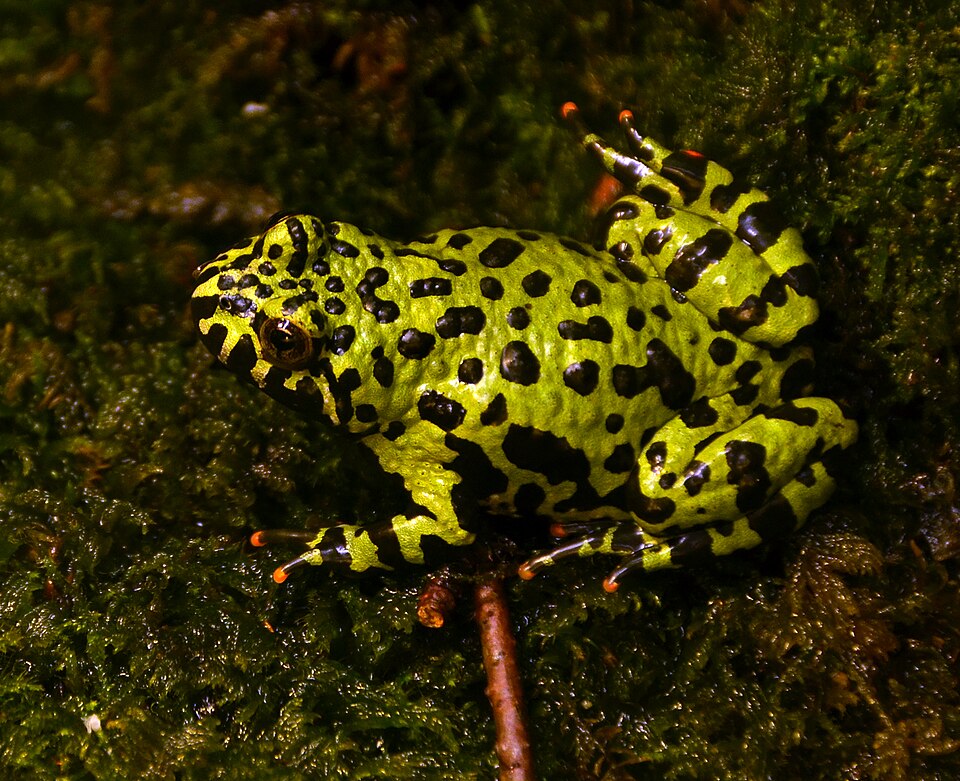
Reference photograph
Reference photograph of an Oriental fire-bellied toad. Compare its colours and form with the identification details in the text.
Source: Vassil · Original material: Bombina_orientalis_Genève_24102014.jpg · CC0
1. Classification, origins and habitat
The Oriental fire-bellied toad is the frog Bombina orientalis. It is known for belly colours and defensive posture, and is not a salamander.
This Bombina is associated with watersides in the Korean Peninsula, northeastern China and the Russian Far East. It differs in classification from red-bellied newts and in species from related European fire-bellied toads. Check scientific names when connecting familiar Korean names with the broader foreign term fire-bellied toad.
2. Appearance and identification
The back is green or brown, contrasting with bright red and black belly patterns.
Consider small dorsal bumps, green-to-brown markings and red or orange against black underneath together. Green-backed animals are not the only members of the species; regions and individuals vary. Its frog anatomy differs from salamanders retaining long adult tails. Turning an animal over to inspect the underside creates a scene different from natural defensive behaviour.
3. Behavior and way of life
These toads eat small arthropods and may adopt a posture displaying belly colours when threatened.
They use small arthropods around shallow water and its margins. Raising the body and limbs to expose the bright belly is understood as defensive signalling. It does not occur at every encounter, and skin secretions do not justify contact. Eggs, tadpoles and post-metamorphic animals can differ in habitat and food use.
4. Observation, conservation and care
Oriental fire-bellied toads use shallow water and adjacent ground. Skin secretions are a reason to avoid repeated hand contact or provoking defence for observation.
Waterside vegetation, shallow water and nearby cover matter for life and breeding. Do not touch to inspect colours or deliberately induce defence. Record how the back and belly appeared and whether the setting was wild or captive. Avoiding confusion with a long-tailed fire-bellied newt photograph is fundamental to matching text and image.
Evidence and references
- Animal Diversity Web — University of Michigan — Bombina orientalis
Classification, origin, appearance and ecology
- American Museum of Natural History — Bombina orientalis
Current scientific names, synonyms, natural distribution and taxonomic research