
Amphibians
Red-eyed tree frog
Red-eyed Tree Frog
Classification and scientific name: Agalychnis callidryas
Sources checked:
Bright areas are concealed by day; leaves and branches are used at night
This tropical American arboreal frog is well known for contrasting eye and body colours.
Origins and distribution
Central America
- Agalychnis callidryas
- Central America
- Observing species-specific ecology
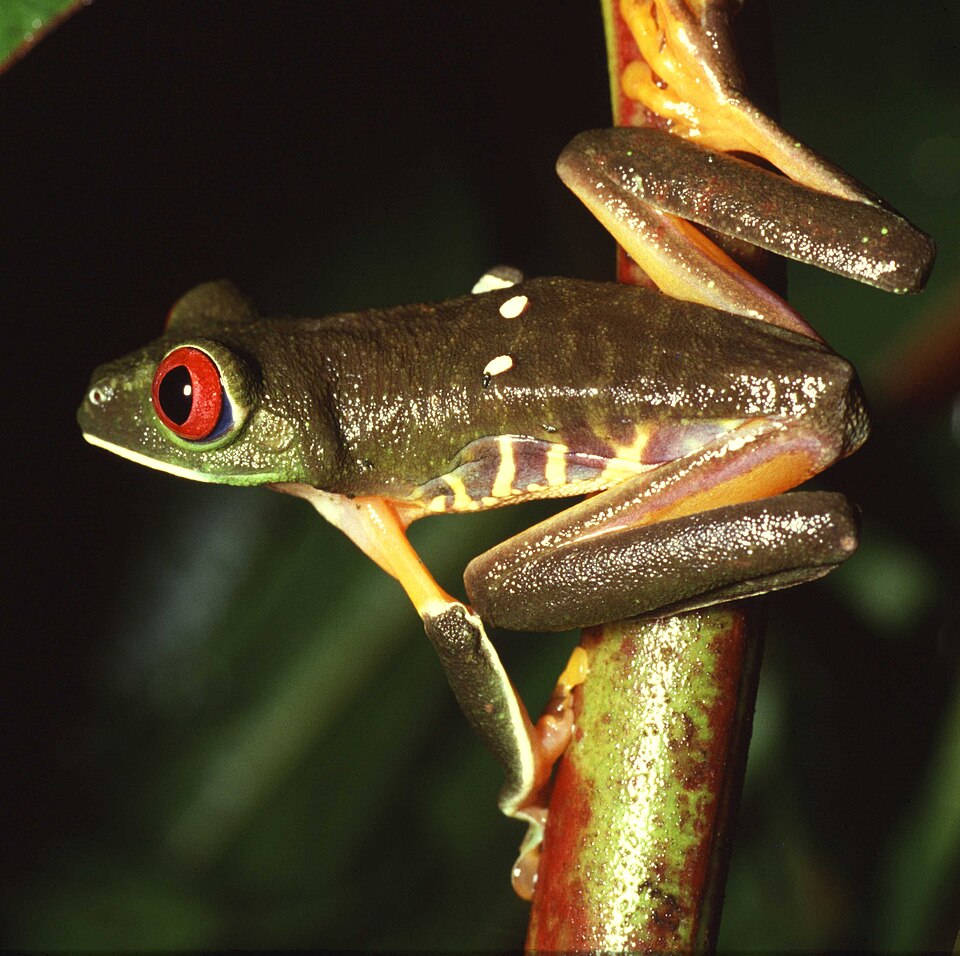
Reference photograph
Reference photograph of a red-eyed tree frog. Compare its colours and form with the identification details in the text.
Source: Christian R. Linder · Original material: Agalychnis callidryas.jpg · CC BY-SA 3.0
1. Classification, origins and habitat
The red-eyed tree frog is an arboreal frog of tropical America. It is well known for contrasting eye and body colours.
This leaf frog is associated with humid Central American forests and breeding waters. Other frogs also have red eyes, so eye colour alone cannot establish the species. Broad older distribution accounts and taxonomic research on related populations also deserve attention. Sharing a green body with Korean tree frogs does not make it the same species or an animal of identical conditions.
2. Appearance and identification
Red eyes, a green body and vivid flank and limb colours are characteristic. Bright areas can be concealed during rest.
Observe red eyes, the green back, contrasting flanks and orange-toned hands and feet together. Folding legs and closing eyes to hide bright areas during rest can make it look very different from representative photographs. Connect open-eyed scenes with daytime rest. Bright body colours should not be generalised as proof of toxicity equivalent to poison frogs.
3. Behavior and way of life
Red-eyed tree frogs are mainly active at night and eat small arthropods. Larvae hatch from eggs on leaves above water and descend into it.
They mainly seek small prey at night, moving among leaves and branches. Eggs on leaves above water connect a terrestrial egg stage with aquatic larval growth. Responses of eggs to vibration and environmental stimuli are also studied. Do not fix every egg to one hatching day or every individual to the same sleeping posture.
4. Observation, conservation and care
Tropical leaves and breeding water need connections. Distinguish adult tree life from the aquatic environment of tadpoles.
Breeding leaves, water beneath them and humid forest shelters matter together. Do not repeatedly disturb sleeping animals to obtain open-eyed photographs. Vivid photographic colours also reflect light and processing, while the text should follow actual species traits. Aquatic tadpole and arboreal adult photographs may show different life stages rather than different species.
Evidence and references
- Animal Diversity Web — University of Michigan — Agalychnis callidryas
Classification, origin, appearance and ecology
- American Museum of Natural History — Agalychnis callidryas
Current scientific names, synonyms, natural distribution and taxonomic research