
Amphibians
Surinam toad
Surinam Toad
Classification and scientific name: Pipa pipa
Sources checked:
Eggs develop within back skin in an aquatic frog's distinctive reproduction
The Surinam toad is adapted to underwater life, distinct from ordinary Bufo toads despite the common name.
Origins and distribution
South America
- Pipa pipa
- South America
- Observing species-specific ecology
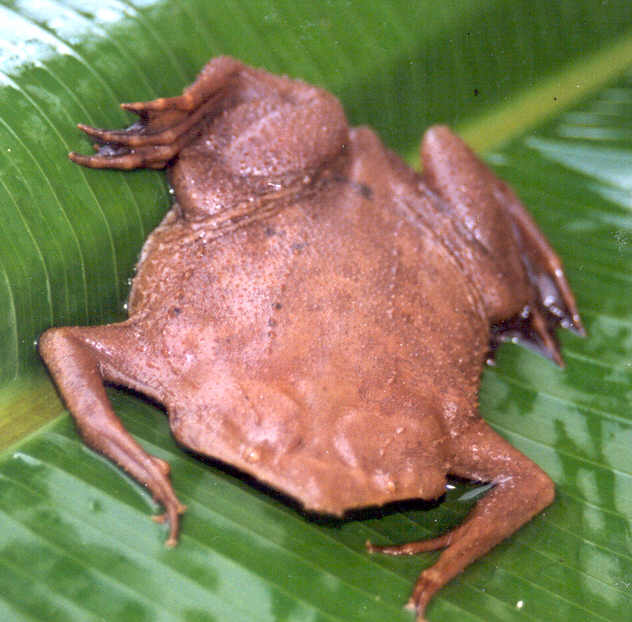
Reference photograph
Reference photograph of a Surinam toad. Compare its colours and form with the identification details in the text.
Source: Hugo Claessen · Original material: Pipa_pipa01.jpg · CC BY-SA 2.5
1. Classification, origins and habitat
The Surinam toad is a frog adapted to underwater life. Despite toad in its name, it does not belong to the same lineage as ordinary Bufo toads.
It is a Pipa frog of South American waters, rather than the same lineage as typical terrestrial toads. Pipa includes species differing in breeding and larval stages, so this page is restricted to Pipa pipa. Even famous videos of small young emerging from a back require checks of exact species and development.
2. Appearance and identification
An extremely flattened body, broad head and small eyes are characteristic. Forefeet and hind feet differ in structure.
The flat body, small eyes and broad head suit bottom leaves and concealment. Slender fingers and heavily webbed hind feet differ in function and form. A female carrying developing eggs on her back can look very different from other individuals. An egg-bearing back should not be interpreted as infection or a disease producing holes.
3. Behavior and way of life
Surinam toads are known for eggs developing within the female's back skin and small froglets emerging.
During aquatic reproduction, eggs settle onto the female's back and develop in spaces within the skin. Young subsequently emerge as small frogs. Expecting free-swimming tadpoles separately at every stage, as in a typical frog life cycle, is misleading. Explain the distinctive reproduction through developmental differences rather than sensational scenes.
4. Observation, conservation and care
Surinam toads use slow water and bottom cover. Young emerging from the back should not be described as disease or parasitic infection.
Slow water, leaf litter and bottom concealment connect with the flattened form. Aquatic adaptations do not classify the animal as a gilled fish. Touching a breeding female's back or removing eggs is not observation. Check image stage and scientific name rather than attaching another Pipa species' tadpole photograph as the next stage without explanation.
Evidence and references
- Animal Diversity Web — University of Michigan — Pipa pipa
Classification, origin, appearance and ecology
- Animal Diversity Web — Pipa pipa classification
Amphibian classification of the scientific name and related groups