
Amphibians
Wallace's flying frog
Wallace Flying Frog
Classification and scientific name: Rhacophorus nigropalmatus
Sources checked:
A tree frog uses broad webbing to control descent
Wallace's flying frog uses trees; it does not fly like a winged bird.
Origins and distribution
Southeast Asia
- Rhacophorus nigropalmatus
- Southeast Asia
- Observing species-specific ecology
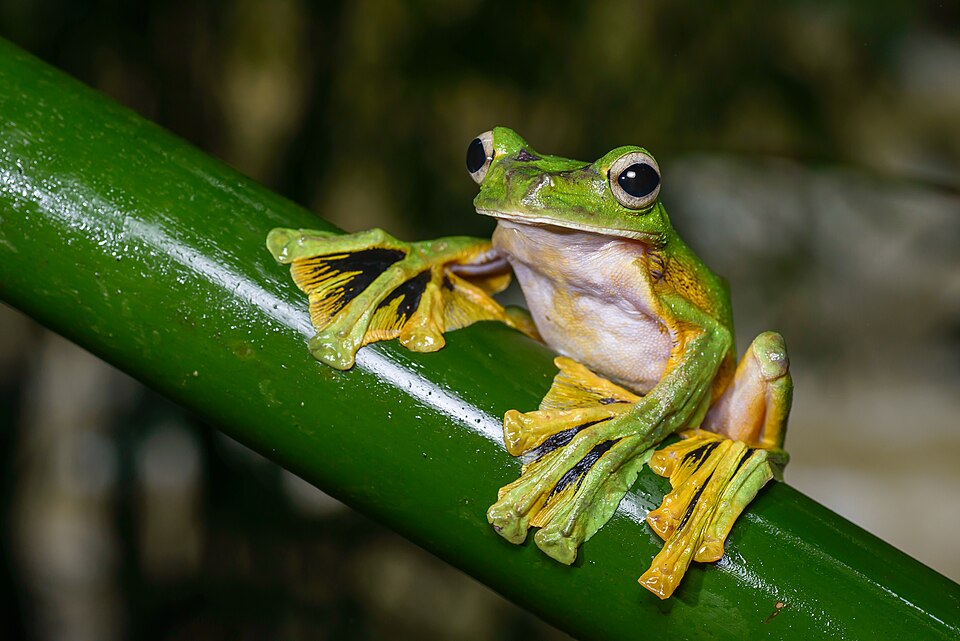
Reference photograph
Reference photograph of Wallace's flying frog. Compare its colours and form with the identification details in the text.
Source: Rushenb · Original material: Rhacophorus_nigropalmatus.jpg · CC BY-SA 4.0
1. Classification, origins and habitat
Wallace's flying frog is a tree-using frog. It does not fly like a bird with wings.
It is a flying frog known from tropical Southeast Asian forests and associated with Wallace's name. Flying frog is also applied to other species, so check the exact scientific name and location. Despite both gliding, its membrane structure and classification differ entirely from a reptilian flying dragon's.
2. Appearance and identification
Broad webbing and limb skin structures help gliding and control of descent. A green body and dark areas between the toes are characteristic.
Examine broad membranes between toes, skin along limb edges and finger and toe tips. Widely spread digits and folded rest on branches can look very different in the same species. A green back and dark interdigital areas are useful observations, but compare ventral colours and membrane size with similar flying frogs.
3. Behavior and way of life
Wallace's flying frogs live in trees, eat small animals and use foam nests in breeding. Gliding differs from flight continuously gaining altitude.
Spread feet and body posture control descent and direction during arboreal movement. This is not flapping-wing flight continually increasing height. Foam nests connect with larval stages descending into water. Do not make every movement airborne from one gliding scene; consider walking and gripping branches too.
4. Observation, conservation and care
Tropical trees and breeding watersides matter. A flying name does not classify it with salamanders or pterosaurs.
Large trees, canopy connections and breeding waters are important together. Do not drop animals from height to obtain gliding photographs. Fingers, membranes and leg posture in resting photographs can sufficiently explain structure. Match images and text to Rhacophorus nigropalmatus rather than adding more colourful feet or patterns from other species as shared traits.
Evidence and references
- Animal Diversity Web — University of Michigan — Rhacophorus nigropalmatus
Classification, origin, appearance and ecology
- American Museum of Natural History — Rhacophorus nigropalmatus
Current scientific names, synonyms, natural distribution and taxonomic research