
Amphibians
Crested newt
Crested Newt
Classification and scientific name: Triturus cristatus
Sources checked:
A tall crest belongs to breeding males: consider the great crested newt's seasons
Crested newt covers several relatives; this entry describes Triturus cristatus.
Origins and distribution
Europe
- Triturus cristatus
- Europe
- Observing species-specific ecology
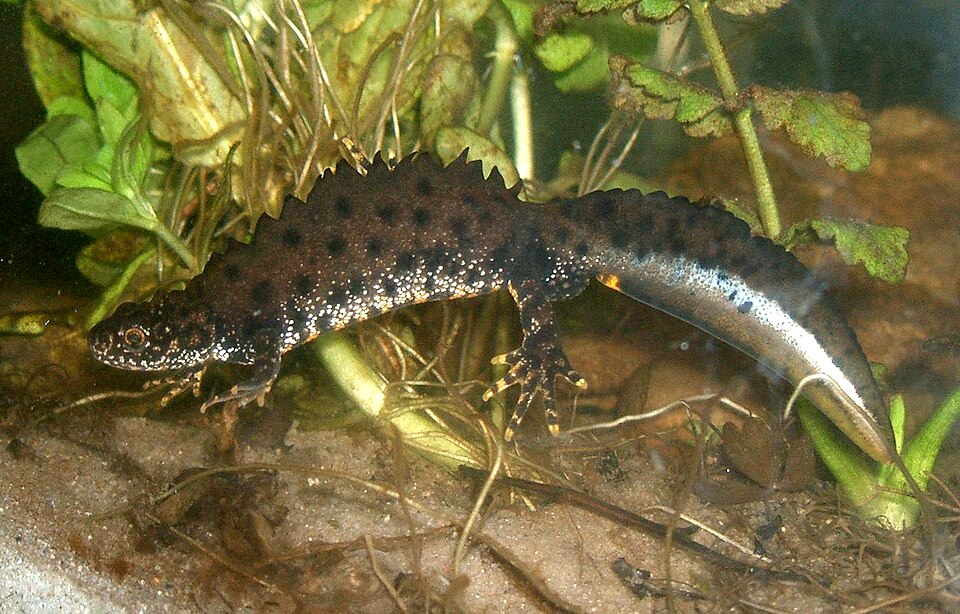
Reference photograph
Reference photograph of a crested newt. Compare its colours and form with the identification details in the text.
Source: Rainer Theuer. · Original material: Kammmolchmaennchen.jpg · Public domain
1. Classification, origins and habitat
Crested newt is used for several close species. This page describes the great crested newt, Triturus cristatus.
It uses Europe's great crested newt as representative, distinguishing related Triturus species sharing the common name. Older broad distribution accounts can include populations now separated into other species. A high crest alone should not determine scientific identity; check provenance, locality and classification together.
2. Appearance and identification
Breeding males develop a high crest on the back and tail, with bright belly colours and dark markings.
The prominent breeding male crest is not the same in females or outside breeding. Consider dark dorsal colours, bright ventral patterns and tail outline together. Individual markings vary, so a black spot cannot establish age. Resemblance between a side-view crest and a dinosaur sail does not make lineage or structure the same.
3. Behavior and way of life
Great crested newts breed underwater and eat small invertebrates. A male's seasonal crest should not become the appearance of females or every season.
Aquatic courtship and attachment of eggs to plant leaves are important in breeding. Consider terrestrial sheltering periods alongside aquatic activity. Conditions for eggs and larvae can differ from those for adult survival. One male's high crest observed in water should not represent permanent species-wide appearance.
4. Observation, conservation and care
Ponds and surrounding terrestrial cover matter. Consider stages together, including water pollution and habitat fragmentation.
Conserving ponds, nearby cover and seasonal routes together connects life stages. Clear water alone does not meet every need of eggs, larvae and adults. Do not remove plant-attached eggs or move animals between ponds. Captions identifying exact species and season help distinguish similar newt photographs.
Evidence and references
- Froglife — Triturus cristatus
Classification, origin, appearance and ecology
- American Museum of Natural History — Triturus cristatus
Current scientific names, synonyms, natural distribution and taxonomic research