
Amphibians
Marbled salamander
Marbled Salamander
Classification and scientific name: Ambystoma opacum
Sources checked:
Autumn breeding and eggs laid in low ground before flooding
Ambystoma opacum is named for contrasting marble-like body markings.
Origins and distribution
Eastern United States
- Ambystoma opacum
- Eastern United States
- Observing species-specific ecology
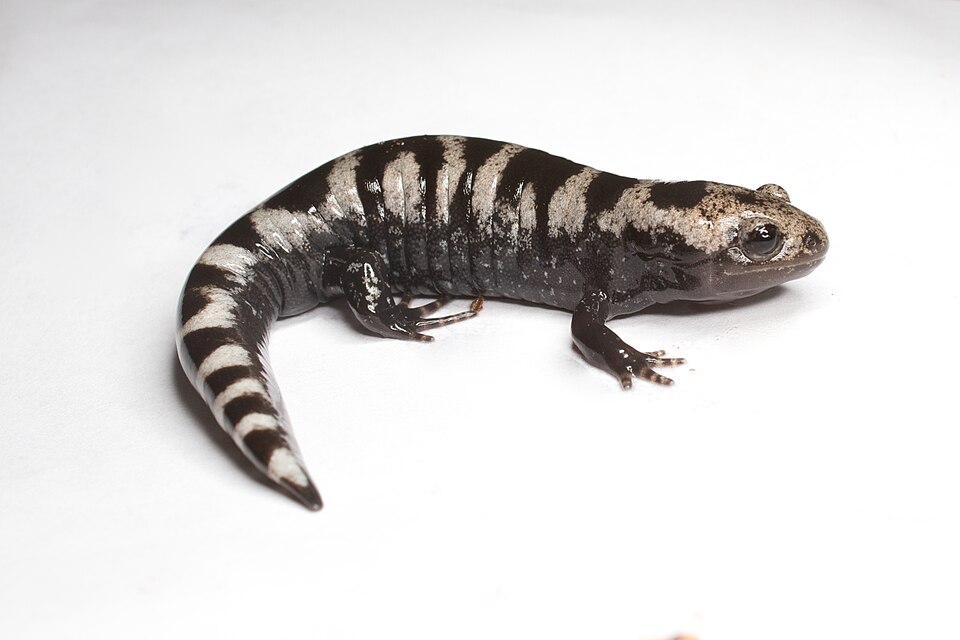
Reference photograph
Reference photograph of a marbled salamander. Compare its colours and form with the identification details in the text.
Source: Brian Gratwicke from DC, USA · Original material: Marbled_salamander_(14367751333).jpg · CC BY 2.0
Marbled salamander · brian.gratwicke / 14367751333 · Brian Gratwicke
1. Classification, origins and habitat
The marbled salamander is Ambystoma opacum. Its name refers to contrasting marble-like body markings.
It is an eastern United States mole salamander, sharing a genus but not a species with the tiger salamander. Light and dark patterns do not mean a captive breed with many colour lines. Breeding times and egg-laying conditions differ among species in the genus, requiring individual life histories.
2. Appearance and identification
Pale bands and spots appear on a dark body. The colour of light areas can differ by sex.
Observe pale bands and spots, short sturdy legs and tail together. Light areas may appear silver or grey according to sex. Young and adult patterns also differ, so one typical photograph should not establish every other animal as another species. The skin differs structurally from a scaled lizard's.
3. Behavior and way of life
Marbled salamanders eat small animals and use ground leaf litter and cover. Laying eggs in low ground before water arrives is a known breeding strategy.
Adults shelter in leaf litter and catch small prey. Breeding connects eggs on low ground before flooding with larval development after water arrives. Distinguish females' behaviour around eggs from permanent underwater life. Comparing egg-laying timing with other seasonal-water salamanders reveals differences.
4. Observation, conservation and care
Terrestrial adult habitat and seasonal breeding water both matter. Observe water changes alongside egg and larval development.
The timing of flooding in low ground and nearby forest shelters matter. A currently dry place is not necessarily useless for breeding. Observe life histories through records without uncovering egg-bearing leaf litter or moving eggs elsewhere. Identify aquatic larvae and terrestrial adults accurately rather than attaching another Ambystoma's eggs without explanation.
Evidence and references
- Animal Diversity Web — University of Michigan — Ambystoma opacum
Classification, origin, appearance and ecology
- American Museum of Natural History — Ambystoma opacum
Current scientific names, synonyms, natural distribution and taxonomic research