
Amphibians
Siren salamander
Siren Salamander
Classification and scientific name: Siren lacertina
Sources checked:
An aquatic salamander has external gills and small forelimbs but no hind limbs
This page describes the greater siren, Siren lacertina.
Origins and distribution
Southeastern United States
- Siren lacertina
- Southeastern United States
- Observing species-specific ecology
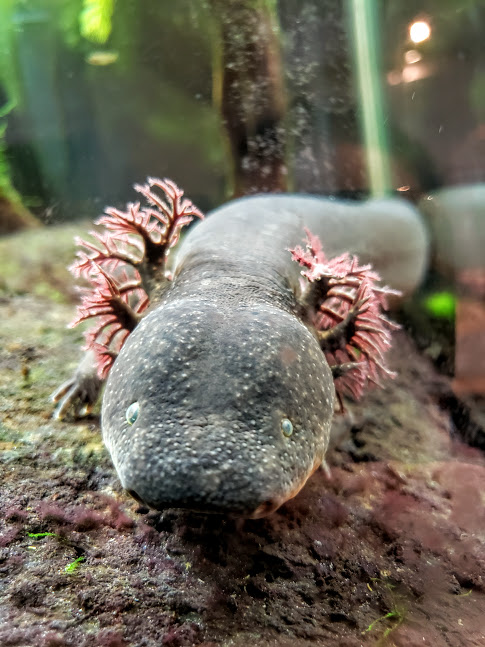
Reference photograph
Reference photograph of a siren salamander. Compare its colours and form with the identification details in the text.
Source: Qualiesin · Original material: Siren_lacertina_face.jpg · CC BY-SA 4.0
1. Classification, origins and habitat
Sirens are aquatic salamanders. This page describes the greater siren, Siren lacertina.
Siren is an evocative name associated with a mythological being; this entry covers the southeastern United States greater siren. Related Siren species can differ in build and range. An eel-like body or few limbs does not classify it as a caecilian or fish; use amphibian lineage as the basis.
2. Appearance and identification
A long body, tail and external gills accompany small forelimbs and an absence of hind limbs.
Observe external gills beside the head, very small forelimbs and the long body and tail together. Missing hind limbs distinguish it from amphiumas retaining four tiny limbs. Forelimbs hidden by the body can make a photograph look wholly limbless. An externally gilled adult should not always be labelled a young larva.
3. Behavior and way of life
Sirens use various aquatic foods and shelter among bottom cover and plants. Responses to seasonal drying have been studied.
They move among the bottom and vegetation and use several underwater foods. Sheltering and reduced activity during dry conditions are studied as responses to changing waters. This does not mean surviving without water for any period under any conditions. Retained larval traits differ from immaturity preventing reproduction.
4. Observation, conservation and care
Wetlands and slow water matter. Fewer limbs do not make a siren a caecilian or snake.
Wetlands, slow water, vegetation and bottom cover form a connected environment. One underwater scene cannot explain lifetime respiration and activity. Do not keep animals out of water for long periods or touch external gills for photographs. Check forelimbs, hind-limb absence and scientific names together to avoid mixing similar aquatic salamanders.
Evidence and references
- Animal Diversity Web — University of Michigan — Siren lacertina
Classification, origin, appearance and ecology
- American Museum of Natural History — Siren lacertina
Current scientific names, synonyms, natural distribution and taxonomic research