
Amphibians
Tiger salamander
Tiger Salamander
Classification and scientific name: Ambystoma tigrinum
Sources checked:
Underground adults and aquatic larvae differ with region and life history
Tiger salamanders belong to Ambystoma; compare formerly broad populations with current distinctions among close species.
Origins and distribution
North America
- Ambystoma tigrinum
- North America
- Observing species-specific ecology
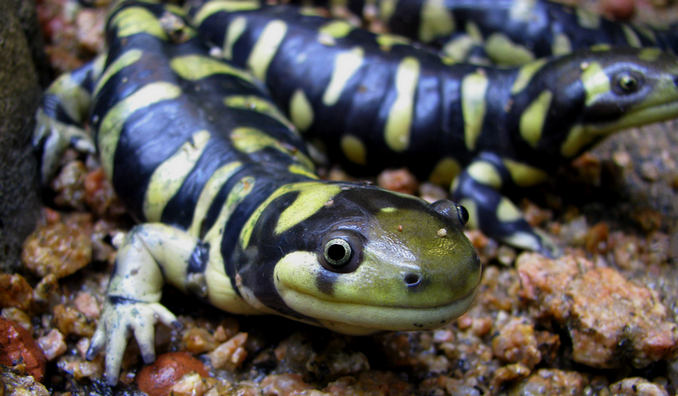
Reference photograph
Reference photograph of a tiger salamander. Compare its colours and form with the identification details in the text.
Source: Carla Isabel Ribeiro · Original material: Salamandra_Tigre.png · CC BY-SA 3.0
1. Classification, origins and habitat
Tiger salamanders belong to Ambystoma. Consider formerly broad populations alongside current distinctions between related species.
The name has historically covered several North American populations. This page focuses on eastern Ambystoma tigrinum, distinct from accounts of A. mavortium and other relatives. Even photographs sold under one captive name need checks of present taxonomy and locality to avoid misrepresenting original environments.
2. Appearance and identification
Yellow or pale markings on a dark body, sturdy limbs and a long tail are representative.
Yellow and dark spots or bands connect with the name. Patterns differ among populations and individuals rather than every animal sharing identical tiger stripes. Aquatic larvae differ from adults in external gills and tail form. Even an axolotl-like photograph requires checking species and life stage rather than treating every externally gilled animal as the same.
3. Behavior and way of life
Terrestrial burrow-dwelling adults differ from aquatic larvae. Some populations may retain larval traits after maturity.
Adults use ground and burrows and eat small animals. Aquatic larvae develop after adults move to breeding water, with developmental patterns affected by local conditions. Retention of larval traits in some populations should not become the species' only life cycle. Being underground during the day does not establish a quiet, people-loving temperament.
4. Observation, conservation and care
Breeding water must connect with terrestrial soil and shelters. One region's life cycle should not be imposed on all tiger salamander populations.
Breeding waters, surrounding soil, grassland and forest cover need connections. Aquatic larval photographs do not establish lifelong suitability of the same tank for adults. Broken waterways and movement routes can affect links between stages. Prioritise images with exact species and locality instead of grouping all historically named tiger salamanders by colour alone.
Evidence and references
- Animal Diversity Web — University of Michigan — Ambystoma tigrinum
Classification, origin, appearance and ecology
- American Museum of Natural History — Ambystoma tigrinum
Current scientific names, synonyms, natural distribution and taxonomic research