
Other Mammals
Orca
Orca (Killer Whale)
Classification and scientific name: Orcinus orca
Sources checked:
Orcas have family relationships, learning and population-specific diets
Also known as killer whales, they are marine mammals in the dolphin family.
Origins and distribution
Oceans worldwide; distribution and diet vary by population
- Dolphin family
- Marine mammal
- Family groups
- Population-specific diets
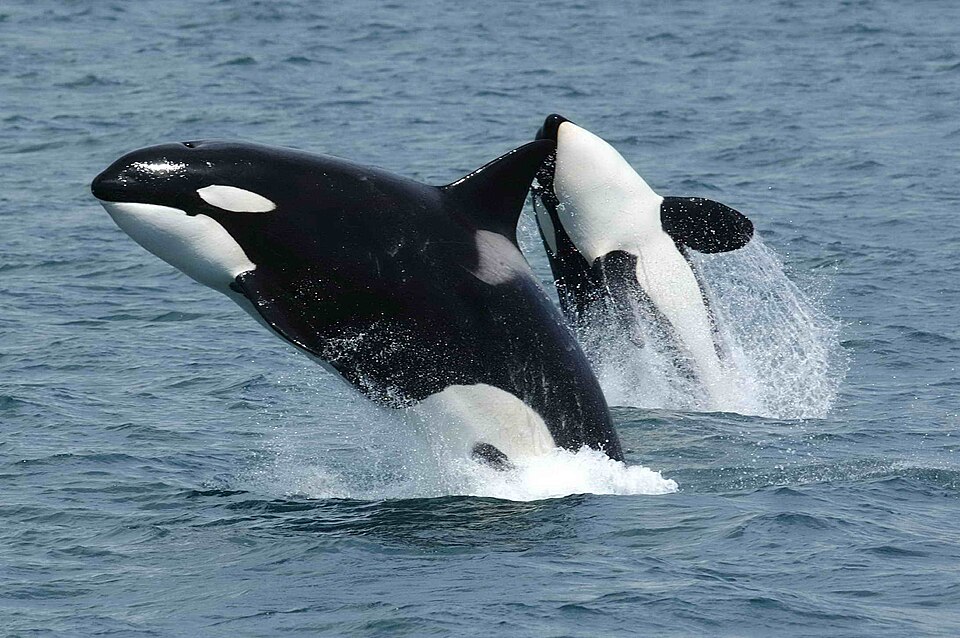
Reference photograph
Reference photograph of orcas. Compare the individuals' color and form with the identification notes in the text.
Source: Robert Pittman · Original material · Public domain
1. Classification, origins and habitat
Orcas, also known as killer whales, are marine mammals in the dolphin family. They occur in many of the world's seas, but their populations do not all live in the same way. Populations feeding mainly on fish and those using marine mammals and other prey can also differ in movement, sounds and social relationships. Research on classification and ecotypes continues, so records from a regional population must not become universal values for the world. Even a photograph showing only a dorsal fin at the surface captures just one moment of an extensive underwater life. Threats and population counts for a particular North Pacific group should not be applied directly to orcas in other waters.
2. Appearance and identification
A contrasting black-and-white body, pale patches behind the eyes and a large dorsal fin are characteristic. The dorsal fin of an adult male is generally large and upright, but its shape differs with sex and developmental stage. Dorsal fins and markings behind them are used in individual-identification research, with the photographic angle also taken into account. Orcas swim by moving their tail flukes up and down and breathe at the surface. They should not be described as having a fish's side-to-side tail movement or gill breathing. One population's coloration and head proportions are not fixed features of every orca, and a dorsal fin alone does not reveal an individual's emotions or overall health.
3. Behavior and way of life
They exchange information through sound and use echolocation to investigate their surroundings and prey. What they catch and how they catch it are closely connected with learning and traditions within populations; not every group eats every animal known to be orca prey. Some populations maintain long-lasting family relationships, while others have different social structures. Young grow through relationships with their mother and other individuals, learning movement and feeding behavior. Do not generalize a striking scene of cooperative hunting into a skill the entire species constantly performs. Leaping above the surface can also have different interpretations according to context.
4. Observation, conservation and care
Conservation requires identifying each population's particular threats, including prey loss, pollutants, vessel noise and contact. Knowing that a population depends on fish helps explain why declining food resources matter. Wildlife-watching vessels should follow applicable distance and speed rules without blocking travel routes. The importance of sound underwater deserves explanation even though it is invisible in photographs. Do not present behavior in captivity in the same context as movements of wild families, or assign a regional ecotype name when the actual population is unknown. Give the region and date of information when citing current classifications or assessments.
Evidence and references
- Animal Diversity Web — Orcinus orca
Classification, distribution, appearance, diet and reproductive behavior
- NOAA Fisheries — Killer whale
Orca populations' diets, social relationships, distribution and threats