
Other Mammals
Platypus
Platypus
Classification and scientific name: Ornithorhynchus anatinus
Sources checked:
An egg-laying mammal that senses underwater prey with its bill
The platypus belongs to the monotremes, mammals that lay eggs.
Origins and distribution
Eastern Australia and Tasmania
- Monotreme
- Electroreception
- Semiaquatic
- Egg-laying mammal
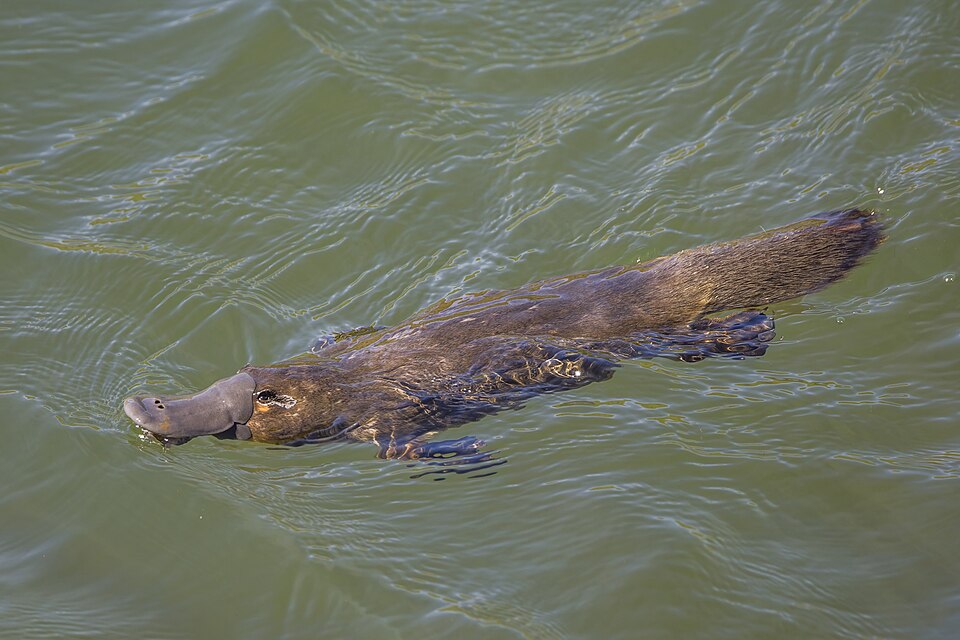
Reference photograph
Reference photograph of a platypus. Compare the individual's color and form with the identification notes in the text.
Source: Charles J. Sharp · Original material · CC BY-SA 4.0
1. Classification, origins and habitat
The platypus belongs to the monotremes, mammals that lay eggs. Its duck-like bill and otter-like body do not make it a mixture of a bird and a mammal. It uses rivers and lakes in eastern Australia and Tasmania, linking water where it forages with banks where it digs burrows. Flowing water alone is not enough: invertebrate prey, shelter and the structure of the riverbank also matter. Changes to waterways and development since European settlement can affect these living conditions. Even when a photograph shows only its face above water, explain that it also rests and breeds in burrows on land.
2. Appearance and identification
Its broad, flattened bill, dense fur, extensively webbed forefeet and flat tail are characteristic. The bill is not the same as a bird's hard beak; it is a sensory structure used to find food. Underwater, the platypus closes its eyes, ears and nostrils and uses the senses in its bill. The tail stores fat associated with energy reserves, but its role should not be described as identical to that of a beaver's broad tail in dam-building. Adult males have venom-associated spurs on the hindlegs, so touching an animal to check for them is inappropriate. Wet and dry fur can look different in color, and a bill that looks hard like a duck's in a photograph still has a different structure.
3. Behavior and way of life
It searches the underwater bottom for small animals, including insect larvae and crustaceans. Its bill detects electrical signals and movement, helping it forage in dark water. Individuals can also be seen processing food at the surface after collecting it. They generally forage alone and use bank burrows for rest. Females lay eggs and later feed their young with milk, but the method differs from that of most mammals, which have nipples. These reproductive traits do not mean that the platypus is not a mammal. Watching both swimming and movement onto the riverbank helps explain the two settings of its semiaquatic life.
4. Observation, conservation and care
Conservation involves water quality, food resources, riverbank vegetation and safe movement together. Fishing gear, waste and changes in water level can pose risks that vary by location. Observe a wild platypus from a distance without catching it or digging into its burrow. Entering the water for a closer photograph can disrupt feeding and escape. Descriptions of its unusual venomous spurs should not encourage physical contact. Identify the species and behavior accurately in photographs, and do not apply the captive requirements of reptiles or ducks simply because it lays eggs. Protecting water and terrestrial riverbanks together is central.
Evidence and references
- Animal Diversity Web — Ornithorhynchus anatinus
Classification, distribution, appearance, diet and reproductive behavior
- Australian Museum — Platypus
Monotreme reproduction, bill senses, venomous spurs and habitat