
Other Mammals
Ring-tailed lemur
Ring-tailed Lemur
Classification and scientific name: Lemur catta
Sources checked:
A primate whose striped tail and scent signals connect its group
The ring-tailed lemur is a primate from Madagascar. It forages in trees and on the ground, using its tail, sounds and scents together in a complex social life.
Origins and distribution
Southern and southwestern Madagascar
- Madagascar
- Ringed tail
- Female dominance
- Scent communication
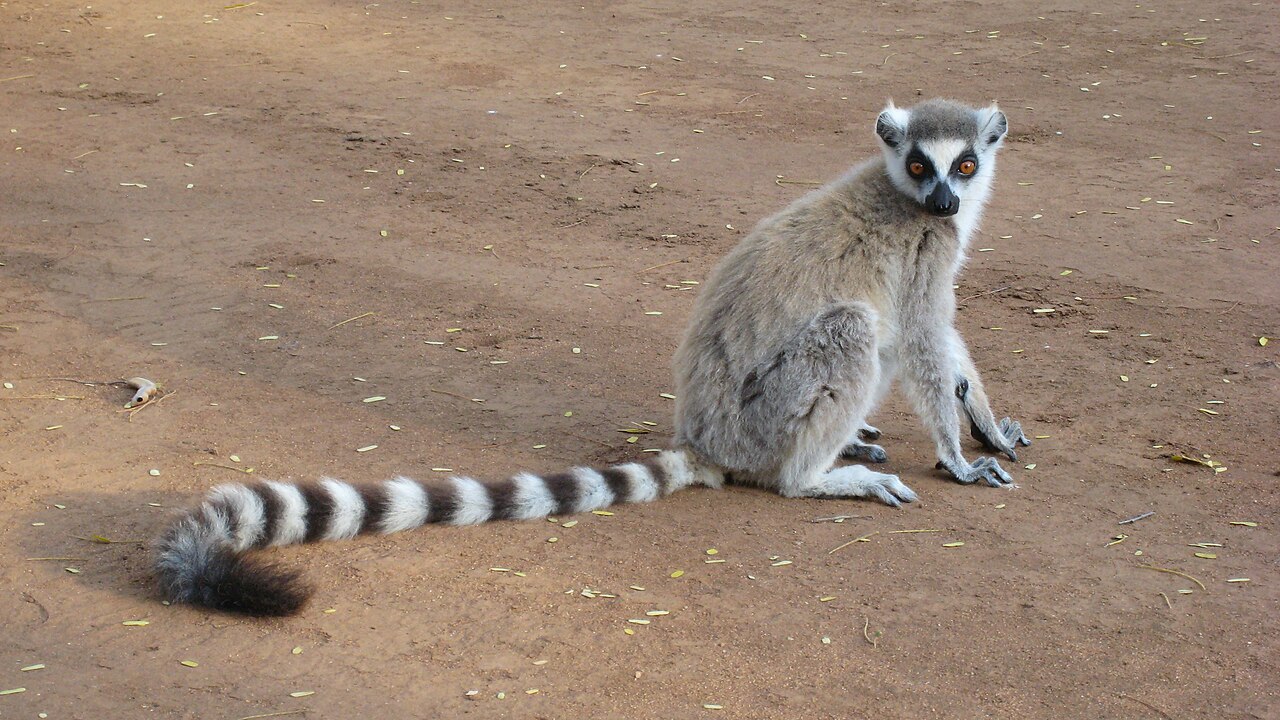
Reference photograph
A ring-tailed lemur photographed at Berenty Reserve, Madagascar. The dark markings around its eyes and its extended ringed tail are clearly visible.
Source: Alex Dunkel (Maky) · Original material · CC BY 3.0
1. Classification, origins and habitat
The ring-tailed lemur is a primate native to southern and southwestern Madagascar. Although its Korean name includes the word for fox and it has an elongated muzzle, it belongs to a different lineage from foxes in the dog family. Its scientific name is Lemur catta, identifying one species among the many animals called lemurs. Lemurs as a whole differ greatly in body size, food and activity times, so this species' ringed tail and group life must not become traits of every lemur. The first step in understanding it is to place a familiar face accurately among Madagascar's diverse primates.
Its habitat cannot be reduced to a single kind of lush rainforest. It uses dry forest, spiny scrub, deciduous forest and forest corridors along rivers. Even within the south, differences in water and plant distribution affect foraging routes. Movement conditions in places with leafy trees clustered along a river differ from those in dry areas with broken canopies. Considering these environments together helps explain why it climbs well yet often walks on the ground. Imagining forest only as a ceiling of continuously joined branches makes the importance of terrestrial movement easy to miss.
The ring-tailed lemur has been the subject of extensive long-term observation. At sites including Berenty and Beza Mahafaly, researchers have studied food, behavior, relationships between sexes and reproduction over many years. Such accumulated work provides more detail on questions of social power or how young develop than a single visit can. Extensive research does not, however, mean that the animal lives safely in the wild. Familiarity in zoos or videos differs from the degree to which its native habitat remains intact. Distribution accounts should also distinguish a former range from the present connectivity of remaining forests.
2. Appearance and identification
Its most conspicuous feature is a long tail with alternating black and white rings. The trunk is gray to brownish, the underside and face are pale, and dark markings surround the eyes. The black nose and pointed muzzle provide further identification clues. Photographs showing face, body and tail together are better evidence than a cropped image of the rings alone. Other lemurs can also have black and white fur, so look at where markings occur rather than one color combination. A species with large black-and-white areas on its trunk and this species with repeated tail rings require different identification criteria.
The tail can appear longer than the body, but it is not a tool that coils around a branch to support its weight. It is especially conspicuous when carried upright during travel, providing a visual signal by which moving companions can see one another. Hands and feet grip trees, and it walks or runs on all fours on the ground. Avoid confusing this with the famous sideways hindleg hopping of sifakas. Both are lemurs, but their limb proportions and commonly used movements differ. Observing posture while walking, as well as finding a striped tail in a video, helps connect appearance with ecology.
Fine, forward-pointing teeth form a comb-like structure in the lower jaw, used in grooming. When individuals bring their faces close to each other's bodies, distinguish feeding bites from grooming. Fur on the underside is relatively sparse, and a seated posture with arms and legs spread toward the sun is connected with gaining warmth there. Rather than assigning human intentions because the pose resembles a resting person, consider the direction of sunlight and time of day. Apparent size and coat appearance vary with posture, age and light; combining facial markings, tail rings and quadrupedal walking provides a more reliable identification.
3. Behavior and way of life
Groups contain multiple females and males, with social relationships characterized by female dominance. Females tend to remain in their birth group, while males move between groups. Dominance affects priority of access to food and interactions among individuals. This does not mean that every female rank forms one simple fixed line, or that a daughter directly inherits her mother's position. Instead of calling an individual at the front in one scene the leader, follow behaviors such as who retreats near food and who grooms whom. A group is a living set of changing relationships, not just a number of animals.
Scent plays a large part in communication. Males rub scent from wrist glands onto their tails and wave them toward opponents. This is often called stink fighting, but not every tail movement is a contest. A tail raised along a travel route, one waved toward another animal and one involved during grooming have different contexts. Scent marks on branches leave information after an individual departs. Movements that look like similar walking and stopping to human eyes can include sniffing and marking, so watch where the nose and wrists point in videos.
Reproduction is distinctly seasonal. In the Malagasy wild, mating generally begins around April, with births in August and September. Single births are common, although twins also occur when food conditions are favorable. Two young together therefore need not have different mothers. While a mother nurses and protects her young, care by other females has also been observed. Recording birth timing alongside growth helps explain the developmental stages of young in the same group. Zoo videos can involve different locations and management conditions, so do not apply the month of filming directly to Madagascar's wild calendar.
Calls and facial expressions also sustain relationships. Calls locating separated group members differ in function from alarm calls, and a display of teeth can have different meanings in different situations. Mutual grooming is connected with social bonding as well as hygiene. Young initially cling to their mother's belly, later riding on her back and progressively moving independently. A growing youngster may briefly leave to play but return to its mother for feeding or rest. Independence is thus a gradual expansion of movement and feeding experience rather than a single completed event. Interactions before and after an appealing action can tell an observer more than the action alone.
4. Observation, conservation and care
Ring-tailed lemurs use varied plant foods, including fruit, leaves and flowers, and sometimes eat invertebrates and other foods. Trees such as tamarind are important food resources at several study sites. Describing it as eating only one particular fruit hides its seasonal selection of resources. Leaves and fruit that remain in dry periods and places where water is available affect group movements. A varied natural diet does not mean that people can give any food. Zoo feeding management is a separate professional process, not simply a list of the names of wild foods.
Damage to dry and riverine forests removes both food trees and resting places. Clearing for crops and pasture or using wood for charcoal can fragment forest, altering the space available to one group and connections among groups. Research and conservation must consider the area of remaining trees, distances between forest patches and local people's lives together. A call to protect forests alone does not fully explain people's need for fuel and livelihoods. This is why habitat work with local communities, long-term research and responsible ecotourism are discussed together. A familiar animal's photograph can support conservation understanding when it also brings to mind the forest outside the frame.
Illegal trade and demand for pets are further concerns. Videos of animals on people's shoulders or hands-on encounters can look friendly without showing the social relationships and extensive environment they require. The Duke Lemur Center opposes keeping wild primates as pets and restricts direct visitor contact. On wildlife trips, choose programs maintaining a viewing distance rather than feeding or touching animals. When sharing photographs, give the correct species and location and avoid captions that encourage ownership. The ring-tailed lemur's appeal lies in the complex way it lives with companions using scent, sound and its tail, rather than how readily it clings to people.
Evidence and references
- Smithsonian National Zoo — Ring-tailed lemur
Facial and tail features, visual and vocal signals, social structure and habitat loss
- Duke Lemur Center — Ring-tailed Lemur
Diet, ground movement, reproduction and young development, wildlife contact and the pet trade
- Animal Diversity Web — Lemur catta
Varied habitats in southern Madagascar, body form, food selection and interactions
- Wisconsin National Primate Research Center — Ring-tailed lemur
Wild distribution, long-term field research, gait, toothcomb and variation among individuals and environments
- San Diego Zoo Wildlife Alliance — Lemur
Lemur classification and diversity, nonprehensile tails and comparison with sifaka locomotion
- Duke Lemur Center — Position Statement on Pet Lemurs
The research institution's position on trade in wild primates as pets and associated welfare issues