
Other Mammals
Sloth
Sloth
Classification and scientific name: Bradypus variegatus
Sources checked:
The brown-throated three-toed sloth's life is shaped by leaves and branches
Sloths comprise several species in two-toed and three-toed lineages.
Origins and distribution
Tropical forests of Central and South America
- Three-toed sloth
- Leaf-eating
- Life in trees
- Tropical forest
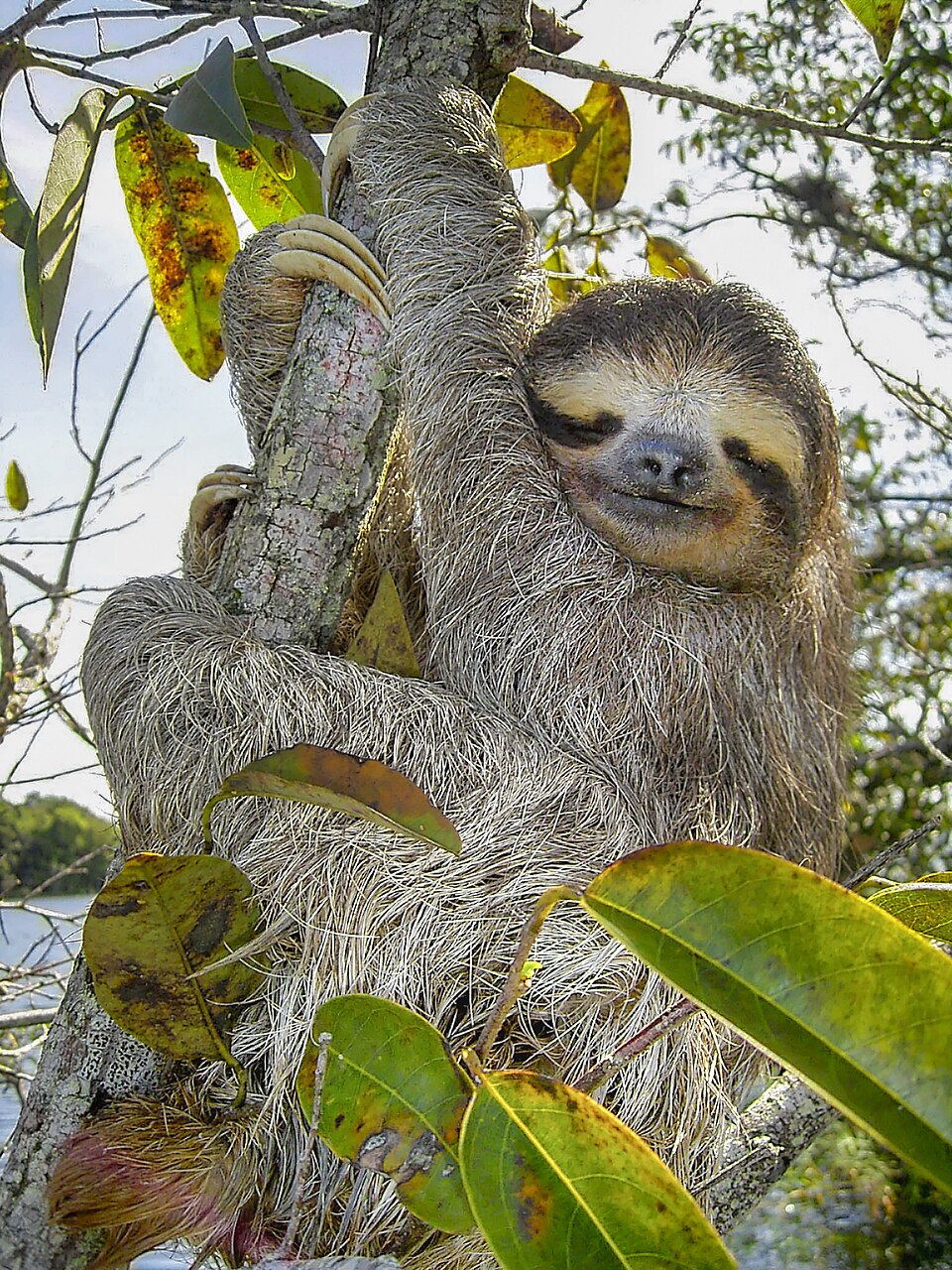
Reference photograph
Reference photograph of a sloth. Compare the individual's color and form with the identification notes in the text.
Source: Stefan Laube ( Tauchgurke ) · Original material · Public domain
1. Classification, origins and habitat
Sloths comprise several species in two-toed and three-toed lineages. This page focuses on the brown-throated three-toed sloth, Bradypus variegatus. It uses leaves and branches in the tropical forests of Central and South America, with connected tree canopies forming its living space. Do not directly apply the broader diet or body size of two-toed sloths to this species. The Korean name for sloth comes from its slow movements, but a human judgment of laziness differs from an ecological adaptation. What matters is whether multiple trees used for food and movement remain connected, rather than simply whether one large tree still stands.
2. Appearance and identification
Three long, curved claws on each forefoot and long limbs give it a form suited to hanging from branches. Dark markings around the face and the brown throat help identify this species, although individual and lighting differences must be considered. Small organisms such as algae can live in the fur and give it a greenish appearance. This does not mean that every individual is always bright green. The long claws are parts of its body used to grip trees, not handles for leaning against a person. Checking the number of claws on the forefeet and the shape of the face in a photograph helps avoid attaching an image of a two-toed sloth to this account.
3. Behavior and way of life
It feeds mainly on leaves, and its slow movements are linked to an energy-saving way of life. Even with long periods of rest, it responds to changes around it, chooses food trees and moves between places. It feeds, rests and cares for its young in trees; descending to the ground is part of its life but also carries risks. Young grow while clinging to their mother's body. An ability to swim does not mean that it moves quickly everywhere on land and in water. Distinguish wild from captive settings and research conditions rather than presenting one fixed daily sleeping time. A seemingly smiling face is not a constant indicator of its actual emotions.
4. Observation, conservation and care
Maintaining forest connectivity and food trees matters to sloths. Roads, power lines and felling can break connections between trees and increase risky travel on the ground. Photographs of tourists holding sloths do not show a wild animal's normal way of life, and slow movement is not proof of an absence of stress. Observe animals while respecting the distance at which they move independently in the trees. Explain in image descriptions that the brown-throated three-toed sloth is the example being discussed, and do not present unverified weights or daily sleeping times as standards for the entire species. Explaining the relationship between its body and forest is more accurate than focusing only on a cute appearance.
Evidence and references
- Animal Diversity Web — Bradypus variegatus
Classification, distribution, appearance, diet and reproductive behavior
- The Sloth Conservation Foundation — Slothopedia
Distinguishing sloth groups, body structure, diet and habitat