
Other Mammals
Snow leopard
Snow Leopard
Classification and scientific name: Panthera uncia
Sources checked:
A high-mountain cat that moves among rocks and snow
The snow leopard lives in high mountains in and around Central Asia.
Origins and distribution
High mountains of Central and South Asia
- Cat family
- Mountain habitat
- Long tail
- Camouflaging markings
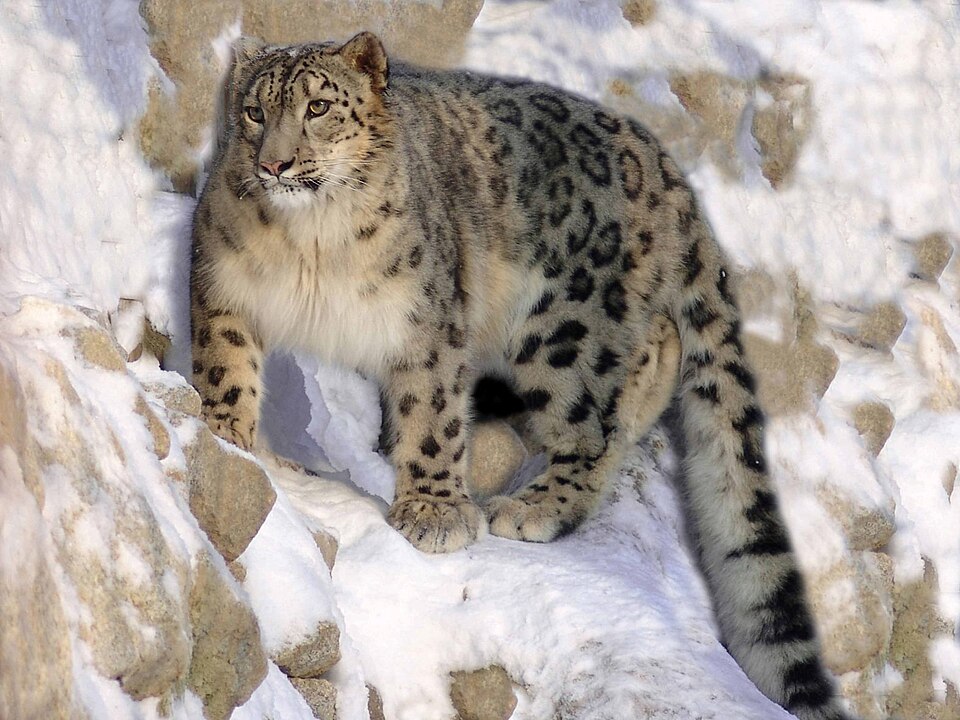
Reference photograph
Reference photograph of a snow leopard. Compare the individual's color and form with the identification notes in the text.
Source: Irbis1983 · Original material · Public domain
1. Classification, origins and habitat
The snow leopard is a member of the cat family living in high mountains in and around Central Asia. The current scientific name Panthera uncia and the older Uncia uncia are different taxonomic names for the same animal. Despite its name, it does not live on snow at all times; it also uses rocks, grassland and seasonally snow-free environments. Prey, terrain that provides cover and extensive travel routes matter. A distribution across large mountain ranges does not mean that populations are continuous. Distinguish photographs of snow leopards and leopards by examining coat color, markings and body proportions, and do not apply one location's maximum travel distance or body size to every individual.
2. Appearance and identification
Thick, pale grayish fur with dark spots and rosettes, a long, thick tail and broad feet are conspicuous. The tail provides balance on rough terrain and wraps around the body during rest. Broad feet and fur are connected with life on cold ground and snow. The face is relatively short, and the rounded ears appear small. An impression of dark markings on a whitish background does not justify describing it as a color variant like a white tiger. In photographs of an animal crouching on rocks, markings can merge with surrounding shadows and obscure the outline. Allow for changes in color appearance with photographic light and season as well.
3. Behavior and way of life
It is a predator that uses wild ungulates and other animal foods, approaching quietly along rocky terrain. Individuals generally move separately, with contact between mothers and young and during breeding. Scent, marks on the ground and sounds leave information for other individuals. Taking livestock can bring conflict with people, so examine changes in wild prey and grazing conditions together. Its ability to make long leaps is related to travel through mountain terrain, but a maximum distance in a record is not an action every individual repeatedly performs. Difficulty observing it in the wild also makes it hard to conclude simply that no animals occur nearby.
4. Observation, conservation and care
Snow leopard conservation involves mountain habitat, wild prey and the livestock and livelihoods of local residents together. Roads, mining, poaching and conflict with people can create overlapping pressures. Some animals travel beyond protected areas, so drawing boundaries on a map alone does not secure their living space. Wildlife photography should not involve driving animals into position or attracting them with food. Distinguish the environmental context of a resting animal in a zoo photograph from vigilance in the wild. Accurate species identification and sources, together with recognizing that snow-free ground is not automatically unsuitable habitat, help explain the variety of its mountain life.
Evidence and references
- Animal Diversity Web — Uncia uncia
Classification, distribution, appearance, diet and reproductive behavior
- Snow Leopard Trust — Snow leopard facts
Mountain adaptations, diet, reproduction and conflict with people