
Other Mammals
Wallaby
Wallaby
Classification and scientific name: Notamacropus rufogriseus
Sources checked:
The red-necked wallaby moves between woodland edges and grassland
Wallaby is a name used for several small kangaroo relatives; it does not mean a baby kangaroo.
Origins and distribution
Eastern Australia and Tasmania
- Marsupial
- Red-necked wallaby
- Woodland edges
- Herbivore
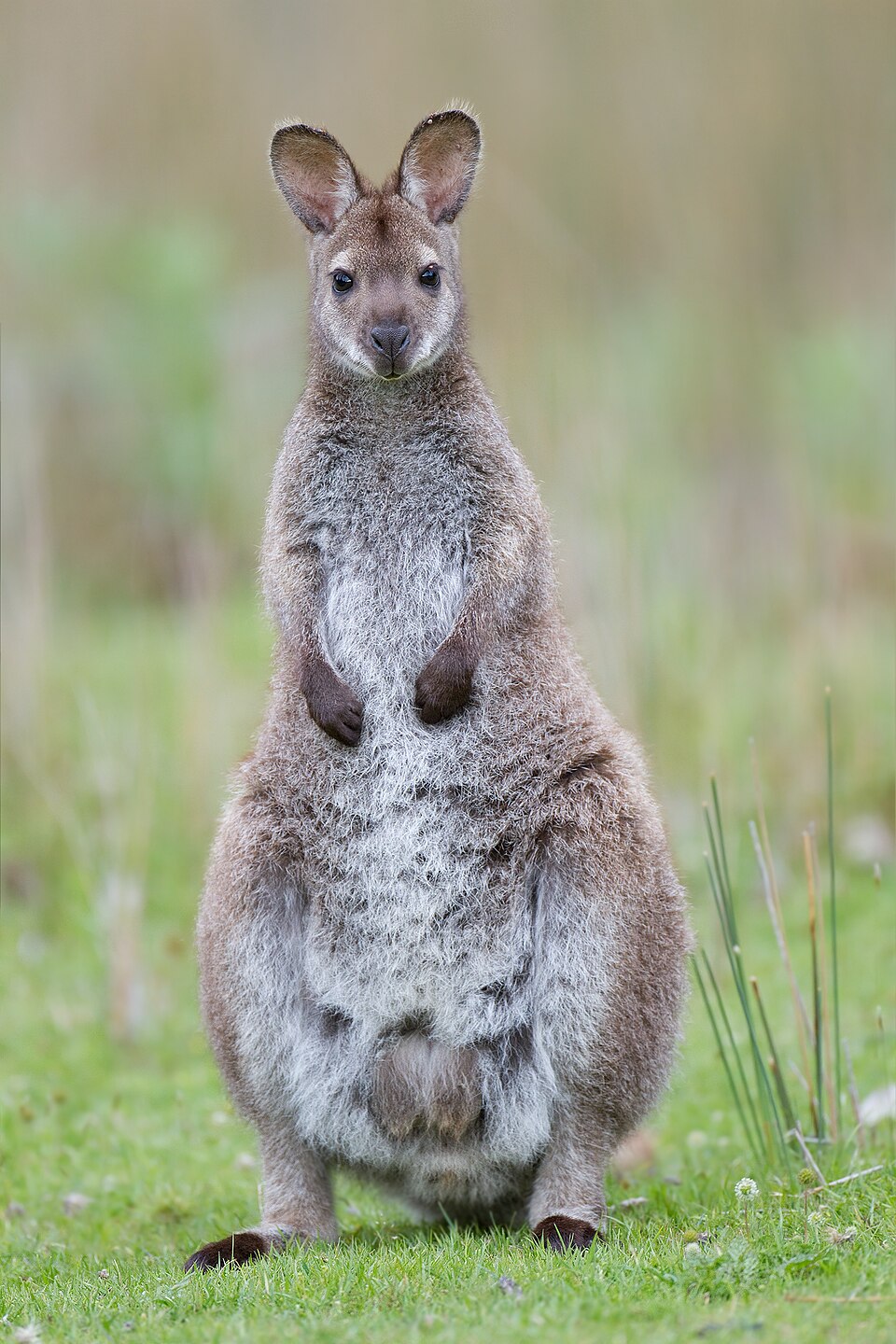
Reference photograph
Reference photograph of a wallaby. Compare the individual's color and form with the identification notes in the text.
Source: Noodle snacks ( https://www.jjharrison.com.au/)Bennett's Wallaby) · Original material · CC BY-SA 3.0
1. Classification, origins and habitat
Wallaby is a name used for several small kangaroo relatives; it does not mean a baby kangaroo. This page uses the red-necked wallaby, Notamacropus rufogriseus, as its representative. The older name Macropus rufogriseus refers to the same species. It lives in eastern Australia and Tasmania in environments where woodland edges, shrubs and grassland meet. The Tasmanian population is also known as Bennett's wallaby. Populations introduced to other countries or established after escaping captivity must be distinguished from the native distribution. Do not combine the behavior and habitats of other wallabies, such as rock-wallabies that climb rocky terrain, into a single way of life.
2. Appearance and identification
Reddish-brown fur around the neck and shoulders, a gray-brown body, dark feet, a long tail and well-developed hindlegs are useful features to compare. Color intensity varies with lighting, season and the individual, so redness in a photograph alone does not establish the species. The forelimbs handle food and assist slow movement, while the hindlegs are suited to jumping. The long tail helps with balance but is not a prehensile tail that wraps around branches like a monkey's. The female's pouch supports the development of her young and is not always visible from outside. To avoid mistaking a small wallaby for a young red kangaroo, check the face, coat color and species identification in the source together.
3. Behavior and way of life
It eats grasses and other plant foods, resting in scrub or woodland before emerging into open areas to feed. Although it tends to be active in dim light, it can also be observed during the day depending on conditions. Individuals may be seen alone or several may gather at the same feeding site; neither scene establishes a fixed family-group size. A joey entering and leaving its mother's pouch spends progressively more time outside as it develops. When threatened, a wallaby may retreat into scrub or escape in rapid bounds. A captive animal approaching people can maintain a different distance from a wild one, so an appealing appearance alone does not explain its way of life.
4. Observation, conservation and care
To understand a wallaby's environment, consider how grassland connects with nearby vegetation for shelter and resting places. Do not drive animals out of scrub for a photograph or attract them with food. Introduced populations can affect local vegetation and agriculture and should be assessed separately from their ecological role in their native range. Accounts presenting wallabies as pets or visitor attractions must consider jumping, movement, social relationships and climate; calling one a small kangaroo does not establish how easy it is to care for. Matching the photographed individual, scientific name and photographic circumstances helps prevent information about another wallaby species' food or size from being attached to it.
Evidence and references
- Animal Diversity Web — Macropus rufogriseus
Classification, distribution, appearance, diet and reproductive behavior
- Woodland Park Zoo — Wallaby joey growing up
Maternal pouch use and growth in red-necked wallaby joeys