
Dinosaurs
Dimetrodon
Dimetrodon
Classification and scientific name: Dimetrodon
Sources checked:
A pre-dinosaur synapsid should not be grouped with Spinosaurus merely for its sail
Dimetrodon lived in the Permian and was a distant relative within the broader mammal lineage, rather than a dinosaur or pterosaur.
Origins and distribution
Permian North America and other regions
- Dimetrodon
- Extinct animal studied through fossils
- Distinguishing reconstruction from evidence
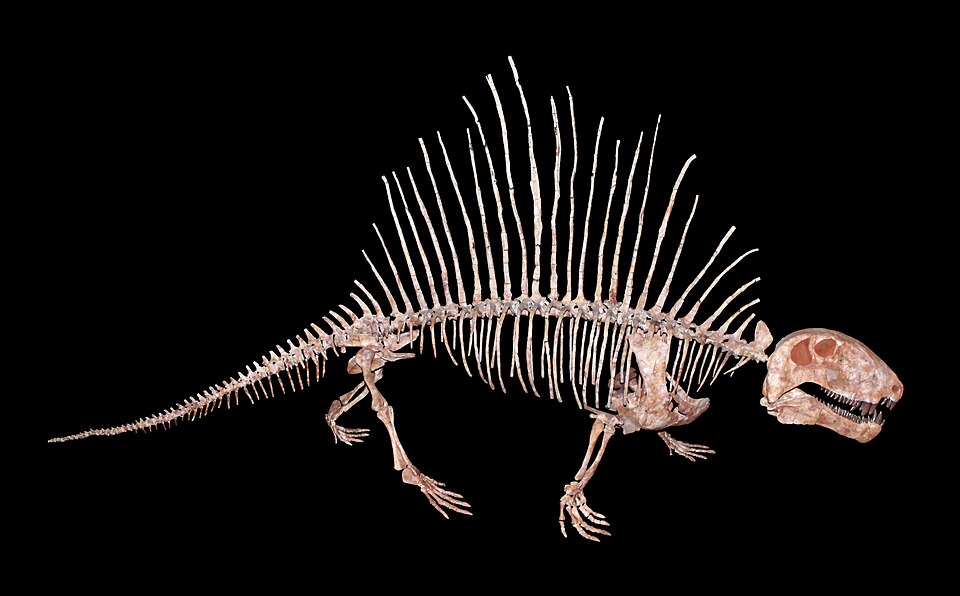
Fossil or skeletal specimen
Dimetrodon fossil and skeletal exhibition material. Displays may include replicated or supplemented parts; this is not a photograph of a living individual.
Source: H. Zell · Original material: Dimetrodon_incisivum_01.jpg · CC BY-SA 3.0
1. Classification, discovery and geological context
Dimetrodon was a synapsid of the Permian, before dinosaurs. It was a distant relative associated with the mammal lineage, rather than a dinosaur or pterosaur.
Known from North American Permian strata and elsewhere, it lived before the Mesozoic flourishing of dinosaurs. A relationship with the broader lineage leading to mammals does not mean modern mammalian appearance or physiology. The different-teeth meaning in its name connects with tooth forms in the jaws. Starting with time and lineage allows correct distinction even among dinosaur models.
2. Appearance and identification
Tall vertebral projections above the back form a sail-like structure. Its four limbs extended outwards beside the body.
Tall dorsal spines and the sail reconstructed between them stand out. Observe the large head, teeth of differing lengths and sprawling limbs together too. A shared sail-like appearance does not establish a close relationship with the much later Spinosaurus. Reconstructed sail edges and colours result from adding soft tissue to surviving bony outlines.
3. Evidence for ecological interpretations
Jaws and teeth support interpretation as carnivorous. The sail has several proposed functions, including temperature regulation and display.
Jaws and teeth show a predator's features for animal feeding. Thermal and display hypotheses for the sail should not be reduced to one established life history. Posture and movement are also inferred through joints and comparative anatomy. Synapsid classification does not establish every modern mammalian feature, including constant body temperature, fur and social behaviour.
4. Limits of the fossil record and reconstructions
First establish its time, different from the Mesozoic in which dinosaurs flourished. A sail alone does not place it in Spinosaurus's lineage.
Other animals associated with Permian sediments reveal terrestrial ecosystems different from the dinosaur era. In images, distinguish actual fossil spines from reconstructions adding a sail. Dimetrodon on this page is presented through extinct-animal fossils or scientific reconstructions rather than photographs of living reptiles. Similar sails do not justify substituting images of another animal.
Evidence and references
- UC Museum of Paleontology — Dimetrodon
Classification, origin, appearance and ecology
- American Museum of Natural History — Dimetrodon fossil skeleton
Synapsid skeletons, teeth, skulls and the mammal lineage