
Dinosaurs
Mosasaurus
Mosasaurus
Classification and scientific name: Mosasaurus
Sources checked:
Reading jaws and flippers in fossils of a marine reptile rather than a dinosaur
Mosasaurus belonged to sea-adapted mosasaur reptiles, distinct from dinosaurs and modern whales.
Origins and distribution
Late Cretaceous seas
- Mosasaurus
- Extinct animal studied through fossils
- Distinguishing reconstruction from evidence
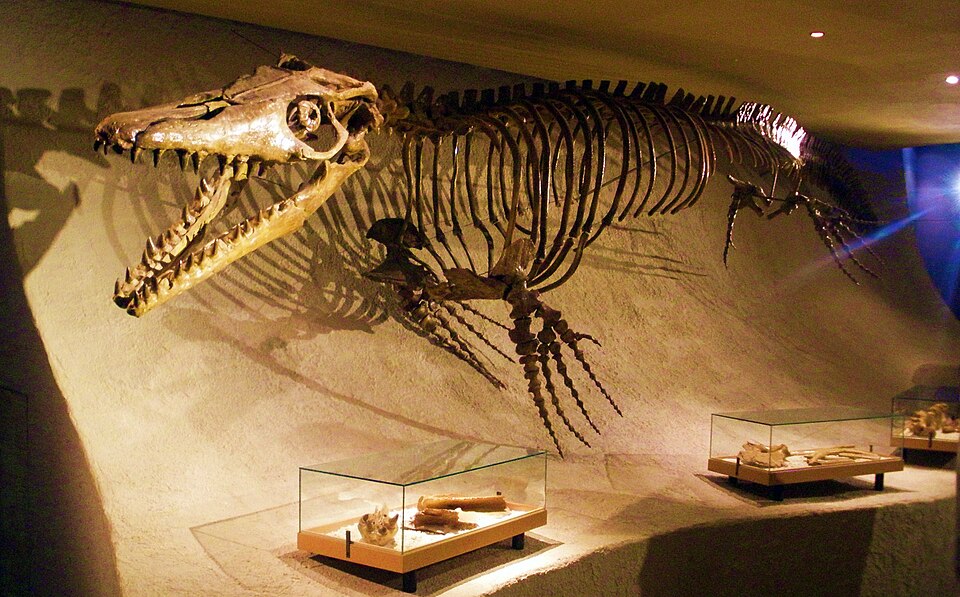
Fossil or skeletal specimen
Mosasaurus fossil and skeletal exhibition material. Displays may include replicated or supplemented parts; this is not a photograph of a living individual.
Source: Ghedoghedo · Original material: Mosasaurus_hoffmannii_-_skeleton.jpg · CC BY-SA 3.0
1. Classification, discovery and geological context
Mosasaurus was a mosasaur reptile adapted to the sea. It did not belong to the same group as dinosaurs or modern whales.
A fossil skull from Maastricht in the Netherlands is important in the history of its discovery. The genus name connects with the River Meuse; distinguish the broader mosasaur group from this particular genus. Mosasaurus includes several species, so one maximum length cannot become the average for every species. Living at the same time as dinosaurs does not mean belonging to the same lineage.
2. Appearance and identification
A long body, strong jaws, and limbs and tail adapted for swimming are characteristic.
Palatal teeth and joints as well as jaw teeth are used to investigate food handling. The limbs became suited for swimming, while reconstructed tail shapes draw on soft-tissue evidence from related mosasaurs. Photographs without distinctions between genus and species can mix different marine reptiles. Separate its form and classification from the long-necked Plesiosaurus and living whales.
3. Evidence for ecological interpretations
Mosasaurus is interpreted as a carnivorous marine animal, with feeding relationships investigated through teeth, jaws and food traces.
It is interpreted as a predator using various marine animals, but a film scene featuring one prey species is not direct evidence. Teeth, jaws, stomach contents and bite marks provide different levels of information. Do not casually convert evidence from other mosasaurs into records for one particular Mosasaurus species. Mass, speed and height of leaps from water especially should not be written as directly observed values.
4. Limits of the fossil record and reconstructions
Cretaceous marine sediments are used to investigate its environment. Distinguish film sizes and hunting scenes from fossil measurements and observations.
Marine strata can be exposed and yield fossils even in places now inland. Comparing discovery sites with ancient seas also helps explain environmental changes on Earth. Images on this page show fossils, skeletons or scientific reconstructions rather than animals living in today's oceans. Prioritise evidence with an accurate genus name and sizes free from film exaggeration.
Evidence and references
- Natural History Museum — Mosasaurus
Classification, origin, appearance and ecology
- National Park Service — Mosasaur Jaw
Mosasaur jaw specimens, strata and limits of fossil preservation